Showing posts with label Miklós Szentkuthy. Show all posts

Thursday, December 05, 2019

Upcoming issue of Hyperion from Contra Mundum Press

One of my favorite magazines/journals has been Hyperion: On the Future of Aesthetics, published by Contra Mundum Press. Unfortunately there hasn't been an issue in four years (see update) but there should be a new issue available later this month. The CMP folks were nice enough to send me the table of contents for the upcoming issue. Since I'm fan of >Szentkuthy, I'm especially looking forward to the excerpt from Chapter on Love and the essay Præ-Prae. I'm sure this will be like previous issues where there is a lot to discover and explore. Be on the lookout for it!

POETRY & PROSE
Maura Del Serra, Sette poesie
Maura Del Serra, Voci dei Nessuno
Dejan Lukić, Earth
ESSAYS
Alessandra Fròsini, Federico Gori: L’essenziale Opacità Delle Cose
Josef J. Fekete, Præ-Prae (Before Prae)
Fritz Senn, Events in Language: Joycean Extras
Olli Ahlroos, The Courage that Art Demands
Riikka Laakso, The Routes of a Nymph: A Shaping Body in the Poetics of Sanna Kekäläinen
LETTER
Stan Brakhage: Letter to Robert Kelly
TRANSLATIONS
Serge Pey, excerpts from Hand & Knife:                                               
Alchemy of the Verb: Preface by Adonis
Around Atomic Birds: Interview with Thierry Renard CHERNOBYL: Oral Poem for the Men and Birds of the First Alarm
Miklós Szentkuthy, Chapter on Love (excerpt)
INTERVIEWS
Rare Marker: Interview with Chris Marker
Bataille, Feydeau, and God: Marguerite Duras & Georges Bataille
REVIEW
Nicholas Birns on Peter Szendy’s Of Stigmatology: Punctuation as Experience

Update: I completely missed this issue from 2018 and this issue from 2017. My apologies, and many thanks to Contra Mundum for updating me.

Thursday, April 26, 2018

Forthcoming: Black Renaissance by Miklós Szentkuthy

Contra Mundum Press has made available some excerpts from the forthcoming book Black Renaissance by Miklós Szentkuthy, the second volume in his St. Orpheus Breviary series. The samples can be found at this link. Needless to say, I'm excited and looking forward to the release.

The sample contains the beginning of the introductory essay by Nicholas Birns, "Startling Dryness: Szentkuthy's Black Renaissance." An earlier version of Birns' essay can be found in the July 2013 special issue of Contra Mundum's journal Hyperion. The journal also contains more of the second section on Brunulleschi than the sample does.
Note: I initially assumed Birns' essay in the book was the same as the earlier online version. Contra Mundum kindly let me know the essay has been updated and revised and I have corrected my comment. Thanks for the correction!

A few excerpts from back cover of the book (the last page of the sample), parts of which were also used on the cover for Marginalia on Casanova:
Black Renaissance, the second volume of the St. Orpheus Breviary, is the continuation of Miklós Szentkuthy's synthesis of 2,000 of European culture. St. Orpheus is Szentkuthy's Virgil, an omniscient poet who guides us not through hell, but through all of recorded history, myth, religion, and literature, albeit reimagines as St. Orpheus metamorphosizes himself into kings, popes, saints, tyrants, and artists. ... "Orpheus wandering in the infernal regions," says Szentkuthy, "is the perennial symbol of the mind lost amid the enigmas of reality. The aim of the work is, on the one hand, to represent the reality of history with the utmost possible precision, and on the other, to show, through the mutations of the European spirit, all the uncertainties of contemplative man, the transiency of emotions and the sterility of philosophical systems."

There's more on the back cover of the three characters dominating the book, and the introductory essay goes into detail about why St. Dunstan was chosen as the opening/guiding saint chosen for Black Renaissance. I'll close with some comments from Szentkuthy’s prospectus for the first volume, which provides a guide to the series:
The name “Orpheus” expresses the underlying conceptual tone: Orpheus wandering in the underworld is an eternal symbol of the brain straying among the dark secrets of reality. The aim of the work is, firstly, to portray the reality of nature and history with ever more extreme precision, and secondly, to display through variations in the history of the European mind an observer’s every uncertainty, the fickleness of emotions, the tragic sterility of thoughts & philosophical systems. The reason for placing the epithet “Saint” before “Orpheus” is because the work seeks to portray both European history and the vegetative world of nature from an essentially religious, supernatural viewpoint. Although both the lives of the saints, as well as the other figures, famous books, and cultural manifestations of history are, in point of fact, nothing more than different features of a lyrical self-portrait, the various roles and masks of the author as it were, the work is in essence “religious,” because form love to politics the emphasis throughout is on the battle of the body-politic of God and the body-politic of the world.

Wednesday, April 02, 2014

Hyperion Volume VIII, No. 1: an excerpt from Miklós Szentkuthy's Prae

The cover of the first edition of Prae (1934)
Picture source

Continuing on with articles from the current Hyperion issue (mentioned here, there is a lengthy excerpt of the third chapter of Contra Mundum Press' upcoming release of Miklós Szentkuthy's Prae, translated by Tim Willkinson. In a post last fall I highlighted another Hyperion article by Filip Sikorski titled “Introductory Remarks on Miklós Szentkuthy’s Prae. Sikorski provides a synopsis of the novel, looks at its main themes, investigates how it can be read non-linearly, and explores Szentkuthy’s narrative technique. Here is Sikorski's summary of Volume 1's third chapter:

In chapter 3, Touqué continues the monologue but abandons the analysis of desire and looks back into his childhood. In a series of flashbacks, he reminisces about his parents, his mother’s boutique in Cannes, his mental illness and a stay in a clinic, a morning in Cannes when he was sent to fetch a dress from the boutique to the seamstress, and another morning when he observed the Riviera landscape from the window of his bathroom. Touqué’s memories are interrupted by one more italicized passage, the Third Non-Prae-diagonal, in which a woman named Yvonne calls her lover to cancel their rendezvous because she is going to confession.

Leville-Touqué is "a French philosopher, writer, and editor-in-chief of a periodical called Antipsyché." Not all of the summary makes it into the excerpt but most does and it provides fun, challenging reading. The Non-Prae-diagonals mentioned are italicized passages expressing inner experiences. Even though this is the third chapter, Sikorski argues "that the novel is composed out of loosely connected segments and therefore it can be read in a non-linear way." WIth the little bit of introduction in this post the reader should be able to follow along through most of the excerpt.

Additional reading of Sikorski's summary of the novel will help fill in a few gaps but I don't believe it's necessary for the full enjoyment of Szentkuthy's style, his inventive comparisons, and his encyclopedic references. If you have never read anything by Szentkuthy this would be a good introduction. Here's just one sentence, an aside, in case you need prodding to read it (or proof that you don't want to touch his work):

(Because clumsiness is just as important a factor as the Protean bogeyman of instinct or the contrary extreme of stylization: that ought to insert between a Parca-visaged automatism of sincerity and a goddess grown into a permanent mask a bit of ersatz mythology from the Guardian Spirit of Stupidity, who plays a role as a positive inspirer and stylistic creator in life, reaching such concrete boundaries that it is all but impossible to treat it merely as an internal mental property.)

If you are interested in Prae, be sure to read an excerpt from the 1983 interview Szentkuthy gave to literary historian Lóránt Kabdebó at Hungarian Literature Online. (These series of interviews were later published in book form.) The excerpt from the interview addresses some of Szentkuthy's sources and inspirations for the novel. Several snippets I wanted to share:

  • During my university years, I read the German existentialist philosophers whom I… caricatured! let’s say. Heidegger, Husserl, Jaspers, and what have you. So I had a good chuckle at those who supposed (still suppose) that I am rooted in German philosophy of that kind. Quite the reverse: I was parodying real-life existentialist philosophers (and some I made up). For instance, I invented the title of one of those philosophical works: Einleitung in die reine Undheit (‘An Introduction to Pure And-ness’).
  • He [Proust] had demonstrable influence here and there. I am a hypersuperultraimpressionist, and instead of writing short stories, essays, small-scale and grand drama, aphorisms, fragments of memoirs, short novels, etc., out of my fantasies: I had always wanted to weave the fantastic thoughts and thousand impressions of my ‘Proust trauma’ of 1926 into the composition of a single giant work.
  • I read Joyce in 1931; I’ve already related the circumstances in which I did, so here let me just note that the essence of the Joyce connection was his most minute observation of the most mundane reality and, at the same time, the most pyrotechnical mythological games — that duality is flesh and blood to my own psyche and nature: hypernaturalism and simultaneously a luxuriance of fantasy.
  • With regard to the style and stock of similes in Prae, the strongest influence was not Proust or even Joyce, but — my mathematical studies.
  • Back then the Einsteinian view of the world and quantum mechanics were novelties for me and for others. Atomic physics was not so much in fashion as it became. I therefore did read through and study the works of authors who concerned themselves with it, and they had an extraordinary influence on Prae. Its stock of metaphors and logical progression would have been inconceivable without reading and experiencing the writings of those distinguished physicists and mathematicians.
  • Continuing with the spurs for Prae. At the time I read a lot of the works of Paracelsus, particularly because the medicine of antiquity — to the great disdain of many practitioners nowadays — had a strong influence on my own thinking about natural science. The whole universe and living human organisms form a material entity: to me that is extraordinarily exciting. De facto, of course, it does not hold water: the kidneys correspond to some chemical element, and that corresponds to some star — or what do I know? What it expresses globally, though, is the idea that somewhere there is a link between each of my organs, a chemical element, and the remotest nebulae — somewhere they are related. It can be established spectroscopically that the same materials are present as in this or that organ. What I like about Paracelsus, let me repeat, is that somehow he knew how to put over that the cosmic unity of the world. The idea of the material unity of the world also went into Prae!
  • One of the leitmotifs in Prae, partly on the basis of my travels, party gleaned from my readings, is Anglo-French rivalry. The difference between the two countries greatly exercised me. One of the protagonists is French: Leville-Touqué, the other an Englishman: Halbert. After the existentialist, sometimes nihilist, Latin-impish world of Leville-Touqué and Leatrice, etc., comes a humane, profoundly human meditation of Halbert’s father, an elderly English vicar. Prae’s lyricism is made perceptible through these two extremes.


"Witches Sabbath" (1510) by Hans Baldung Grien
Woodcut with tone block
Picture source at Web Gallery of Art
Used on the back cover of the second addition of Arc és álarc (Face and Mask), 1982

Tuesday, October 01, 2013

Miklós Szentkuthy: Black Renaissance, Doctor Haydn, and Prae

The cover of the first edition of Prae (1934)
Picture source

This will be my final post devoted to notes and quotes on the Hyperion issue devoted to Miklós Szentkuthy (pdf version is here)…

Filip Sikorski’s “Introductory Remarks on Miklós Szentkuthy’s Prae provides a synopsis of the novel, looks at its main themes, investigates how it can be read non-linearly, and explores Szentkuthy’s narrative technique. “Miklós Szentkuthy: Prae” by Antal Szerb, was one of the few complimentary reviews of the novel at the time of its release. Szerb believed the novel to be a “curious stranger” causing bewilderment in the reader but also decided

There has not yet been a Hungarian book as intelligent as Prae. It skips lightly, playfully, ironically and in incomparably individual fashion around the highest intellectual peaks of the European mind. It will become one of the great documents of Hungarian culture that this book was written in Hungarian.

There are more articles in Hyperion on Prae in French and Slovakian. I’m not going into more detail on the articles in English, saving comments about them for the release of the novel over the next two years by Contra Mundum Press. I’m looking forward to those releases.

In my earlier post on Szentkuthy and masks one of the essays covered was on the Mozart biographical fantasy. Szentkuthy wrote four more of these self-portraits in masquerade, using Haydn, Goethe, Dürer, and Handel to explore themes of culture and history. The fragment from the end of Szentkuthy’s Doctor Haydn (translated by Tim Wilkinson) leaves me wanting more from the novel. It’s very short and well worth checking out. If this is representative of his biographical self-portraits, I hope they are planned for translation.

Fejezet a szerelemről (1936)
Black Renasissance
Picture source

Nicholas Birn’s article ”Startling Dryness: Szentkuthy’s Black Renaissance provides an introduction to the novel. Birn highlights the contradictions that fuel Szentkuthy’s writing as well as Hungarian history, at once both a part of and alien to Europe.

In Black Renaissance, the second volume of his massive mega-treatise-cum-roman flueve called the St. Orpheus Breviary, Szentkuthy explores two infrequently examined but constitutive ironies of European civilization: that its sources are the only partially compatible legacies of Athens and Jerusalem (a paradox perfectly captured in the very idea of “St. Orpheus”), that its sources were about equally from the Byzantine East and the Latin Catholic West of the former Greco-Roman world, and that the very centuries in which European culture was solidified were also centuries of instability, barbarism, and histories which the mainstream Eurocentric really prefers to avoid. (228)

The first part of Black Renaissance, as Birn describes it, lays out a 500-year progressions using Tiberius / Theodora / Dunstan, Sylvester, István (Stephen) / Brunelleschi / Szentkuthy (and us) as the stepping stones for the passage of time. Don’t worry if you don’t recognize all the names…Birn explains it well. The hinge is near the year 1000 CE, when Hungary “converted to Christianity under the leadership of its king, St. Stephen (Szent István) and as guided by Pope Sylvester II.” Birn doesn’t say it but I think it’s implied that the saint, a study of which is provided at the beginning of each volume in the Breviary, is Saint Dunstan (if anyone knows, please confirm or correct me if I’m wrong). Szentkuthy makes Dunstan, effectually a prime minister at times, much more of a sensual and rebellious figure than history describes. Before him is Tiberius and Theodora, Szentkuthy basing much of their stories on Robert Graves’ historical novels (I, Claudius for Tiberius, Count Belisarius for Theodora). Szentkuthy admired and met Graves and although he uses ancient figures, his fiction brings a modern approach and sensibility to their times. (As Birn puts it, “Szentkuthy’s Tiberius and Theodora are not only Gravesian but also above all British.”) He also notes “Szentkuthy portrays people, but they are personalities, not characters”.

This seems to hold true for the second section of the novel which centers on Filippo Brunelleschi, a long section of which can be found at this link, translation provided by Tim Wilkinson. A few more quotes from Birn’s essay before I turn to the excerpt:

Whereas the first section tries to formulate meaning in history, the black Renaissance of Brunelleschi finds at history’s heart naught but its inner meaninglessness. Brunelleschi, in his design and applicability, will not alienate his customer, who will not on the immediate level be able to see the pessimism Brunelleschi has ingrained into his creations. For them, the surface prettiness will be all. (238)

The third section of the novel turns to poetry for a scherzo-like finish, including a “long monologue of a tutor to Princess Elizabeth Tudor (the future Queen Elizabeth I),” resuming “the Hungary-England analogy, as well as indicating the English Renaissance, with its asymmetrical excellence in literature but not in art or music, as, in its unbalanced jaggedness, another kind of Black Renaissance.” This sounds like a study on art and power, too (something Szentkuthy would be acutely aware of in the late 1930s when he wrote this).

So let’s take a look at the second section that can be found at the above link. The vantage point rapidly changes at times, from a young Venetian to Brunelleschi to Pope Sixtus IV to an unidentified “I.” The young Venetian, Monteverdi, admires some of Brunelleschi’s work in Venice. Making matters more complicated is a sharing of names between some characters. The text quickly switches to Brunelleschi’s point of view and his fascination with a “mongrel Spanish-Arab boy” that was a fortune-teller, stargazer, and mathematician to the King of Naples. From this boy, Claudio, Brunelleschi learns many skills he will apply to his works. While this section is a pseudo-biography, it is more about fictional lessons and how he learned them rather than verifiable events in his life. For example, the stars that the Arab adolescent points out to him would find a reproduction in the cupolas of his chapels—the architecture of the universe was reproduced in Brunelleschi’s works. (“The point [star] was a symbolic marriage of mass and nothingness,” (256) something the young Venetian admires in one of Brunelleschi’s chapels.) Just as we can't fully grasp the universe when we look at it, so the artist harnesses his buildings to give the same feeling of inspired awe and difficult paradoxes.

Szentkuthy stresses a paradox of Brunelleschi’s art, weaving mathematical precision with instability and relativity to reflect a new reality. Geometric order and senseless acts coincide at the same time in the same place. “The expression of that duality is what in the Renaissance, above all in Florence, became commonplace.” (257) Paradoxes abound in Szentkuthy’s writing, where “boundless thirst and boundless gratification” (257) effortlessly coexist. My favorite section of this excerpt comes from a supposed letter from Brunelleschi to a patron that had asked him to illustrate Book One of Herodotus’ Histories. Brunelleschi struggles to describe the “essence” or “elements” that he is trying to depict versus what is happening on the surface. He demeans people that desire only reproduction: “But for anyone who likes reality above all else analysis is just a momentary adolescent illusion.” (264) The meaning lies beyond what happens as we see it. Brunelleschi's letter devotes a couple of paragraphs to the chair that Candaules’ wife would throw her clothes while Gyges looks on—how to depict such an insignificant detail so that it has meaning? It's absolutely beautiful.

I’ll include a few paragraphs that give a feel for Szentkuthy’s style and grace. Once again, from Brunelleschi’s supposed letter to the patron wishing to have Herodotus illustrated:

Herodotus is not history, not epic: Herodotus is picture, and Herodotus morality. If the catalogue of my plans tires you, throw it away; but I, my customer, am obliged to lay out on the counter the selection I can offer you.

I would like to paint on the ceiling of the domestic chapel a fresco depicting the excavations carried out by Pisistratus on the sacred island of Delos. For on Delos that Greek potentate announced a grand ‘purification,’ as prescribed by celestial portents, and he dug up the dead from the area around the temple and had them transported to quite another region. That is a topic! Resurrectionless resurrection, the hellish parade of “I don’t believe in the resurrection of the body”—all in a marvelous Delian landscape, a heap of previously dug-up dead bodies amid palms and parrots; carried in the arms of slaves like the abducted Sabine women; Hellene floozies on Saracen shoulders, Greek sages carried in the arms of Persian soldiers, Thracian despots on the backs of Jewish stall-keepers. Is that picture not to your taste?

I want to bore into the frescoes and statues of your villa to the very deepest of the inner meaninglessness of history. I want to formulate all my disappointments with startling dryness . Don’t worry! The connoisseurs will in any case fail to notice my pessimism in the picture—my disillusionment finds expression in such abstract formal tricks that they will not suspect my confession. This transport of the dead is an unforgettable historical lesson—all of that on an island: in a chosen nest of limitedness and narrow-mindedness. (269-270)

Since the patron Brunelleschi wrote this letter to was a friend of Sixtus IV the focus shifts to the thoughts of the (at the time) future Pope. Once again there are many contradictions and paradoxes that Szentkuthy applies in this section, appropriate for the changes Europe was undergoing in the Renaissance.

In an excerpt that has on its final page a mention of “a party rallying in Nuremberg” and a description of “the whole alkali-and-acid-Renaissance,” the question of what is meant by the use of “Black” in the title of the novel continually arises. Birn supplies his interpretation, which is supported throughout the excerpt. “Black” is meant

more as in the contemporary locution “black site”: something off-the-radar, sub toasa, illicit--the flip side of the official, neoclassicist, humanistic Renaissance. A more pessimistic Renaissance, a less officially classicist Renaissance, a more opulent one, one with medieval, Renaissance, baroque aspects, not simply rectilinear and perspectival?” (236)
Or, simpler put, “a more plural renaissance.”

Friday, September 13, 2013

Miklós Szentkuthy and the man beyond every variant of cultures

Picture source

Continuing with my notes and quotes on the Hyperion issue devoted to Miklós Szentkuthy (pdf version is here)…

I’m not going to post much about István Vas’ article “Miklós Szentkuthy: a True Avant-Gardist”, although I do recommend reading it for his insight into the author and his work. I will draw attention to this extended quote since it highlights Szentkuthy’s own guide to the Orpheus books:

In 1942, after the first of these [Orpheus] “Notebooks” had appeared, Szentkuthy published a guide to the [five] parts that had appeared up till then. This editorial skeleton was produced with the same approach as twenty years later — this shows how Szentkuthy was a precursor even in such minutiae — as the handy guide to contents in the Pléiade edition of Proust to facilitate finding one’s way around the huge structure of In Search of Lost Time. The first page of the guide summarized the ultimate import of Orpheus so succinctly as to astonish us all, just as it would still astonish anyone who knows the author only from his works. This brief directory, in itself, is proof that the complexity of his style does not derive from simple inability to simplify, or as non-professionals often put it so appositely: he can write well, if he wants to. This summary, among other things, states the aims of Orpheus in the following way: “it seeks the man beyond every variant of cultures, all promise and failure of sciences and mythologies, the most distant periods and far-flung regions, the vast yet nevertheless finite shades of psychology. What remains of the masses of experience left behind? What can be utilized in the future? What is the play of time and what is the indispensable essence and possibly a permanent positive?” Then, even more clearly: “what should the new man be like, and what should he do?” That kind of reference to the future was not at all fashionable at that time, least of all among our generation, most of the best of whom, as a defense against the incursions of the horror of the present, became completely absorbed in the past, in memories, turning resolutely away from any thought of the future. If, therefore, Szentkuthy referred to the future, there could be no prescriptive “pointing to the future” either, just a serious intention to settle accounts with the past, and not with the filth of the recent past but the finest legends of human culture.

This “settling of accounts” only becomes evident, of course, if one can have some purview of the work’s structure. Perhaps the most fundamental point of László Németh’s acute, early analysis — against the charge of formlessness that was raised in most criticisms — is the sentence: “Nonetheless it is the structure that is most important in this work, not the structure that fits the details together, but the structure that sees the details; the perspective almost regardless of object…” Looked at from the standpoint of structure alone, the fictions and absurdities of the Orpheus Notebooks also serve this settling of accounts. It is quite natural that in this settling of accounts there should also be nostalgia for, even identification with, the role that is being played, or in other words, historical enchantment — for without that it would not be authentic or effective. Nietzsche was justifiably concerned about the historicism of recent times, but sympathetic cures are not without effect here either, and anyone who has imbibed as much history as Szentkuthy has, and furthermore is a strong enough personality, cannot be said to be a captive to, but is a grand master of historicism: history stands before him like a mighty organ, and he knows, as initiates do, how the surest harmonies come out of defending it.
(pages 45-46)

I would love to find that guide! Until then I’ll make do with what he wrote in his own words in Prae: Recollections of My Career, also in the Hyperion issue, translated by Tim Wilkinson. He calls it an abbreviated curriculum vitae but think of it as a blog post titled “Thirty-eight things about me.” There is lots to savor here, with several entries referred to and expanded on in the introductions to Marginalia on Casanova and Towards the One and Only Metaphor. A few notes and quotes follow:

  • Szentkuthy mentions two formative trips around Europe, where “modest Orpheus seedlings" were planted. His love of European history and art shines through in his references throughout the work, but none as overwhelming as his brief description of his second trip, where he lived “in such ceaseless ecstasy that I was almost ill” (§17). Szentkuthy describes stretches of having no social life, choosing instead to go to the theater every night, then reading and writing until dawn.

  • The items have the feel of a confession, although you really have to read between the lines in a few places to find anything remotely resembling anything he has to apologize for. His relationship with his parents is complex, with love and respect on one hand offset by independence on the other. I’ll let this entry speak for itself:
    I am lost for words to describe a scene in which what I see at the foot of Father’s death bed (in 1954) are stacks of unsold copies of Prae. I am tormented to this day by the thought that I was the source of bitterest disappointment to one I held so dear and who was all to me.
    (from §12)
  • The struggle to resolve (apparent) opposites or conflicts appears throughout these notes, as it does in the two books I’ve read so far. The following anecdote comes after Szentkuthy talks about Marginalia on Casanova and provides a perfect illustration of man’s dual nature as presented in the novel:
    À propos my Casanova, let me relate an anecdote. The structure of my commentaries [in each book of Orpheus] was determined by the structure of the 1919 magnum opus of the Protestant theologian Karl Barth on the Epistle of St. Paul to the Romans; my bookmark was the prospectus for a Sicilian spa by the name of Cattólica [Eraclea] above which can be seen a sexy photo of a lady in a bathing suit.
    (from §15)
  • Despite his declaration that he is more attracted “to the simple thinking of simple people.” Szentkuthy demonstrates a remarkable breadth and depth of knowledge throughout these notes (as he does in his works).

There are plenty of stories and anecdotes about his work, but I will end this post by pulling two long paragraphs from §28. This section talks about his struggle to fund publication of the Orpheus books by subscription as well as providing his intentions behind the series. Could some of this be from the guide mentioned in Vas’ essay? Szentkuthy does mention he started these recollections in 1941, just before the guide was published, so there may be some borrowing or overlap. I include them because they should prove helpful to keep in mind when reading the series.

I started the prospectus for the first of the Orpheus Booklets with the following text:

The work, larger continuous installments of which will appear quarterly, comprises an interlocking Essay series. At the beginning of each chapter there will be a longer or shorter life of a saint, and, appended to that, historical essays, extracts from a novel, short stories, lyrical poems and aphorisms that are connected with aspects of the life and times of the saint who stands at the chapter head. The designation ‘Breviary’ in the title refers to this manner of composition. The name “Orpheus” expresses the underlying conceptual tone: Orpheus wandering in the underworld is an eternal symbol of the brain straying among the dark secrets of reality. The aim of the work is, firstly, to portray the reality of nature and history with ever more extreme precision, and secondly, to display through variations in the history of the European mind an observer’s every uncertainty, the fickleness of emotions, the tragic sterility of thoughts and philosophical systems. The reason for placing the epithet “Saint” before “Orpheus” is because the work seeks to portray both European history and the vegetative world of nature from an essentially religious, supernatural viewpoint. Although both the lives of the saints, as well as the other figures, famous books and cultural manifestations of history are, in point of fact, nothing more than different features of a lyrical self-portrait, the various roles and masks of the author as it were, the work is in essence “religious,” because from love to politics the emphasis throughout is on the battle of the body-politic of God and the body-politic of the world.


The goal of Orpheus: to find the human ideal and the most acceptable lifestyle that the reflective cerebrum and happiness-seeking sentiment could wish for after the widest-ranging historical, the most universal religious, and the most profound natural-scientific experiences. Its goal, therefore, is most unmistakably a humanist goal: to seek what is human beyond every variant of culture, every promise and failure of sciences and mythologies, beyond the remotest eras and most distant lands; psychology’s myriad and yet finite shades: what is left behind out of all these masses of experiences? What will be usable in future? What part is the play of time, and what the indispensable essence and possibly eternal positive?


Previous posts:

Wednesday, September 11, 2013

Miklós Szentkuthy and masks


Photo by András Szebeni
Picture source

In my previous post on a collection of Szentkuthy links, I mentioned the Hyperion issue, devoted to Szentkuthy (pdf version is here). Three articles have “mask” in the title (and other articles mention the word, too):

So why the emphasis on masks? Nagy’s article gives the best overview of Szentkuthy’s life and output, and he notes that the author’s name itself

is already a “mask,” a metaphorical incognito and a personal statement, the composition of Szent, “holy” (sacred, saint), and of kút, “fountain” (source of water, well), with archaic Hungarian orthography (“th” at the end instead of a simple “t”) and with a reference to noble origins (the “y” instead of a common “i”).
(page 16)

More importantly, Nagy notes, is that

many years later Szentkuthy characterized his literary output of the difficult post-war years as a “self-portrait in masks” and a paradoxical way of expressing the unchangeable features of the personality in the process of permanent metamorphoses. Though the definition refers to novels written in a different tone from his early masterpiece, the created identities clearly reflect his outlook.
(page 26)

The caveat is important because if the following is the quote that Nagy is relying on, it applies only to some of Szentkuthy’s post-war (World War II) output:

In essence, the work involved in my books on Mozart, Haydn, Handel, Dürer and Luther was purely theatrical; they were my characters, combining my most subjective intellectual sympathies with the most objective historical reality. To confess yet another pipe dream, it is as if, by a miracle, they should one day all be published together as an omnibus edition, I would entitle it ‘Self-Portrait in Masks’ (that is a thought I have been carrying for several decades).
(From Miklós Szentkuthy, Prae: Recollections of My Career, §33)

The article by Pintér focuses on one of these works (and he is more straightforward on the focus of the quote), the book on Mozart, and he relies on that quote to some extent but he broadens the view of what these novels are and what they are not. Starting with what they are not—they are not musicological treatises, although sometimes they are filed (in Hungary) under the music section. They are not standard biographies, although sometimes they are filed there as well. They aren’t biographical novels, although that classification is more correct since it places them under fiction. Biographical novels, though, usually blend more than fact and fiction, with the intention of entertaining the reader through an expression of the romantic self. Szentkuthy brings in the whole of European cultural history in order to

create a fantasy that is paradoxically more real than the documented life itself. This paradox was one of the most important parts of his ars poetica. Life, biography, even history itself is yet not real in its simple gathering of detailed events and facts. On the contrary: these elements totally transform all of the “original” events and facts. For Szentkuthy, ever historical element was a mask that concealed the greater truth of existence. The so-called precise biography is only a surface, a collection of historical facts. The real existence of a human being and history itself is beyond the facts: the reality is a Grand Guignol.
(page 190)


Photo by György Járday
Picutre source

In this particular case, Szentkuthy uses real occurrences in Mozart’s life to provide the framework for the author to hang his views “on human existence, the place of the artist in society, and history itself.” (page 190). Pintér lays out how Szentkuthy made this work (and it sounds like a fascinating novel), but the point I wanted to highlight is how much this functions like The Great Gatsby does, with a narrator that immediately disappears into variations of the narration (to which Amateur Reader at Wuthering Expectations has recently highlighted). Mozart becomes a set-piece that sees and relays the truths behind the surface that Szentkuthy wants us to experience.

Bálint’s article focuses on an early work, Narcissus’ Mirror, written in his early twenties, around the same time as Prae but never finished. The fragments have only recently been published. In this early work Bálint describes an approach that matches the books by Szentkuthy I've read so far.

[I]nstead of the classical novel form it will create a breviarium type of work in which each chapter and each story and their masked protagonists as well as mythical references and philosophical commentaries supplement, tinge, strengthen or question each other.
(page 196)

In other words this format and approach was part of Szentkuthy’s early style, seen in more polished form in his ten-volume St. Orpheus’ Breviary, which itself was suspended by the war and post-war political problems, and in the musical biography novels. Bálint highlights some of Szentkuthy’s view of the world which includes an agreement with “the old wisdom that chaos is a natural state in existence, while on the contrary, order is unnatural, requiring constantly conscious and serious efforts by its creator.” (page 200).

So back to Nagy’s essay, looking at the whole of Szentkuthy’s work. Nagy notes that Szentkuthy translated James Joyce’s Ulysses into Hungarian. I’m not sure who I’ve seen note this (and I would love to give proper attribution), but a list of the translators of Ulysses provides a formidable list of authors. Although often compared with Joyce’s work, I don’t see the similarity except for the dense layering of ideas and dialogue as well as art, culture, and history providing the basis for his novels. Wearing the “mask” of the recreated identity allows Szentkuthy an ability to speak from his (then-)modern world on greater themes raised by earlier figures. These masks go beyond just the names but also include the personal (especially moral) world.

Nagy talks about Szentkuthy’s diary, placed in the trust of the Petőfi Irodalmi Múzeum (PIM) in Budapest in 1987 with some sections to be released this year and remaining sections later. (Estimates are that in total it is over 100,000 pages.) Nagy seems to think the diary has a “frankness and uncontrolled sincerity,” so maybe he has seen parts of it. I’m a little leery without having read any of it. This is an author whose works used masks and episodes (looking similar to diary entries) in his fiction—should I expect his diary to be free of pretense or masquerade? This is an author that thrived on dualities (or as Nagy puts it, polar opposites), such as the holy versus the erotic. Maybe this schismatic approach means his diary provides truthful information instead of just another mask. I may be overreacting and part of it has to do with reading a large section of Gombrowicz's Diary,realizing he shaped large parts of it to portray a particular character.

A few closing notes on Nagy’s essay… . I liked how he put Szentkuthy’s achievement in context of what he lived through and what he survived.

Szentkuthy’s magnificent oeuvre is a perfect example of a genius living through the most difficult and often highly tormenting historical times of the 20th century yet remaining untouched by the different totalitarianisms, by wars, and by revolutions; and it is his oeuvre that emphasizes the importance of ideas, values, and achievements that are far beyond everyday crises and conflicts, whether they be social, political, or economic.
(page 16)

Nagy spends time looking at Szentkuthy’s focus and reliance on Hungarian collective identity in his first major work, Prae, as well as how he uses the Hungarian language throughout his books. Which leads to the biggest question I have regarding my reading of Szentkuthy—can his work be translated to other languages successfully?

The [Hungarian] language is ethnically isolated, not Indo-European in its origin, hard to translate faithfully to any other language, however extremely fit for artistic use. All these difficulties become nearly “visible” in Szentkuthy’s texts, for in his oeuvre language includes everything, even if narration, metaphors, description, reflection and all possible (and translatable) poetic and rhetorical categories are substantial in his novels, yet the real medium is Szentkuthy’s language, used and paraphrased in an poetically original way, which is deeply rooted in his knowledge and in his experience of the philosophy of language, while applied with a very personal and playful emphasis of artistic communication.
(page 17)

From what I’ve read so far (and it's only two of his books), I may be getting only a fraction of what Szentkuthy intended. If that's the case, it makes what he achieved even more dazzling.

Related posts:


Photo by András Szebeni
Picture source

Monday, September 09, 2013

A collection of Miklós Szentkuthy links

Since my notes on several books I've read have been lost, I thought I would start posting on what I'm currently reading...which is many articles about Miklós Szentkuthy as well as the recently released translation of Towards the One and Only Metaphor. Instead of having 20 tabs open in my browser I'm going to collect links related to Szentkuthy in this post. It's meant to provide a starting point for anyone interested in the author and not a comprehensive overview, especially since only two of his books have been translated into English.

Hyperion, the online magazine published by Contra Mundum Press, has devoted Volume VIII, Issue 2, July 18, 2013 to Szentkuthy (the full 326-page pdf version can be found here). More on some of these articles in separate posts. This is a treasure trove of articles about and excerpts from Szentkuthy's books. Highly recommended.

Contra Mundum Press has also devoted itself to translating most (if not all) of Szentkuthy's work. So far there has been two books released. Each of their publicity pages below contains many helpful links (some of which I'll duplicate here). I'm sure more links will be added to the second book as reviews are published:
Marginalia on Casanova
Towards the One and Only Metaphor

I've never gone beyond introductory notes on Casanova, something I intend to correct before the end of the year, but do check out the links provided on its publicity page.

I'm not sure what order I'll go in for more posts on Szentkuthy. Since I haven't finished Metaphor yet, I'll probably start with some of the articles about him in Hyperion. Regarding Towards the One and Only Metaphor, the introduction to the English translation release by Rainer J. Hanshe can be found at Asymptote and The Quarterly Conversation. My jottings on the introduction can be found here.

Since Metaphor is the recent release, I'll include a link to Asymptote's excerpt from the book. Hungarian Literature Online has two posts with excerpts as well. The first sample contains the first two 'entries' that are important in understanding what Szentkuthy is attempting to do with the book. Or at least what he says he is trying to do. The second sample helps round out the picture on what it's like to read the book.

Speaking of Hungarian Literature Online, they have plenty of helpful articles on Szentkuthy. All of their articles tagged with the author's name can be found here. Some posts you may want to check out are Outprousting Proust (an overview to his work), A Comedy of Ideas (about his first book, Prae), and two excerpts from his Recollections: one and two. Entry 25, in the second excerpt, focuses on Metaphor.

Besides his biography, Szentkuthy's Wikipedia entry includes a bibliography and additional links.

Related posts:

Wednesday, April 17, 2013

Miklós Szentkuthy in Asymptote

I don't think I'll ever get caught up on what I missed this past week. I did want to highlight the articles on Miklós Szentkuthy in Asymptote journal while I work my way through everything.

The first article is an overview on Szentkuthy by Rainer J. Hanshe titled Entering the World Stage: Miklós Szentkuthy's Ars Poetica, with a special focus on the upcoming translation of 1935's Towards the One and Only Metaphor. The second article is an an excerpt from Towards the One and Only Metaphor. Be sure and click on the sidebar's "Read translator’s note" for Tim Wilkinson's take on some of the challenges Szentkuthy poses for translators.

Tuesday, January 22, 2013

Marginalia on Casanova by Miklós Szentkuthy: introductory notes and links


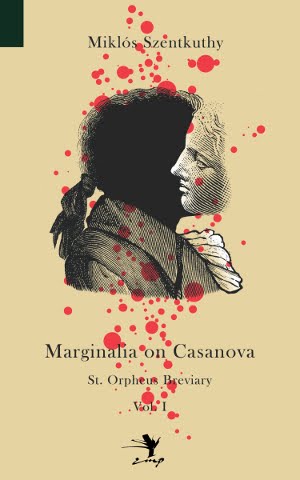
Marginalia on Casanova by Miklós Szentkuthy
St. Orpheus Breviary, Vol. 1
Translation by Tim Wilkinson
Introduction by Zéno Bianu (Translation by Rainer J. Hanshe)
Afterword by Mária Tompa
(New York: Contra Mundum Press, 2012)
ISBN 9780983697244

This is one of the strangest and most enjoyable books I’ve read in quite a while. I have hesitated to write about it but I think I'm ready to give it a try. At first the book appears to be Szentkuthy’s comments on Casanova’s History of My Life, but the scope quickly expands to include a study in the underlying philosophy of Casanova’s works in addition to a commentary of his time (and a comparison with the 20th century).

So what is the St. Orpheus Breviary? From the Afterword by Mária Tompa (ellipsis in original):

In his [Szentkuthy’s] 1976 memoir Recollection of My Career, this is how he refers to it: “Among the huge amount that I learned from Antal Szerb I ought to list my real acquaintance with the eighteenth century. It was he who inspired the Casanova commentaries of Orpheus… The structure of my commentaries was determined by the structure of the 1919 magnum opus of the Protestant theologian Karl Barth to the Epistle of St. Paul to the Romans

Zéno Bianu’s introduction augments that inspiration:

In 1938, Szentkuthy read the Römebrief of the famous Protestant exegete Karl Barth, a commentary that is based on an analysis, phrase by phrase, even word by word, of the Epistle to the Romans. Literally enchanted by the effectiveness of this method—“where, in his words, every epithet puts imagination in motion”—he decided to apply it on the spot to Casanova, whose memoirs (a German edition in six large volumes) he had just annotated with gusto.

There are ten books in the St. Orpheus Breviary, the last volume (or is that the last two volumes?) unfinished. By the way, a translation of the second volume, Towards the One and Only Metaphor is scheduled to be released later this year by Contra Mundum (and more from this author is scheduled). [Thanks to reader JC Buckley for the correction] Why Orpheus in the title? From Szentkuthy’s prospectus for the first volume:

The name “Orpheus” expresses the underlying conceptual tone: Orpheus wandering in the underworld is an eternal symbol of the brain straying among the dark secrets of reality. The aim of the work is, firstly, to portray the reality of nature and history with ever more extreme precision, and secondly, to display through variations in the history of the European mind an observer’s every uncertainty, the fickleness of emotions, the tragic sterility of thoughts & philosophical systems. The reason for placing the epithet “Saint” before “Orpheus” is because the work seeks to portray both European history and the vegetative world of nature from an essentially religious, supernatural viewpoint. Although both the lives of the saints, as well as the other figures, famous books, and cultural manifestations of history are, in point of fact, nothing more than different features of a lyrical self-portrait, the various roles and masks of the author as it were, the work is in essence “religious,” because form love to politics the emphasis throughout is on the battle of the body-politic of God and the body-politic of the world.

I’m not sure I got all of that while reading the book but several points shine through in this volume. Mária Tompa’s Afterword provides a good overview of Marganalia on Casanova, highlighting the emphasis on that ‘battle’:

In reality it is a reader’s diary divided into 123 numbered sections which provides a picture of Casanova’s personality extending to highly comprehensive, balance, and minute psychological details. Szentkuthy gives an extremely detailed analysis not only with regard to his accomplishments in seducing women, but his intellectual and mental endeavors, his psychological and emotional stumbling blocks—much of it with great subjective vehemence.

I have to mention the structure of the Breviary: a Vita (Life of a Saint) and Lectio (Saintly Reading). Szentkuthy had written the first six volumes in the series without including “Life of a Saint” sections but decades after their initial writing he added them. The saint included in Marganalia on Casanova is Alfonso Maria di Liguori (1696 – 1787).

OK, more on the actual marginalia in a separate post.

Links:
Wikipedia bio on Miklós Szentkuthy
Contra Mundum’s page for the book
Review and links at the complete review
A review at the Guardian
Links at Hungarian Literature Online:
          Boudoir & Theology (used as the book’s Introduction, by Zéno Bianu)
          Excerpt (the first 12 sections)
          Review, notes