I finally got a chance to see the recent adaptation of Jane Austen’s Northanger Abbey and I wanted to add a note since I had reviewed the 1986 version. I just noticed that I had originally commented on the (then) upcoming version and hoped that it would succeed…and indeed it did. My comments have to do with the 90 minute version shown on PBS’ Masterpiece.
I think this version is about as good an adaptation as you are going to get from the novel. Not that there isn’t room for improvement, but many things were done well. The casting felt right, especially with Felicity Jones as Catherine Morland and JJ Field as Henry Tilney. There were changes from the book, but most of them were very much in the same spirit.
That being said, there are some marked differences. I got the feeling that Felicity Jones is much prettier than Catherine—from a viewing standpoint that is fine but there is some dissonance from the book when she is one of the prettiest women in a room. At 90 minutes, a lot had to be cut or combined. There were some areas that could have been expanded, such as Catherine’s suspicions of General Tilney (which seem to be extremely thin in this adaptation). Probably the weakest point and where this version suffers the most compared to the previous version has to do with Catherine’s halting introduction into society at Bath. For me, the one area that stood out as not ringing true with the book was Henry being much more amiable and open with Catherine. In the book you are never quite sure how far his affection for her runs as he keeps things at a socially proper level, plus actions that can be interpreted (incorrectly, but still possibly) as slights or disinterest in her. In this adaptation there is rarely any question of his affection.
As I said, most of these are minor quibbles and didn’t detract from the enjoyment at all. My wife, who has not read the novel, thought it very well done and pleasing. While I could not recommend the 1986 version, I have no problem doing so with this one.
Showing posts with label Northanger Abbey. Show all posts
Showing posts with label Northanger Abbey. Show all posts
Thursday, February 28, 2008

Monday, August 28, 2006
Northanger Abbey, 1986 movie version
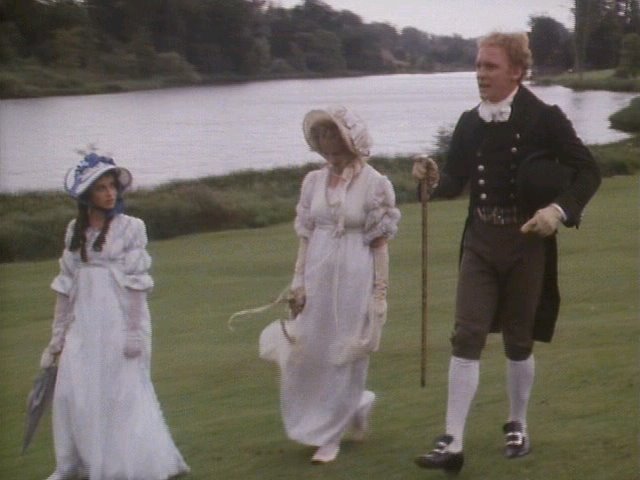
Screen capture of the characters (left to right) Catherine Moreland, Eleanor Tilney, Henry Tilney
I watched the BBC production of Northanger Abbey this weekend and, while enjoyable, I found it a little underwhelming. While some of the story line is faithful to the book, much is missing. The biggest loss is the lack of irony and playfulness. I was happy to see the concerns about money and dowries more explicit than in the book, though.
Peter Firth is the only name I recognized (he plays Henry Tilney). His was probably the best drawn character in this adaptation. His anger at Catherine for assuming his father had something to do with his mother’s death was palpable. The difference between Henry’s worldly understanding and Catherine’s innocence is captured very well. You get a definite sense that he is interested in Catherine, which is kept a little ambiguous in the book.
I expect some differences in adapting to the screen, but there were some wholesale changes that undermined the book: I don’t recall any mention of gambling in the book, yet that is mentioned for one of General Tilney's concerns about money. Eleanor sees a poor man behind the General’s back. There is an additional character thrown in that serves no purpose. Catherine burns The Mysteries of Udolpho after Henry reproaches her for her assumptions (well, that might be a nice touch). Most troubling of all to me was Catherine’s flights of fantasy when reading her gothic novels—definitely a rape fantasy. I know that is one element in the gothic novels, but that isn’t all.
Yet there are some good things: Henry confronting the General after the latter sends Catherine home (only alluded to in the book, I believe). A scene is shown of the characters at the baths in Bath, while probably not completely historically accurate (mixing of the sexes, for example) is nice to see. The period costumes and music add a lot, although the original music sounds like it could be from a Skinamax production. The scenes around Bath are beautiful—the best feature of the movie.
I don’t recommend this version’s adaptation, unfortunately. My wife passed by and said "This looks like a bad Masterpiece Theatre movie." Yeah...that was the feeling.
According to the IMDB.com message boards, there are versions of all Jane Austen’s novels upcoming: “The film will be shown in England on ITV in 2007 as part of their Jane Austen season, and in the US on PBS' Masterpiece Theatre in November 2007 as part of the Jane Austen Festival.” I hope this version of Northanger succeeds. Some casting for this movie as it stands now: Catherine Morland - Felicity Jones; Henry Tilney - JJ Field; Isabella Thorpe - Carey Mulligan; Eleanor Tilney - Catherine Walker; Director - Jon Jones.
Friday, August 25, 2006
Northanger Abbey summary
One-stop shopping for any Northanger Abbey related post. As we move on to other books, feel free to add any comments about the book here.
Northanger Abbey discussion: Volume 1, Chapters 1 – 5
Northanger Abbey discussion: Volume 1, Chapters 6 – 10
Northanger Abbey discussion: Volume 1, Chapters 11 – 15
Northanger Abbey discussion: Volume 2, Chapters 1 – 8
Northanger Abbey discussion: Volume 2, Chapters 9 – 16
Northanger Abbey links
More Northanger Abbey resources
Bath
The Mysteries of Udolpho
The terror of Northanger Abbey had no name!
Northanger Abbey discussion: additional thoughts?
Northanger Abbey, 1986 movie version
Update: Northanger Abbey, 2007 TV version
Northanger Abbey discussion: Volume 1, Chapters 1 – 5
Northanger Abbey discussion: Volume 1, Chapters 6 – 10
Northanger Abbey discussion: Volume 1, Chapters 11 – 15
Northanger Abbey discussion: Volume 2, Chapters 1 – 8
Northanger Abbey discussion: Volume 2, Chapters 9 – 16
Northanger Abbey links
More Northanger Abbey resources
Bath
The Mysteries of Udolpho
The terror of Northanger Abbey had no name!
Northanger Abbey discussion: additional thoughts?
Northanger Abbey, 1986 movie version
Update: Northanger Abbey, 2007 TV version
Monday, August 21, 2006
Northanger Abbey discussion: additional thoughts?
Any additional thoughts you'd like to share on Northanger Abbey? I hope to watch the BBC video of the book while traveling this week and I'll post my review.
I've mentioned this before: at first glance the book felt very slight, but the more I looked the more I saw. Definitely a good preview of what was to come from Austen. Many of her favorite themes are developed here. I'm sure we'll cover more of her books soon.
Your thoughts?
I've mentioned this before: at first glance the book felt very slight, but the more I looked the more I saw. Definitely a good preview of what was to come from Austen. Many of her favorite themes are developed here. I'm sure we'll cover more of her books soon.
Your thoughts?
Wednesday, August 16, 2006
Northanger Abbey discussion: Volume 2, Chapters 9 – 16

We finish the book with this section. “And they lived happily ever after” is a little simplistic, so add your thoughts in the comments!
"To begin perfect happiness at the respective ages of twenty-six and eighteen, is to do pretty well..."
Tuesday, August 08, 2006
Northanger Abbey discussion: Volume 2, Chapters 1 – 8
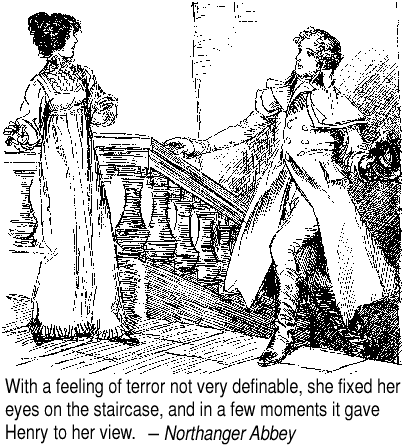
I won't be able to comment for a couple of days, but wanted to get the discussion post up for others to do so.
With these chapters, the setting moves to Northanger Abbey and the gothic-novel spoof is in full bloom. I can do no better than "The terror of Northanger Abbey had no name, no shape--yet it menaced Catherine Morland in the dead of night!" So check the window latches and post a comment on any topic in the book up to here.
Wednesday, August 02, 2006
Northanger Abbey discussion: Volume 1, Chapters 11 – 15
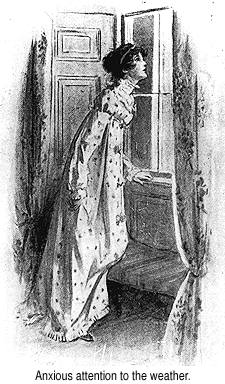
The stay in Bath continues, with Catherine increasingly tricked and cajoled to spend time with John Thorpe. We meet more of the Tilneys, and receive good news(?) at the end of Volume 1.
The comments section is for what you think of the book through the end of Volume 1. Add anything interesting you've found from other sources as well!
The illustration is from The Republic of Pemberley.
Friday, July 28, 2006
The terror of Northanger Abbey had no name!

(click for larger image--the text is priceless)
Check out this wonderful 1965 bookcover to "A paper library gothic." I wonder if that is the forerunner to "romance novels." Actually wondered the same thing while reading Northanger Abbey. Anyway, you think they missed the entire point of the novel? I have to believe that anyone that bought the book based on the cover and back had to have been disappointed.
Here is the quote that they take completely out of context:
The wind roared down the chimney, the rain beat in torrents against the windows, and everything seemed to speak the awfulness of her situation. [...] The storm still raged, and various were the noises, more terrific even than the wind, which struck at intervals on her startled ear. The very curtains of her bed seemed at one moment in motion, and at another the lock of her door was agitated, as if by the attempt of somebody to enter. Hollow murmurs seemed to creep along the gallery, and more than once her blood was chilled by the sound of distant moans.
Thanks to The Republic of Pemberley for the book find. I just found the site and it looks to have lots of Austen links and information.
Wednesday, July 26, 2006
Northanger Abbey discussion: Volume 1, Chapters 6 – 10
The season in Bath continues and there are many gothic novel references in this section. We are introduced to John Thorpe and Catherine’s brother, James as well.
As usual, post your thoughts about the book through Chapter 10 in the comments section!
As usual, post your thoughts about the book through Chapter 10 in the comments section!
The Mysteries of Udolpho
In Chapter 6 (Volume 1), Catherine gushes about The Mysteries of Udolpho by Ann Ward Radcliffe. The text of the book can be found online here. I did a quick search for references that Catherine made to the black veil, and I believe this section is it:
Whatever could be behind the veil? I won't tell here, but maybe in the comments...
Passing the light hastily over several other pictures, she came to one concealed by a veil of black silk. The singularity of the circumstance struck her, and she stopped before it, wishing to remove the veil, and examine what could thus carefully be concealed, but somewhat wanting courage. 'Holy Virgin! what can this mean?' exclaimed Annette. 'This is surely the picture they told me of at Venice.'
'What picture?' said Emily. 'Why a picture--a picture,' replied Annette, hesitatingly--'but I never could make out exactly what it was about, either.'
'Remove the veil, Annette.'
'What! I, ma'amselle!--I! not for the world!' Emily, turning round, saw Annette's countenance grow pale. 'And pray, what have you heard of this picture, to terrify you so, my good girl?' said she. 'Nothing, ma'amselle: I have heard nothing, only let us find our way out.'
'Certainly: but I wish first to examine the picture; take the light, Annette, while I lift the veil.' Annette took the light, and immediately walked away with it, disregarding Emily's call to stay, who, not choosing to be left alone in the dark chamber, at length followed her. 'What is the reason of this, Annette?' said Emily,
when she overtook her, 'what have you heard concerning that picture, which makes you so unwilling to stay when I bid you?'
'I don't know what is the reason, ma'amselle, replied Annette, 'nor any thing about the picture, only I have heard there is something very dreadful belonging to it--and that it has been covered up in black EVER SINCE--and that nobody has looked at it for a great many years--and it somehow has to do with the owner of this castle before Signor Montoni came to the possession of it--and'---
'Well, Annette,' said Emily, smiling, 'I perceive it is as you say--that you know nothing about the picture.'
'No, nothing, indeed, ma'amselle, for they made me promise never to tell:--but'--
'Well,' rejoined Emily, who observed that she was struggling between her inclination to reveal a secret, and her apprehension for the consequence, 'I will enquire no further'---
'No, pray, ma'am, do not.'
'Lest you should tell all,' interrupted Emily.
Whatever could be behind the veil? I won't tell here, but maybe in the comments...
This brought to her recollection the veiled picture, which had attracted her curiosity, on the preceding night, and she resolved to examine it. As she passed through the chambers, that led to this, she found herself somewhat agitated; its connection with the late lady of the castle, and the conversation of Annette, together with the circumstance of the veil, throwing a mystery over the subject, that excited a faint degree of terror. But a terror of this nature, as it occupies and expands the mind, and elevates it to high expectation, is purely sublime, and leads us, by a kind of fascination, to seek even the object, from which we appear to shrink.
Emily passed on with faltering steps, and having paused a moment at the door, before she attempted to open it, she then hastily entered the chamber, and went towards the picture, which appeared to be enclosed in a frame of uncommon size, that hung in a dark part of the room. She paused again, and then, with a timid hand, lifted the
veil; but instantly let it fall--perceiving that what it had concealed was no picture, and, before she could leave the chamber, she dropped senseless on the floor.
Monday, July 24, 2006
Bath

The Wikipedia entry on Bath, England is useful to see the setting of over half the book.
From the Celts who founded it to the Romans who turned the springs into a spa, Bath became a social center in the 18th century. By the time the book was written, the social aspect of Bath was in decline as the wealthy began frequenting seaside resorts like Brighton. Richard Nash was responsible for the renaissance of Bath in the 1700s, and his requirements posted in the Pump Room make you wonder how raucous the atmosphere originally was. And some of the requirements are delightfully mean (see #8):
1. That a visit of ceremony at first coming, and another at going away, are all that are expected or desired by ladies of quality and fashion—except impertinents.
2. That ladies coming to the ball appoint a time for their footmen coming to wait on them home, to prevent disturbance and inconvenience to themselves and others.
3. That gentlemen of fashion never appear in a morning before the ladies in gowns and caps, show breeding and respect.
4. That no person take it ill that anyone goes to another’s play or breakfast and not theirs; except captious by nature.
5. That no gentleman give his ticket for the balls to any but gentlewomen. N.B.—Unless he has none of his acquaintance.
6. The gentlemen crowding before the ladies at the ball show ill manners; and that none do so for the future except such as respect nobody but themselves.
7. That no gentleman or lady takes it ill that another dances before them—except such as have no pretence to dance at all.
8. That the elder ladies and children be content with a second bench at a ball, as being past or not come to perfection.
9. That the younger ladies take notice how many eyes observe them.
10. That all whisperers of lies or scandal be taken for their author.
11. That all repeaters of such lies and scandal be shunned by all company; except such as have been guilty of the same crime. N.B.—Several men of no character, old women and young ones of questioned reputation, are great authors of lies in these places.
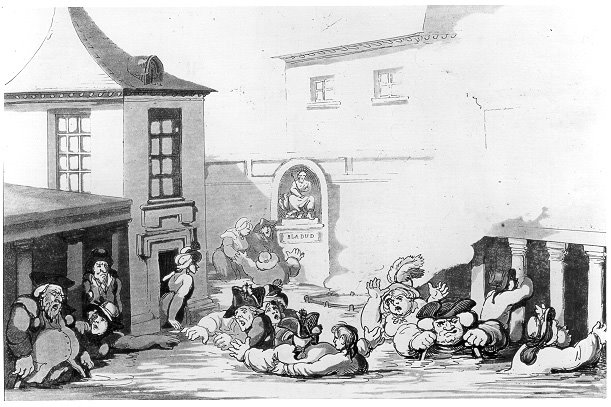
Ironically for this group, much of the movie Vanity Fair was filmed around Bath. The images shown are from Thomas Rowlandson's satiric "The Comforts of Bath" (1798). I can not find all the watercolors in one online place, but seven of them can be found here.
Thursday, July 20, 2006
Northanger Abbey discussion: Volume 1, Chapters 1 - 5
I've been traveling and unable to post, so I'll start the discussion of Northanger Abbey now. I realize the pace of the schedule is slow, but I wanted people starting late with the book to have the ability to easily catch up.
Chapters 1 through 5 introduces us to our heroine, Catherine Moreland, and we follow her to Bath. Several other characters are introduced here, as well as many of the themes that run through the book.
Post your thoughts, likes, dislikes or anything about this section in the comments!
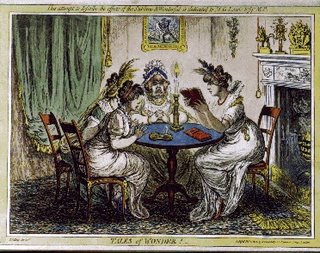
James Gillray, Tales of Wonder
Chapters 1 through 5 introduces us to our heroine, Catherine Moreland, and we follow her to Bath. Several other characters are introduced here, as well as many of the themes that run through the book.
Post your thoughts, likes, dislikes or anything about this section in the comments!
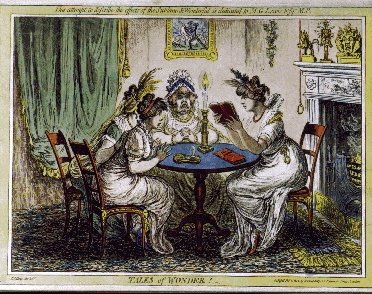
James Gillray, Tales of Wonder
Tuesday, July 18, 2006
More Northanger Abbey resources
Fellow blogger Barry Barnitz is something of a Jane Austen buff. He supplied us with many of the links for this post. You may want to check out his Economic analysis of Jane Austen.
Here are some other thoughts Barry has provided "off the top of his head":
"First, let us examine some of the proprieties for ball etiquette. First of all, the man was given the prerogative of asking a lady to stand up and dance. (The lady does not have this right.) A lady is free to refuse the invitation, but should she do so, propriety demands that she can not accept another man's offer until after completion of the dance set. If a man claims the first two dances prior to the dance, as happens to the unfortunate Lizzy Bennet (in Pride and Prejudice) with Mr. Collins, the lady is somewhat up the creek. If Lizzy accepts the offer, she is stuck with Mr.Collins for the first two dances; if she refuses, etiquette demands that she sit out the two dances. (Lizzy decides to get the punishment over with quickly by accepting the Collins offer.)
By the way, Regency dances were in sets, which means that the dance was a group dance. The competent spate of recent Austen film adaptations ( 96 BBC Pride and Prejudice; 95 Emma Thompson Sense and Sensibility; and the most recent BBC production of Emma) naturally cannot resist the obvious theatrical appeal of choreographing the dance scenes in Austen, and they do a good job of capturing Regency dance.
Other points of etiquette that may or may not appear in Northanger Abbey deal with proper relations between the sexes. For example it is highly improper for ladies and men to exchange or accept gifts prior to a formal engagement. So, for example, Marianne Dash (in S&S) is acting improperly when she accepts Willoughby's offer of a horse (Elinor convinces her to refuse the gift on practical financial grounds). Fanny Price (in Mansfield Park) is rightfully scandalized when she discovers that the necklace Mary Crawford gives her is a disguised gift from her brother Henry Crawford.
By the same token it is improper for a man and a woman to exchange personal letters unless they are formally engaged. During the London scenes in S&S, everyone assumes that Marianne must be engaged to Willoughby since she writes to him.
There are likely to be other points of etiquette coming to the fore in Northanger Abbey, although the setting of the first part of the action is in Bath, a city devoted to vacationing and health spas, with a more relaxed holiday like social atmosphere."
Here are some other thoughts Barry has provided "off the top of his head":
"First, let us examine some of the proprieties for ball etiquette. First of all, the man was given the prerogative of asking a lady to stand up and dance. (The lady does not have this right.) A lady is free to refuse the invitation, but should she do so, propriety demands that she can not accept another man's offer until after completion of the dance set. If a man claims the first two dances prior to the dance, as happens to the unfortunate Lizzy Bennet (in Pride and Prejudice) with Mr. Collins, the lady is somewhat up the creek. If Lizzy accepts the offer, she is stuck with Mr.Collins for the first two dances; if she refuses, etiquette demands that she sit out the two dances. (Lizzy decides to get the punishment over with quickly by accepting the Collins offer.)
By the way, Regency dances were in sets, which means that the dance was a group dance. The competent spate of recent Austen film adaptations ( 96 BBC Pride and Prejudice; 95 Emma Thompson Sense and Sensibility; and the most recent BBC production of Emma) naturally cannot resist the obvious theatrical appeal of choreographing the dance scenes in Austen, and they do a good job of capturing Regency dance.
Other points of etiquette that may or may not appear in Northanger Abbey deal with proper relations between the sexes. For example it is highly improper for ladies and men to exchange or accept gifts prior to a formal engagement. So, for example, Marianne Dash (in S&S) is acting improperly when she accepts Willoughby's offer of a horse (Elinor convinces her to refuse the gift on practical financial grounds). Fanny Price (in Mansfield Park) is rightfully scandalized when she discovers that the necklace Mary Crawford gives her is a disguised gift from her brother Henry Crawford.
By the same token it is improper for a man and a woman to exchange personal letters unless they are formally engaged. During the London scenes in S&S, everyone assumes that Marianne must be engaged to Willoughby since she writes to him.
There are likely to be other points of etiquette coming to the fore in Northanger Abbey, although the setting of the first part of the action is in Bath, a city devoted to vacationing and health spas, with a more relaxed holiday like social atmosphere."
Thursday, July 13, 2006
Northanger Abbey links
I thought having a post with links related to Northanger Abbey would be helpful to some people. If you find something that relates to the book or Austen that you think is helpful, relay that information in the comments and I'll be happy to add to this post.
Online texts:
- Project Gutenberg
- University of Virginia's e-text center
- Bibliomania
Book information:
- Wikipedia entry
- I found this site that has a wealth of Northanger Abbey links available (post a comment if you find anything interesting from the links)
- A calendar for Northanger Abbey
- A selection of critical essays on Northanger Abbey
- SparkNotes study guide for Northanger Abbey
Some helpful links sent to me (thanks Barry!):
- An intro to Northanger Abbey (without spoilers)
- An explanation of female education (Catherine Morland's bouts with this regimen of "accompishments" is handled with wonderful comic appeal in the opening chapter of the novel)
- A wonderful look at Regency era dress styles
- A map of Bath
- On the realities of marriage
There are many options for reading the book, but I wanted to draw notice to the Longman Cultural Edition. I had not seen this series before now. They have additional information on cultural context, critical reviews, and literary references. For those familiar with the Norton Critical Edition, this is in a similar line.
Online texts:
- Project Gutenberg
- University of Virginia's e-text center
- Bibliomania
Book information:
- Wikipedia entry
- I found this site that has a wealth of Northanger Abbey links available (post a comment if you find anything interesting from the links)
- A calendar for Northanger Abbey
- A selection of critical essays on Northanger Abbey
- SparkNotes study guide for Northanger Abbey
Some helpful links sent to me (thanks Barry!):
- An intro to Northanger Abbey (without spoilers)
- An explanation of female education (Catherine Morland's bouts with this regimen of "accompishments" is handled with wonderful comic appeal in the opening chapter of the novel)
- A wonderful look at Regency era dress styles
- A map of Bath
- On the realities of marriage
There are many options for reading the book, but I wanted to draw notice to the Longman Cultural Edition. I had not seen this series before now. They have additional information on cultural context, critical reviews, and literary references. For those familiar with the Norton Critical Edition, this is in a similar line.
Friday, June 16, 2006
Next Book: Northanger Abbey by Jane Austen
Our next book has been chosen and it is Jane Austen’s first book: Northanger Abbey. Written in 1798 but not published until 1818 (after her death), it is a satire on over-the-top Gothic novels that were popular at the time. Like Don Quixote, it has lived longer than the literature it satirized. Another common Austen theme of confusing life and art is prevalent throughout the book.
Free online versions can be found at Project Gutenberg and at the University of Virginia’s e-text center. Paperback copies can be found in bookstores or online for under $10. There are 31 chapters, and we will cover around 6 a week—that will be about 50 pages at a time. Hopefully a shorter book and slower reading schedule will make it easier for people to read and participate.
I’ll post a schedule later, but plan to start discussions on this a couple of weeks after the last scheduled Vanity Fair date (or around the middle of July). There are a lot of online resources for the book, which I’ll also post later. Have fun reading!
Free online versions can be found at Project Gutenberg and at the University of Virginia’s e-text center. Paperback copies can be found in bookstores or online for under $10. There are 31 chapters, and we will cover around 6 a week—that will be about 50 pages at a time. Hopefully a shorter book and slower reading schedule will make it easier for people to read and participate.
I’ll post a schedule later, but plan to start discussions on this a couple of weeks after the last scheduled Vanity Fair date (or around the middle of July). There are a lot of online resources for the book, which I’ll also post later. Have fun reading!
Subscribe to:
Posts (Atom)