Wednesday, October 10, 2018
At the risk of excessive exultation
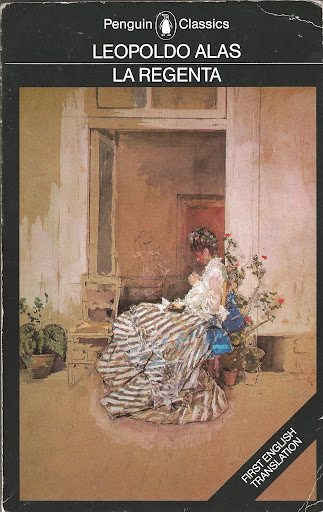
The other major find yesterday was a "new" used copy of La Regenta, retiring the pictured copy being held together by rubber bands. While I have many fond memories of piecing together the old copy (literally) while reading it, I'm hoping this one survives re-readings. Which I hope to do soon. First, though, I'll need to finish and post on Galdos' La desheredada / The Disinherited, a pivotal book in an impressive career.
Friday, September 07, 2012
La Regenta by Leopoldo Alas
Even with several long posts on La Regenta I've barely scratched the surface of this wonderful novel, but I want to wrap things up so I can get to other books. Here are the posts to date on the book:
Introduction: summary, introduction, technique, illustrations, references
Excerpts: extended quotes on Ana's boredom, attending Don Juan Tenorio, rivalry and hypocrisy in Vetusta, and Victor's rude realization
Alas the critic, part one: Alas' career as a critic and his literary theory, influence of Krausism, and possible benefits of literature
Alas the critic, part two: on Alas' use of literature and other arts in La Regenta
Alas the critic, part three: provincialism and moral corruption in Vetusta
1995 TV serives (Spain)
In the introductory post I mentioned two resources I found helpful in understanding La Regenta. I have used Albert Brent’s dissertation in several posts but haven’t talked about John Rutherford’s critical guide (Rutherford is also the translator of the novel edition I read). The guide (Rutherford, John. 1974. Leopoldo Alas: La Regenta, Critical Guides to Spanish Texts. London: Grant & Cutler Ltd in association with Tamesis Books Ltd.) focuses on a straightforward analysis (characterization, story, setting) in looking at the novel, but the key is that these elements are essential in understanding the story’s development. Rutherford’s introduction to each of these areas provides good overviews of his approach. Regarding his contention that characterization is a “permutation of themes” and how this approach applies to this novel:
A consensus of published opinion about the vision of life presented in La Regenta could be state in the following terms: Man seeks to direct his life towards spiritual fulfilment, but he is disastrously unsuccessful because he lives in a world of hypocrisy in which spiritual activities have been debased and converted into material and worldly activities. The themes involved here could be conveniently formulated as four pairs of opposite concepts: control/abandon, fulfilment/frustration, sincerity/hypocrisy, and spirit/matter. (page 12)
Rutherford looks at each of the pairs and how the many characters fit into the opposing groups. The last pair is further broken down to include religion/ritual, love/lust, and culture/snobbery. Going through these pairs help lay out the principal themes and shows how the characters (major and secondary) help advance them. One of the strengths of the novel lies in its complexity of its characters—there are no absurd caricatures (although Mesía, the Don Juan approaches one). Each character occupies a different position on the axes of these pairs of opposites.
The wide range of these themes and the complexity of their patterning are, arguably, characteristics of the realistic novel. Rather than representing single concepts, each character, even minor ones, assembles and interrelates many themes in a special permutation; caricature, in other words, is avoided (caricature could be tentatively defined, in the terms of this analysis, as the drastic reduction of the number of main themes and the total polarization of those pairs of opposite concepts involved, so that characters are simple magnifications of single concepts). The relationship between characters, too, are complex: they are so frequently marked by an ambivalent combination of attraction and repulsion, of admiration and envy, that some such pair of opposites could almost be postulated as a fifth major theme. (page 28
Even when little happens in the way of action or storyline, through character introduction for example, the characters embody and advance the themes of the novel through these opposing qualities. La Regenta is very much a novel of frustration—the four main characters (husband Victor Quintanar, wife Ana Ozores, canon Fermín de Pas, and Mesía) finds themselves in undesirable situations. How they deal with fulfilling their desires and where they can be plotted on the axes of opposites drive the story. There are so many touches, obvious and subtle, that focus on the choices the characters make and their outcome, whether intended or not. The duel provides examples on this on many levels, highlighting what the characters choose to do—especially before the duel. This includes not just in the actions that led to the duel but including whether or not a participant went to the bathroom before shots were fired.
La Regenta is a remarkable novel, one of the greatest 19th-century novels in any language. It has a few flaws, particularly around the loose ends from such an attempted all-inclusive novel about a provincial Spanish town in this timeframe. Alas' critical background can show a baser side, making him sound like a scold at times. Even so, this novel has been one of my biggest enjoyments in reading since I’ve started this blog. Highest recommendation.
All quotes from the referenced guide by Rutherford when he was a Fellow of The Queen's College, Oxford. I've tried to maintain the spelling provided in the book, but automated spellchecking may change words to an Americanized spelling.
Wednesday, September 05, 2012
La Regenta: 1995 TV series, Spain
Picture source
I’m always happy to post about a good adaptation from novel to screen and this one is a pretty good one. The IMDb.com page gives more detail on the cast and other details. As usual, I focus more on the differences between the novel and the adaptation rather than provide a full movie review. (If unfamiliar with the story, please see the posts on the novel.)
The TV series format works much better for a lengthy novel like La Regenta. There were two main concerns I had before watching the series:
- How will a screen adaptation show the rich inner world that Alas develops in the novel? Overall this was done fairly well. There were some additions in dialogue to help fill the backstory or allow the actors to provide inner thoughts without seeming forced or contrived. Unfortunately some of the characters still felt a little two-dimensional, reduced to foils of the main characters. On the whole, though, I thought they did an admirable job on this issue.
- How much would have to be cut or condensed in the adaptation? Even at 4 ½ hours in length, the series still had to make quite a few cuts to the novel. Certain characters weren’t developed, as mentioned above. The major characters fare well for the most part, although the depiction of Mesía, the least developed of the major characters in the novel, seems even more of a caricature. On the whole, though, I was impressed with how little of the central storyline was cut. The major shortfall is the reduction of time spent developing and showing the Vetustans. As has been pointed out in many other reviews of the novel, Vetusta is the main protagonist of Alas’ novel but at times the city and the secondary characters are shortchanged in order to cover the main storylines revolving around Ana.
Picture source
There were other areas where the series excels, taking advantage of the different medium to highlight certain areas. Very little was changed for the canon Fermín de Pas, for example, but in seeing his vanity, quest for power, and cravenness before his mother he seemed even more of an oily character. In addition, minor changes help drive home a point about certain characters. Seeing the canon’s mother chomp on a cigar reinforces her tough-as-nails character. While Ana watches Don Juan Tenorio we see her on the stage with Mesía playing the central roles of the play (at times) instead of just reading about Ana’s feeling of being transported to the time of the play.
With almost no changes to his character from the novel I couldn’t help but wonder how Victor Quintanar became a judge, a question that didn’t occur during my reading of the novel because of the history provided. Only after he discovers his wife’s infidelity does the richness of his character shine through on the screen, becoming more than just an irritating clown at soirees. The novel had provided much more of his background and the extraordinary circumstances of his marriage to Ana, providing more depth to his character earlier than in the film. Another example where the novel was followed faithfully but still came across differently was seeing the importance of Petra, Ana’s maid, to many of the events and intrigues. Although Alas makes clear how central her role is in the novel, seeing her initiate or abet so much on the screen made it clearer for me--I don't think it a stretch to call her one of the major characters. One thing the series didn’t attempt to replicate was the “free indirect style,” mentioned in my introductory post on the novel. While this reduces insight into the characters the series did a good job of filling in some of these blanks through other means (as noted above).
The scenery is gorgeous, providing a glimpse of what Alas saw since many of the settings are in Oviedo (Vetusta) and around Asturias. As one of the crew members mentions in one of the extra features, to prepare some of the locations all they had to do was cover the power lines. There is some nudity, which I don’t usually mention, but (speaking from experience) it may be an issue to people around you on a plane.
Highly recommended. The three episodes appear to be available online (without subtitles).
Picture source
Friday, August 31, 2012
La Regenta by Leopoldo Alas: The critic, part three
The progressives would present objections, upholding the solidarity of the dogma and the priest, and then Don Pompeyo would have to take sides with the reactionaries, up to a certain point, and say, ‘Let us not confuse one thing with another, gentlemen, the very roots are diseased. The clergy is neither good nor evil, it is as it has to be.’ But on hearing this everybody would oppose him, some for defending the clergy and others for attacking the dogma. He was so right to say that he was utterly alone, that he was unique. From these arguments, which he sought and provoked every day, he affirmed that ‘his spirit—for want of a better word—emerged full of bitterness’ (which was untrue, as his guilty feelings made clear to him), full of bitterness because nobody ever thought in Vetusta, people merely vegetated. Plenty of intrigues, plenty of petty politicking, plenty of material interests (though not even these were properly understood)—but no philosophy, no elevation of the mind to ideal regions. There were one or two scholars, various canonists, a few jurists, but not a single thinker. There was not a thinker in town—apart from himself.
(page 445)
Vetusta the noble was scandalized, horrified. Behind looks of hypocritical compunction the worthy Vetustans concealed from each other the intimate pleasure which that great scandal, just like a novel, gave them, something to interrupt the eternal monotony of the sad city. Very few of them showed that they were pleased about what had happened. It was a scandal! Adultery, discovered! A duel! … A few hours after the catastrophe became known in town, Obdulia Fandiño swept out of her house wearing her largest hat and her most clinging skirt and her most rustling petticoats, to breathe the air of slander, to catch a whiff of scandal, to savour the after-taste of crime being passed from mouth to mouth like a bon-bon which everybody was licking, careful to hide the pleasure afforded by its sticky sweetness.
(pages 706-707)
La Regenta focuses on the provincial world Alas would have been familiar with in Oviedo. The previous post looked at the importance of literature in Vetustan life and Alas’ use of the arts to develop his characters. Alas spent a lot of time showing the poor cultural aspects of Vetusta, of which literature was only one piece. In this post I’ll touch on another aspect of the culture Alas focused on criticizing that I’ve mentioned several times, that of the desire of the upper classes to copy what they see happening in Madrid and foreign cultural centers in order to soften their small-town ways. The main focus of the post, though will look at the central criticism of the novel—his depiction of the moral corruption in the town.
The novel opens with the canon theologian, Fermín de Pas, ascending the cathedral bell tower to survey Vetusta laid out below him, allowing the narrator to provide an overview of the city. As the novel unfolds Alas zooms in on character after character so the reader understands what de Pas was examining. Alas pokes fun at his characters’ provincialism and petty behavior, or rather he lets them demonstrate it. There’s almost too much satire at times, bordering on meanness and losing some of its effectiveness. Fortunately Alas offsets this by providing a rich internal life for his characters so that they are not just caricatures. The Vetustans beclown themselves in many different ways. They imitate what they see and hear in Madrid and Paris. Trying to pass as educated and worldly, their behavior is often rude and boorish. Anyone wanting to be taken seriously in regard to books criticizes authors they have never read. [As an aside, sometimes it’s clear they have read something but completely miss an unspoken point: the archdeacon obviously has Herodotus’ anecdote in mind when he tells “my good Catholic people, ‘inhabitants of the banks of the Nile, those blind heathens whose wisdom impious authors tell us to admire, adored leeks, garlic, onions.’” (page 258)]
The frequent mispronunciation and misuse of words (especially Latin phrases) works its way into misquoting literature and mangling history. The Vetustans often demonstrate horribly bad taste, especially in their furnishings, which are often poor imitations of what they claim. They revere attending the theater but ignore what is happening on the stage. At the same time, they allow the theater building to fall into appalling disrepair. The Gentlemen’s Club, the organization and not the building, proves to be an empty shell to facilitate superficial camaraderie—there is nothing of substance inside. Oftentimes their provincialism overlaps with their moral corruption. I provided an extended quote in the previous post on the citizens’ use of Don Santos Barinaga’s declining health to attack the canon while doing nothing to help the ailing man.
If not done well Alas, in his skewering of a city rife with moral corruption, could come across as a scold. With the upper classes, almost everything seems to be done for sex. The things reserved for scandal, though, are not the actual trysts but failure to follow the acceptable protocol. Discretion only goes so far—everyone finds out about conquests sooner or later. Those that comment on trysts speak more from envy than from principle. For the upper crust religion is simply another dress to put on when appropriate. Attending services, such as the Christmas Eve mass described, provides a crush of people so that persistent gropes and pinches can occur and enjoyed under acceptable cover.
The clergy receives even more wrath from Alas’ pen. Most of the priests are petty tyrants, looking to protect and expand their influence. Their charges are good only for the gossip and secrets they provide. The canon Fermín de Pas turns out to be a very complex character, but the villagers’ charges of simony and vanity are well founded. He turns out to be ruthless in obtaining and wielding power, playing parishioners as pawns for his desires. Alas makes clear that it is the individuals at fault instead of the institution, though, taking pains to show some of the clergy (especially the bishop and Ripamilán) as truly interested in their mission.
Vetusta’s provincialism and moral corruption at all levels come together as major components for the central story—the undermining of Ana’s virtue. With the aristocracy so focused on sex, they admire and reward conquests. The city’s Don Juan becomes a role model for the marquis’ son (and this is actively encouraged by his mother). Ana didn’t really stand a chance since so much of the city was aligned against her. Beautiful and sensitive, she never fit in the social circles of her husband. But then she never fit in from an early age. Her governess, frustrated at not seducing Ana’s father, focuses her anger on Ana and believes the worst about her. Ana’s aunts are more practical in their guidance but their marriage pairing leaves a lot to be desired. Many of the citizens watch Ana out of envy, hoping she falls to their level—Vetusta is a town that improves itself by bringing others down. Several of the characters take an active role to assist Mesía (the Don Juan) in his conquest. Some do it out of spite and envy, others to strike at the canon and weaken his influence. Since he was Ana’s confessor, her behavior is seen as an extension of his power. Fermín even sees her this way. One of the more confusing examples of helping undermine Ana’s virtue comes from a religious widow, Doña Petrolina Rianzares. Even though the widow coordinates many of the good works in the city, she also provides the rendezvous site for private meetings between Fermín and Ana—what does she think goes on in her parlor?
Small wonder then, given such a perverse environment, that Ana falls. But I’m also interested in the regimen Fermín prescribed to her—it involves doing good works (involving people assisting her pursuer) and reading devotional material (that fails to inspire her long-term). Was his program wrong for Ana, insuring her failure? He recognizes her extraordinary soul, the depth of which has no equal in Vetusta. Yet his thirst for power never ceases and, even though he is one of the few people to appreciate Ana, he helps seal her doom. Among the many contrasts and echoes in the novel, their relationship (echoing the father/daughter feeling with her husband) feels one of the most unnatural. The Good Friday processional in which she participates drives her away from the church and closer to Mesía. At this point it’s only a question of time when Ana’s lack of fulfillment on so many levels will cause her to fall.
All quotes from the novel from the Penguin Classics edition shown below, translated with an introduction by John Rutherford. At the time of publication Rutherford was a Fellow of The Queen's College, Oxford. I've tried to maintain the spelling provided in the book, but automated spellchecking may change words to an Americanized spelling.
Thursday, August 30, 2012
La Regenta by Leopoldo Alas: Excerpts
‘But that wasn’t the point. She was dying of boredom. She was twenty-seven years old, her youth was slipping away, for twenty-seven years, in a woman, were the threshold of old age, and she was already knocking at the door. Not once had she enjoyed those delights of love about which everyone talks, which are the subject of plays, novels and even history. Love is the only thing worth living for, she had often heard and read. But what love? Where was this love? She had never experienced it. And she remembered, half in shame half in anger, that her honeymoon had meant no more than futile arousal, a false alarm for senuality, a cruel practical joke. Yes, yes, why try to keep the fact hidden from herself when her memory was shouting it at her? On the first night, when she awoke in the bridal bed and became aware of a magistrate breathing at her side, it seemed absurd and impertinent that if Señof Quintanar was in there with her he was not wearing his long machine-knitted frock-coat and his back flannel trousers. She remembered that the inevitable physical pleasure had been an embarrassment, a mockery and a source of bewilderment: lying with that man, against her will, reminded her of the phrase spoken on Ash Wednesday, quia pulvis es—thou art ashes, you are mere matter—but at the same time it threw light on the meaning of all those things she had read in her books of mythology and overheard in the mischievous whispering of servants and shepherds. To think of what it could have meant—and what it had meant! And in that prison of chastity she was not even left with the consolation of being considered a martyr and a heroine. She remembered, too, the envious words and curious looks directed at her by Doña Agueda (R.I.P.) [one of Ana’s spinsterish aunts] during the first few days after the marriage; she remembered that although she had never spoken disrespectfully to her aunts she had needed to make a great effort not to scream “Idiot!” when she saw her aunt looking at her in that way. And life had gone on and on in the same manner. She had suffered the same existence in Granada, in Saragossa, in Granada again, and then in Valladolid. And nobody even felt sorry for her. No question of children. True, Don Victor did not pester her. He had soon tired of playing the beau and had by degrees adopted the role of greybeard, for which he was better suited. Oh, as a father, certainly, he was lovable! She could not go to bed at night without his kiss on her forehead. But spring would come around, and she would try to make him kiss her on the mouth; for it filled her with remorse not to love him as a husband, not to desire his caresses and, furthermore, she was afraid of senses aroused in vain. All this was a great injustice and she did not know who was responsible for it, an incurable pain which did not even have the attractions of poetic suffering, a shameful pain, like the illnesses she had seen named in advertisements on lamps painted green and red, in Madrid. How was she going to confess all this—above all in this way, as it was in her mind? For confessing it meant just that.
‘And youth was slipping away, like those little clouds of crinkled silver passing in front of the moon on speedy wings. They were silvery now, but they went rushing on, flying on, away from that bath of light, falling into the dark abyss of old age, miserable old age, where there was no hope of love. Behind these silver fleeces crossing the sky like flocks of birds, loomed a great black cloud which extended to the horizon. And then the images were reversed, and it was the mon which was rushing on, to fall into the black chasm, and put out its light in that sea of darkness.
‘She was just the same. Like the moon, she was rushing through life alone, to plunge into the abyss of old age; into the darkness of the soul, where there was no love, no hope of love—oh no, no, not that!’
(pages 210-211)
After enjoying Volume One of the novel, Volume Two proves to be even better. It starts off with Ana’s first play, appropriately enough Don Juan Tenorio. The real life Don Juan trying to seduce her, Don Alvaro Mesía, watches and listens to her reaction. Alas, as usual, cannot refrain from inserting a critic's note:
Ana did not hear her husband’s words. She was beginning to take a real interest in the play, and when the curtain dropped she was left with a keen curiosity about the result of the wager between Don Juan and Mejía. …
The second act started and Don Alvaro noted that he had a powerful rival that evening: the play. Ana began to appreciate the artistic worth of Zorrilla’s enterprising, foolhardy, brave, wily Don Juan. She was fascinated by him, as were Doña Ana de Pantaoja’s maid and the go-between, Brígida, who offered him the love of the novice Doña Inés like a piece of merchandise. The dark, narrow lane, the corner under Doña Ana’s grated window, Ciutti’s diligence; Don Juan’s schemes; Mejía’s arrogance; the adventurer’s first provisional seduction, in which he did not have to give any proof of his valour; the fiendish preparations for the great adventure—the attack on the convent—it all moved the judge’s wife to her very soul with its fresh, dramatic vigour which many people cannot appreciate, either because they were introduced to the play before they had the critical powers to enjoy it, and as a result are immune to its beauty, or because they do not know chalk from cheese. Ana marveled at the poetry in those lanes of canvas, which she saw as transformed into solid constructions of another age—and marveled no less at the scorn with which it was viewed and heard in boxes and stalls. The gallery, joyful and enthusiastic, seemed much more intelligent and cultured than the high society of Vetusta.
Ana felt herself transported to the times of Don Juan, which she imagined as vague historical romanticism would have that they were. Her sentimental egotism returned and she began to regret not having been born four or five centuries earlier. … The third act was a revelation of passionate poetry. Ana shuddered when she saw Doña Inés in her cell. The novice looked so like her! … With her eyes riveted on the novice, oblivious of everything but what was happening on stage, she feasted on the poetry of that chaste cell into which love was filtering through the walls. Mesía was surprised and even upset by Ana’s enthusiasm. Talking about Don Juan Tenorio as if it were a brand-new play! Really, by now Zorrilla’s Don Juan was only good for parodying!
(pages 374-377)
The canon theologian, Fermín de Pas, suffers several set-backs to his influence in Vetusta. The daughter of a wealthy citizen has died and the city holds de Pas responsible (the convent was in an unhealthy location and the canon had supported her decision to become a nun). While his mother oversees the operations of La Cruz Roja, a shop that has a sanctioned monopoly on religious goods, the life of the former competition (Don Santos Barinaga) falls apart. A drunkard, he roams the city at night after the taverns close and shouts about his treatment by the canon and his mother. Enemies of de Pas use Barinaga’s declining health to bludgeon the canon’s reputation without bothering to help the sick man:
Sister Teresa’s death was a blow which made the canon totter in that lofty place which his enemies imagined him to occupy, and even overshadowed poor Don Santos Barinaga for a time. After a few weeks, though, this victim again began to shine in his halo, and Vetusta solicitously redirected its false piety and feigned amiability towards him, like an uncaring stepmother playing out the farce of being a second mother. For, in truth, the life or death of Don Santos was of little consequence to most Vetustans. Nobody had offered a hand to help him out of his poverty, and people even continued to call him a drunkard; yet everyone was indignant with the vicar-general, everyone cursed the man responsible for so much misfortune, and everyone felt satisfied, believing, or pretending to believe, that the indignation and the curses would keep Charity happy.
‘Oh! In these times of ours,’ Foja shouted in the Gentlemen’s Club, ‘in these times, slandered by the enemies of progress—in these so-called materialistic, corrupt times—nobody can insult with impunity the philanthropic sentiments of the people without a unanimous voice being raised to protest in the name of outraged humanity. Poor Don Santos Barinaga, the victim of the scandalous monopoly of La Cruz Roja, is dying of hunger in the deserted warehouses where once shone sacred vessels, patens and pyxes, lamps and candlesticks, together with a hundred and one other articles of worship. He is dying in that corner and he is dying of hunger, gentlemen, through the fault of the simonist whom we all know; he is dying, yes, he will die. But the man who employs tricks to make a mockery of our commercial law and the laws of the Church, engaging in trade althrough he is a priest; the man who is starving poor citizen Barrinaga to death—that man will not rejoice in his works for long, because the tide of public indignation is rising, rising—and finally it will swallow the hated tyrant!’
In spite of this speech and other similar ones, it did not occur to Foja to send Don Santos a hen so that some broth could be made for him.
All the other theoretical defenders of the ruined tradesman behaved in the same way. They proclaimed with one voice that he was dying of hunger, but not one of them took him a piece of bread. Only a few even went to see him. Foja would enter the house and immediately go away again, it being sufficient for his purposes to ensure that the poor old fellow was still sick and destitute. He would hurry off to heap abuse upon that man, believing this was the way to serve the good cause of progress and solidary humanity.
(pages 512-513)
Victor Quintanar has long been a fan of the theater, but when he finds out Ana has been unfaithful to him he struggles over the gradual realization that life is not a play:
‘But now his turn had come. This was his own cloak-and-dagger drama. They existed in life, too. But how unpleasant they were, how horrible! How could all that treachery and death and hatred be so entertaining in verse and in the theatre? How wicked man was! Why would one enjoy such sorrow when others were suffering it, if it was so painful with it came one’s own way? … He cried like an old man; he remembered that he was an old man. The idea had never occurred to him. His temperament had deceived him, shamming an endless youth; misfortune, attacking him so suddenly, had, like a shower of rain, washed all the dye out of the grey hairs of his spirit. … Grief and self-pity brought other ideas to his mind—ideas more natural and opportune than those aroused, amid the fantasies of fever and of sleepiness, by false indignation inspired by romantic readings and opposed by lethargy, self-concern and weakness of character. …
'Kill her! That was soon said, but kill her! Bah—actors are quick to kill, poets too, because they do not kill—but an honourable person, a Christian does not kill the people to whom he is tied by all the bonds of affection and habit, so soon, or without dying of grief himself.'
(pages 669-670)
All quotes from the novel from the Penguin Classics edition shown below, translated with an introduction by John Rutherford. At the time of publication Rutherford was a Fellow of The Queen's College, Oxford. I've tried to maintain the spelling provided in the book, but automated spellchecking may change words to an Americanized spelling.
Wednesday, August 29, 2012
La Regenta by Leopoldo Alas: The critic, part two
Ana's resemblance to this depiction of Mary is noted several times
Picture source
Befitting the work of a literary critic, La Regenta contains many references and allusions to artistic works, quotes, and characters. In the dissertation I’ve mentioned in previous posts, Albert Brent adds an appendix listing each artistic reference—the list is five large pages in length (Brent, Albert. 1951. Leopoldo Alas and La Regenta: A Study in Nineteenth Century Spanish Prose Fiction. Columbia: Curators of the University of Missouri.) In this post I want to take a look at the use of these references, focusing on the four main characters but also containing a glimpse at some of the secondary characters. I haven’t gone into much detail on the central storyline so I’ll include some background for each character.
Ana Ozores
After Ana’s mother dies, she is raised by a governess who hoped to marry her father. Ana’s father dies, forcing her to live with two spinsterish aunts in Vetusta. Even though Ana is beautiful and innocent she is raised without any affection. This lack of love continues after she marries Victor Quintanar—their relationship is described more as a father-daughter relationship than husband-wife. After years of immersing herself in mythology and fairy tales she discovers St. Augustine’s Confessions in her father’s library. She follows that up with religious and mystical works which mirror and expand the spiritual side of her nature. Books fill the void left by her lack of relationships and she begins to write poetry. After Ana marries Victor, her writing makes her the target of jokes in Vetusta. Ana’s life and temperament follows wild swings, and after she exhausts the religious side of her nature she returns to mythology. Brent points out an important point on the impact of books for her: “Like Don Quixote and Madame Bovary, Ana is a dreamer who lives wrapped in fantasies, but, unlike them, her dreams arise not out of books principally but from her own situation and circumstances in life.” (page 32) Literature plays an important role in her life, mostly as a symbol of what she is experiencing at the moment.
Victor Quintanar
An actor in his youth, the judge still loves the theater. In his bed at night he recites from his favorite plays and brandishes his sword in time with the lines. He infuses his conversations, especially when attempting to romance Ana, with theatrical gestures. Don Victor embodies the plays of Calderón, declaring the defense of his honor while at the same time he befriending Álvaro, the man who will betray his trust. Brent’s comments sum up this wonderful character:
Viewing life through the ideas and actions of the seventeenth century, he declares that if ever faced with the situation of his wife’s infidelity, he would unhesitatingly deal with it in the Calderonian manner. But this man, who on his wedding trip finds the reading of El mayor monstruo los celos more engrossing than his lovely bride, who when his wife needs him most at a crucial moment in her life is found sitting up in bed brandishing a sword and declaiming verses, is one day horrified to discover that, while living in an imaginative world of intrigue and honor and vengeance, he has been a principal all along in a real life drama of marital infidelity and finds himself impotent to meet the situation in the dramatic fashion he had envisioned. (page 31)
Fermín de Pas
The canon theologian seeks a spiritual friendship with Ana, calling her his (mystical) sister. The main attraction to having such a relationship, in addition to the religious aspect, lies in helping amass more power and influence in Vetusta—having such a high-profile convert and ally adds to his stature. Books were important to Don Fermín’s youth and helped insure his escape from a small village—as much as he recognizes the importance of his mother for his rise in power, his eloquence and well-read background help him, too. He had tinkered with the idea of writing a novel but he enjoys living a novel-like existence instead of writing one. He does occasionally work on a theological treatise that he hopes will promote him to a more prestigious position and location.
Álvaro Mesía
Mesía doesn’t have many ties to literature, he is a literary character. He out-Don Juans Don Juan Tenorio. Mesía’s reputation rests on his conquests, his former lovers recalling their liaisons as the happiest times in their life. The marquis’ son hangs around Mesía, hoping to catch his cast-offs. He has transformed the seducer’s art to a science, supremely confident in his abilities. His seduction of Ana drives the novel’s plot as he befriends Victor in order to study his target and pounce when he detects weakness on her part. Mesía recognizes his role and revels in it, although he knows his advancing age will eventually diminish his effectiveness. Unlike Tenorio, though, there is no redemption, only cowardice.
Secondary characters
The richness of the secondary characters adds to La Regenta’s appeal, many of them receiving development and fullness matching that of the principals. Like the principal characters, literature factors in their lives, too. The Marquesa de Vegallana devours risqué books. Another priest adores poetry that idealizes women. The chapter that introduces the reader to the Gentlemen’s Club of Vetusta devotes a large, humorous section to the reading habits of the members. The archdeacon receives the nickname “Glouceter” because of his physical deformity. But my favorite secondary character is Saturnino Bermúdez, the city’s self-proclaimed historian. His love of local, mediocre artists becomes a running joke. The tour he leads of the art in the cathedral climaxes, almost literally for him, when “reading” an effaced engraving in the dark. He has written many volumes of history of the area, none of them read by anyone. What makes Don Saturnino so amusing (and there’s a lot to choose from) is that besides the obvious rebuff of the ignorant provincialism masquerading as culture is the less than flattering portrayal of a critic. Alas had to have his tongue firmly in cheek with this character.
There is some dissonance with the inclusion of so many literary references, particularly by the secondary characters. While a little bit would not feel forced, the amount of references by the very people Alas skewers for their provincialism rings false at times. I noticed it during my reading and Brent comments on it as well:
Alas is sometimes guilty of extravagance in the choice of figure to fit the situation. When the saintly Don Fortunato Camoirán, bishop of Vetusta, pleads to be allowed to go to the bedside of the impenitent Barinaga in a last-minute effort to convert him, he is accused by De Pas of trying to emulate Monseigneur Bienvenu and play the scene about the member of the Convention [Les Misérables]. Again, the case seems to be overdone when the officious and garrulous ex-mayor Foja, reporting to the crowd gathered outside Don Santos’ house, likens the dying man to King Lear in his resentment against his daughter, and when the Magistral, possessed of an insane desire to destroy his rival Mesía, remembers a certain murder in the tales of Edger Allan Poe. … Álvaro Mesía delights his adorers with certain mannerisms described by them as “Byronian,” and Ana is derisively called a “George Sand” by her acquaintances because of her literary aspirations. (page 39)
While not wholly excusing Alas, part of this problem can be explained by Alas’ outlook toward Vetustans—they try to imitate Madrid, Paris, and other centers of culture [more of the provincialism problem in a planned separate post] but they only copy superficial aspects. Their literary consumption is only for the story, and many times solely for the naughty bits, so they fail to take away anything deeper from their reading. Alas (as narrator) interjects when highlighting that the marquis’ son, Paco, would not have been taken in by Mesía’s false friendship (the dandy was using the young marquis to get close to Ana) if he had read wider and bothered to understand what he read. Another partially mitigating reason for the numerous inclusions by secondary characters is the popularity of the theater and performing artists in Vetusta. Since there isn’t much to do during the long rainy season, the theater becomes a popular place to go to see others and be seen. Like the lack of understanding with books, the upper classes in Vetusta don’t bother to pay attention to what happens on the stage. Alas’ narration on the frequent bankruptcy of touring theaters and the incorporation of former troupe members into the population provides a droll diversion.
The importance of the theater and theatricality proves to be a central topic in the novel. There are two performances that are central to the story. The first is the All Saints’ Day performance of Don Juan Tenorio, the first play Ana attends. The effect on Ana during the performance is profound. Her excitement lies (in addition to the story) with the comparison between the exciting action on the stage and the cheerlessness of her life. For someone that has been seeking love and acceptance all her life, the play resonates with her as she contemplates this comparison:
’Oh yes, that was love: a philter, fire, mystical madness. It was impossible to run away from it, impossible to enjoy greater fortune than to savour it, poisonous as it was. Ana compared herself with the novice. Ozores Mansion [where Ana lived] was her convent, her husband the rigid order of boredom and coldness in which she had professed a full eight years before; and Don Juan—Don Juan was Mesía, who also filtered through walls, made miraculous appearances and filled the air with his presence!’
(from Chapter XVI; note the use of quotation marks)
The second performance central to the story is the Good Friday procession, with Ana as one of penitents. Following the funeral cortege barefoot and in a purple robe, Ana was the center of attention. Women envied the attention she received, and “Not a single Vetustan was thinking about God” during the procession. Like the theater, only the superficial aspects of the performance are noted.
Alas integrates the arts, mostly literature and theater but also art and music, into the lives of his characters. What a person reads and whether they comprehend it plays a central role in Alas’ characterization of the Vetustans. But Alas was doing more than developing and criticizing his characters' literary foibles and eccentricities in La Regenta, a topic I hope to explore in the next post on Alas the critic.
Friday, August 24, 2012
La Regenta by Leopoldo Alas: The critic, part one
Leopoldo Alas’ Wikipedia entry
In addition to La Regenta Leopoldo Alas only finished one other novel (His Only Son, which I plan to read soon) but wrote more than 80 short stories. I hope the short stories are some of the untranslated works Margaret Jull Costa will be working on in the near future.
Alas’ most famous role, though, may be as the literary critic “Clarín” (bugle). La Regenta is very much a work of criticism—the times, literature (including the theater), Spanish culture, and religion all provide large targets for Alas’ pen. Because of the importance of his role as critic I thought it worthwhile to explore his comments about novelistic standards and theories in his writings. I’m relying on Albert Brent’s dissertation Leopoldo Alas and La Regenta: A Study in Nineteenth Century Spanish Prose Fiction (see below for citation) for this post since I haven't been able to find Alas’ critical writings translated into English.
From Brent's opening of the chapter on novelistic theory:
Alas’ literary career may be considered to begin in 1875 when, on October 2nd, he used his subsequently famous pen name, Clarín, for the first time in signing an article for the Madrid paper, El Solfeo. Although there was not a great deal to indicate it at the time, that year might also be regarded as the real beginning of the rebirth of the novel in Spain. In that year Alarcón published El escándalo and Valera Las ilusiones del doctor Faustino. Pepita Jiménez had appeared the year before. Galdós had written his first novel five years earlier and was at work on the first two series of the Episodios nacionales. Pereda, Pardo Bazán, and Palacio Valdés had not yet produced their first novelistic work. Six years later, however, when Alas published his first collection of articles under the title Solos de Clarín (1881), the novel had begun in earnest. He wrote enthusiastically of this literary revival, which he spoke of as the “glorious renaissance” and “blessed restoration” of the Spanish novel. During the years following the Revolution of 1868, when liberalizing and revolutionary forces had initiated an era of freedom of thought and inquiry, when the national consciousness had been awakened and all spheres of intellectual life in Spain quickened, the novel had arisen as the literary vehicle best suited to disseminate “the fertile germ of contemporary life” and had become the most vigorous of the literary genres.
The extent to which their work reflected “modern life, the ideas of the times, the aspirations of the spirit of the present” was the chief criterion by which Alas judged the principal novelists at this time.“There are two factions in the novel; here, in a field broader and more suited to battling [than the other literary genres], fight the past and the present, freedom and tradition.”Galdós and Valera were the outstanding exponents of the “new Spanish novel” in Alas’ opinion, as well as the most gifted writers.
(page 11)
The choice of Galdós highlights Alas’ goal for the novel—to engage the public in order to improve Spanish life. As I touched on in the Torquemada novels and as we’ll see in Fortunata and Jacinta, Galdós doesn’t attack institutions or classes of people, rather he focuses on blindly following customs, ignoring social problems, and commonly practiced corruption. My exposure to Valera is limited so I’ll rely on Brent’s comments on that author:
In his subject matter, thought Alas, Valera was much more revolutionary than Galdós, but his influence as a novelist was less. The subtleties of thought in his novels, which made him the cherished writer of a select number, were too difficult for the average reader to penetrate. With unprecedented daring he had ventured into realms of the spirit never before revealed in Spanish literature; the discerning reader of Valera was made to think about, and read between the lines, things which a Spanish author had never before suggested. (page 12)
Reactionary writers such as Alarcón and Pereda weren’t dismissed out of hand, rather they were judged on their artistic merit. If they made weak arguments on included banal irrelevancies, Alas criticized them while praising their excellence in descriptive writing. An influence (that was new to me) was the philosophy known as Krausism. See this article (pages 169-170) for some of the philosophy's influence during this period in Spain. Brent goes into some detail on the philosophy’s overall influence and particularly on Alas:
As expounded and practiced by the generation of its followers to which Alas belonged, it was a liberalizing, reformative, energizing force, the influence of which was passed on to the Generation of ’98 and succeeding generations in Spain. It sought to awaken the nation from the apathetic state in which it lay at the time of the Revolution of 1868, to remedy its intellectual backwardness , and to destroy the forces of ignorance, intolerance, and the dogmatism that dominated it. It stood for freedom of thought, inquiry, and expression. It applied its doctrines to the schools, the church, and the state, in an effort to rid these institutions of their deleterious elements and to renovate and vivify them. … It is usually pointed out that Alas was never a real or very ardent Krausist, that his association with the movement was of relatively short duration, and that in time he even came to satirize certain figures and aspects connected with it, as in his unforgettable short story Zurita. While that is true as regards his attitude toward its popular and ephemeral manifestations and his affiliation therewith, he was keenly affected (to a degree not heretofore sufficiently recognized) by its basic philosophy and program of national rehabilitation with which he was in complete sympathy and accord. As his part in raising the cultural level of the country, he set out in his capacity as a critic to improve the quality of literary production. Although he frequently felt that his efforts were futile, he made it his life-long mission to champion the cause of good literature by being unafraid to speak the truth about what he considered good and what he judged bad. It is important to know these things in order to understand his ideas on literature and his criteria for evaluating the writers of his day.
(pages 15-16)
In the following quote (directly from Alas), he shows he values both a novel’s aesthetic value as well as its social importance. He understands that the author will project himself in his work but Alas desires to see “the soul seen from within”, not the writer’s opinion:
“I firmly believe that the formula of art for art’s sake is, to a certain extent, out-of-date, and that if it served excellently to combat didactic and, in part, tendentious literature, it is no longer useful in the face of the objectives of the new artistic generations, who reject, clearly, the thesis work, as this is understood, but who recognize that the positive, the real, the natural, must be, even more than in the artistic content, in the intent, and that this intent lives, and ought to live and must live in solidary existence with all the rest, which is the artist and poet besides. And to dispense with this is to deny the natural, the real, at the very point and moment when it matters most.
“When it is clear to me that a writer has ideas of his own and a lively and original feeling in regard to life’s most vital matters, I cannot say that the master works of that writer are ones in which I see nothing of what he thinks and feels about the things of highest interest.
“Observe that what is wanted is not the writer’s opinion, or rather, opinions; the writer is not required to uphold, even if done artistically, a cause, a religion, a philosophy, a political or social system, etc. This he may do or not do, according to his kind of inspiration, style, and temperament. But his ideas and concepts, his fellings and impressions, are not opinions; they are the soul seen from within; they are the outline of the make-up of a spirit that is part of the psychical reality of his time, country, race, communion, or whatever it may be.”
(pages 17-18)
Naturalism made inroads into Spain and Alas defended the new approach, although with some adjustments. It’s commonly mentioned that Spanish naturalism didn’t approach the same levels in certain areas as the brand practiced by someone like Zola. Alas confirms this watered-down approach by focusing on what naturalism should be, in particular focusing on the avoidance of ugly, base, and repugnant descriptions or images. As Brent puts it,
When he [Alas] spoke of naturalism and encouraged Spanish writers like Galdós and Pardo Bazán to follow its aims and methods, he was only advocating a broader novelistic approach to the depiction of life than had been practiced in Spain. It included the naturalistic technique of gathering and studying material, but it was actually no more than a Balzacian or Flaubertian realism.
(page 20)
Alas believed that novels could be beneficial for society, a possibility beginning to be tapped by authors like Galdós and maybe by his own example. By the time he wrote La Regenta he had a decade’s worth of experience in literary criticism over a rapidly changing landscape. Brent ends this section with a nice summarization from Alas’ own declarations and recommendations:
Perhaps nowhere is there to be found a more concise statement of what he considered the essence of the novel and the novelist’s method to be than in the following quotations:“…I believe that the novel is the complete history of every event of moment, the only difference, strictly speaking, between history and the novel being the intention for which they are written, not the end result, which for both is truth as to the facts.”The second is the advice that he gave to the young novelist Ortega Munilla:“…study, then, even more than [literary] models, life: draw from its depths your plots, wrestle in art for some idea, as the artist should wrestle, with the beautiful…”In short, then, Alas conceived of the novel as a vital and meaningful expression of the manners and problems of contemporary life; at the same time, he saw it as a work of art, the esthetic qualities of which transcended the historical element to give it a universality and lasting value in the realm of literary creation.
(page 22)
I think these points are important because they outline some of the core principals about the novel Alas held as he worked on his own contribution. They also give a good guideline on judging La Regenta--how successful was he in achieving these goals?
More on La Regenta when I return next week…
Note: All quotes come from Brent, Albert. 1951. Leopoldo Alas and La Regenta: A Study in Nineteenth Century Spanish Prose Fiction. Columbia: Curators of the University of Missouri.
Picture source
Thursday, August 23, 2012
La Regenta by Leopoldo Alas: introduction
Located in the plaza of the Cathedral of San Salvador, Oviedo, Spain
Picture source
This post will be a scattershot introduction to La Regenta, one of the best 19th-century novels I’ve read. Since its release, La Regenta has had its share of misrepresentation. Alas was initially accused of plagiarizing Flaubert’s Madame Bovary. Back covers on current versions breathlessly promise a book “smoldering with sensuality” (well...yes and no). Fortunately the back cover of the version I have has the most accurate short summary I’ve seen to date:
Its subject is a shabby provincial Spanish town and, in particular, an intelligent and sensitive woman’s unsuccessful—and eventually disastrous—quest for fulfilment through marriage, adultery and religion. By dint of a remarkably complete and skilful use of realism, Alas combines a lively and satirical portrait of the society as a whole with an incisive exploration of the inner life of its principal characters.
A few of the basics: The title La Regenta is often translated as “The Judge’s Wife,” but as you’ll see in a later quote there are additional connotations. Volume One of La Regenta was published in 1884, Volume Two followed a year later. The setting of Vetusta in the novel was modeled on Oviedo where Alas taught Roman law at the local university. Volume One takes place October 2-4, 1877 (the days are exact, the year approximate). The action in Volume Two occurs over the next three years. While the exact time isn’t important, the general setting in the early years of Restoration Spain highlight that
La Regenta is about conservative times and a conservative society—the wealthy classes of a proud, ancient, backward-looking provincial town (the Spanish adjective vetusto—feminine vetusta—means ‘ancient’, and is itself an archaic word).
(page 15 in the Introduction)
Rutherford’s introduction is outstanding in its inclusion of information helpful in understanding the novel, such as its historical setting and for his ability to concisely summarize many aspects of the story. He goes into detail about the novelistic approaches of the day, the history surrounding the time it was written, and some of the techniques used in the book. Here’s part of the introduction:
The subject-matter of La Regenta, the life of a shabby Spanish provincial town in the late nineteenth century, might make it seem dated and parochial. But thanks to its universal themes, psychological insight and technical boldness it has proved itself to be worthy of the attention of modern men and women. La Regenta is ambitions—astonishingly so for a man of thirty-two writing his first novel. It is a big, rich novel in the nineteenth-century tradition—not just a long novel but an all-embracing one of many styles and moods, from broad humour to the most intense feeling, kept from degenerating into sentimentalism by Alas’s controlling irony. … But most of the time Alas shows in vivid and telling detail the absurd, unchanging world of mediocrity, pretence , hypocrisy, boredom and quirkiness of decadent provincial society. Against such a backcloth Fermín De Pas and Ana Ozores stand out as powerful protagonists. The canon theologian [Fermín ] and the judge’s wife [Ana] are, in Spanish, el magistral and la regent, words with incidental yet inescapable suggestions, impossible to recapture in translation, of “the man who is the master’ and ‘the woman who rules’.
(pages 13-14, 16 in the Introduction)
Rutherford focuses on the narrative style of La Regenta in his introduction since it is important in understanding the novel. One of Alas’ critical reviews of a Benito Pérez Galdós novel describes the technique he would use throughout La Regenta:
”Another procedure employed by Galdós,” wrote Alas, “and now with more insistence and success than ever, is one also used by Flaubert and Zola with very impressive results: replacing the observations which the author often makes in his own voice about a character’s situation by the character’s own observations, using the latter’s style—not, however, in the manner of a monologue, but as if the author were inside the character, and the novel were being created inside the character’s brain.”
Later called style indirect libre, this indirect discourse frees itself from introducing its use. Alas often takes the technique a step further and encloses these observations in quotation marks. The result is that the novel makes use of direct and indirect narration along with the quoted thoughts, scrambling these approaches over a page, a paragraph, and sometimes within a sentence. The difficulty, at times, is deciding who is making the observation. Sometimes the observation isn’t from a particular person but reflects general opinion in Vetusta. La Regenta is often described as having an unreliable narrator, but that doesn’t completely capture the subtleties of this technique and the full range of ambiguities.
I just discovered that my edition of La Regenta comes with a serious defect—none of the original illustrations from the original edition are included. I don’t know if subsequent translated editions have included these or not but, if such a version is available, the following article by Dr. Gareth Wood makes it sound like it would be worthwhile to use. The article’s abstract:
This article examines the illustrations by Joan Llimona and Francisco Gómez Soler that featured in the original edition of La Regenta (1884-85) by Lepoldo Alas. The inclusion of those images in the recently published edition of the novel in the Ediciones Nobel Obras completas has given fresh impetus to an assessment of their contribution to the reading experience they help to create.
The first section of this article describes the reception of Llimona's work until now, as well as the difficulties of determining how much input Alas had in recommending scenes for illustration and/or editing the final images. In that first section comparisons are also made with other Restoration novelists - notably Emilia Pardo Bazán - and their attitudes to illustrated editions. The second section conducts a detailed analysis of how the illustrations might be read alongside the text. That analysis serves to show what an attentive reader of the text Llimona, in particular, was and how much the illustrations reinforce and heighten moments of pathos, irony or humour in the novel.
There are plenty of articles, guides, and studies available on La Regenta but I want to note two that I found extremely useful (even if just skimming through them). I’ll note whenever I’m using these books. They are
Brent, Albert. 1951. Leopoldo Alas and La Regenta: A Study in Nineteenth Century Spanish Prose Fiction. Columbia: Curators of the University of Missouri.
Rutherford, John. 1974. Leopoldo Alas: La Regenta (Critical Guides to Spanish Texts). London: Grant & Cutler Ltd in association with Tamesis Books Ltd.
The next post will rely on Albert Brent’s study and his comments on Alas the critic.
All quotes from the novel and introduction are taken from the Penguin Classics edition shown below, translated with an introduction by John Rutherford. At the time of publication Rutherford was a Fellow of The Queen's College, Oxford. I've tried to maintain the spelling provided in the book, but automated spellchecking may change words to an Americanized spelling.