Showing posts with label Rudyard Kipling. Show all posts

Wednesday, August 31, 2011

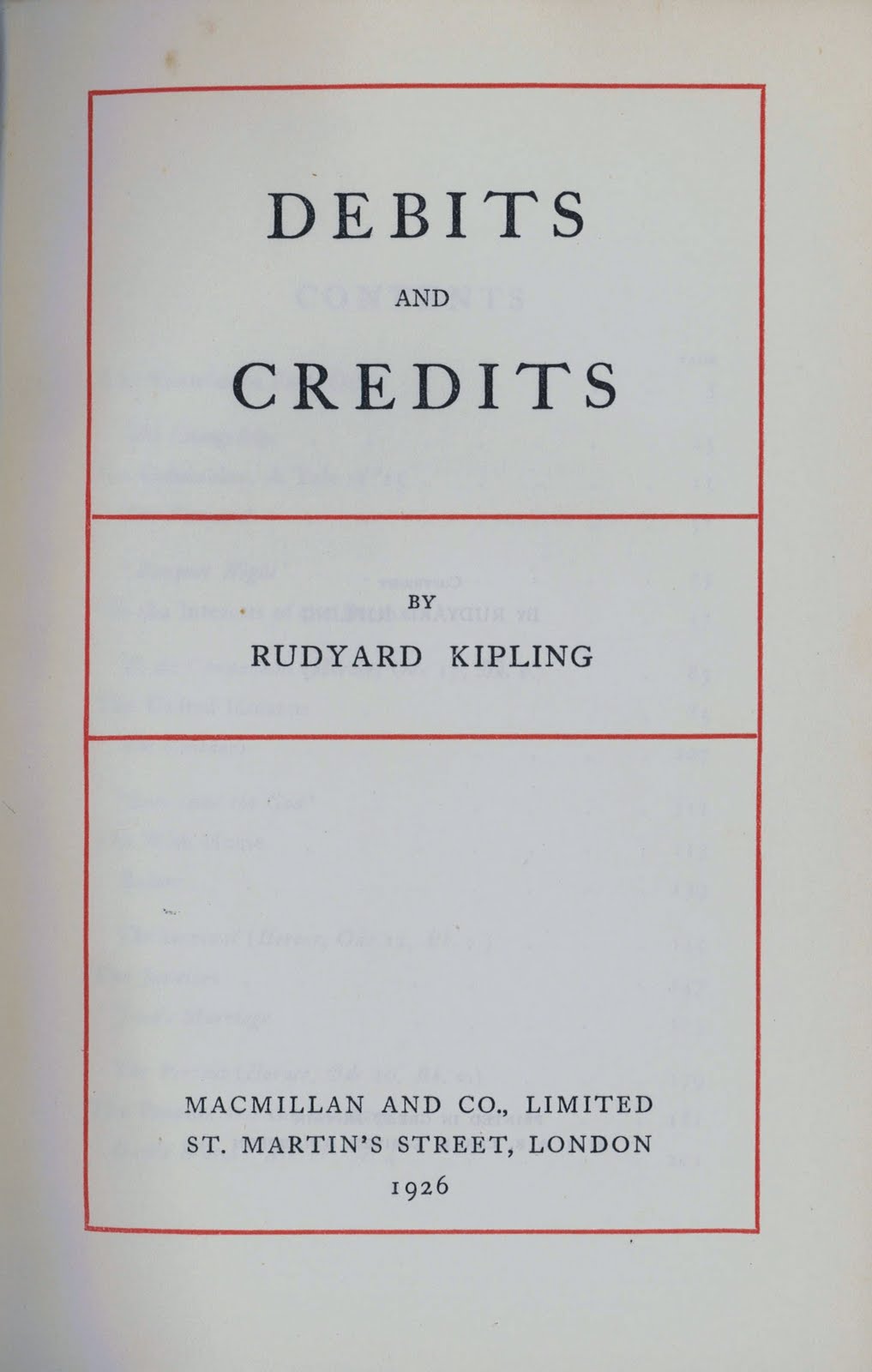
Debits and Credits: The Changelings and Sea Constables


I’ve started Debits and Credits by Rudyard Kipling and I’m impressed once again by Kipling’s storytelling power. Not to mention I’m at a loss as to why I haven’t heard more about this collection since it has some of his best writing. But then I’m only a few stories into the collection. We’ll see how it goes over the next couple of weeks. So what’s in Debits and Credits? Nineteen poems, fourteen stories, and two scenes from a play (unfinished).

The combination of the poem “The Changelings” and the short story “Sea Constables” is the first look at the collection I want to highlight. First, the poem “The Changelings”:

Or ever the battered liners sank
    With their passengers to the dark,
I was head of a Walworth Bank,
    And you were a grocer's clerk.

I was a dealer in stocks and shares,
    And you in butters and teas,
And we both abandoned our own affairs
    And took to the dreadful seas.

Wet and worry about our ways---
    Panic, onset, and flight---
Had us in charge for a thousand days
    And a thousand-year-long night.

We saw more than the nights could hide---
    More than the waves could keep---
And---certain faces over the side
    Which do not go from our sleep.

We were more tired than words can tell
    While the pied craft fled by,
And the swinging mounds of the Western swell
    Hoisted us Heavens-high...

Now there is nothing---not even our rank---
    To witness what we have been;
And I am returned to my Walworth bank,
    And you to your margarine!

To say the poem takes a dark turn may be a misstatement since the opening two lines telegraph what the banker and grocer’s clerk will see during World War I. Nothing fits in this scenario—not seeing more than the waves or night can hide nor returning to the pre-war life after witnessing such horrors. The last stanza contains a disturbing twist as well—“To witness what we have been”. Not “seen”, which would come close enough to fit the rhyme, but “been”. It’s light verse that becomes more disturbing every time I read it.

The story that follows the poem, “Sea Constables: A Tale of ‘15”, fits the same disturbing pattern. The structure of the story is simple---four men eat at a luxury restaurant in a London hotel while comparing experiences of serving in the Royal Naval Volunteer Reserve. Their conversation focuses on a blockade runner that several of them dealt with recently. The meal they eat and the wine they consume (yes, I’m jealous on this point) are exceptional, leading to a physical numbness that mirrors the moral detachment in their stories.

It helps to understand the background of the story, where the British employed private yachts for a ‘soft’ blockade of ships to or from Germany, although the context can be figured out from the story itself. As a couple of the diners tell their experience in dealing with the declared neutral party, they make it clear there is no such thing as neutrality for oil-runners like “Mr. Newt”. But Kipling also highlights the moral cost and degradation possible in war through the actions of several members in the party. Will they be able to go back to selling groceries or work in the bank after what they’ve been? The most disturbing part of the story may be that they think so.

Thursday, February 28, 2008

George Orwell on Kipling

I found George Orwell’s essay on Rudyard Kipling recently, which can be found here (there are many essays in the link, but do a text search on 1942 and the essay will be about the fourth match, halfway down the page). It appears Orwell was responding to a T.S. Eliot essay that prefaced selections of Kipling’s poetry as well as an essay by Edmund Wilson. While much of the review is about the poetry itself (Orwell’s take in a nutshell—third-rate, but a guilty pleasure that speaks to many people), Orwell has many points on Kipling that mirrored much of what I tried to say in a previous post.

Orwell doesn’t try to defend the indefensible…Kipling was a proud advocate with of the empire. But neither does he dismiss him out of hand, looking not at just what he said but how he said it. I’ll include a few lengthy quotes from various parts of the essay below:
Kipling is in the peculiar position of having been a byword for fifty years. During five literary generations every enlightened person has despised him, and at the end of that time nine-tenths of those enlightened persons are forgotten and Kipling is in some sense still there. Mr. Eliot never satisfactorily explains this fact....
Kipling spent the later part of his life in sulking, and no doubt it was political disappointment rather than literary vanity that account for this. Somehow history had not gone according to plan. After the greatest victory she had ever known, Britain was a lesser world power than before, and Kipling was quite acute enough to see this. The virtue had gone out of the classes he idealized, the young were hedonistic or disaffected, the desire to paint the map red had evaporated. He could not understand what was happening, because he had never had any grasp of the economic forces underlying imperial expansion. It is notable that Kipling does not seem to realize, any more than the average soldier or colonial administrator, that an empire is primarily a money-making concern. Imperialism as he sees it is a sort of forcible evangelizing. You turn a Gatling gun on a mob of unarmed 'natives', and then you establish 'the Law', which includes roads, railways and a court-house. …
But because he identifies himself with the official class, he does possess one thing which 'enlightened' people seldom or never possess, and that is a sense of responsibility. The middle-class Left hate him for this quite as much as for his cruelty and vulgarity. … How far does Kipling really identify himself with the administrators, soldiers and engineers whose praises he sings? Not so completely as is sometimes assumed. …
Any soldier capable of reading a book of verse would notice at once that Kipling is almost unconscious of the class war that goes on in an army as much as elsewhere. It is not only that he thinks the soldier comic, but that he thinks him patriotic, feudal, a ready admirer of his officers and proud to be a soldier of the Queen. Of course that is partly true, or battles could not be fought, but 'What have I done for thee, England, my England?' is essentially a middle-class query. Almost any working man would follow it up immediately with 'What has England done for me?' In so far as Kipling grasps this, he simply sets it down to 'the intense selfishness of the lower classes' (his own phrase). When he is writing not of British but of 'loyal' Indians he carries the 'Salaam, sahib' motif to sometimes disgusting lengths. Yet it remains true that he has far more interest in the common soldier, far more anxiety that he shall get a fair deal, than most of the 'liberals' of his day or our own. He sees that the soldier is neglected, meanly underpaid and hypocritically despised by the people whose incomes he safeguards. 'I came to realize', he says in his posthumous memoirs, 'the bare horrors of the private's life, and the unnecessary torments he endured'. He is accused of glorifying war, and perhaps he does so, but not in the usual manner, by pretending that war is a sort of football match. Like most people capable of writing battle poetry, Kipling had never been in battle, but his vision of war is realistic. He knows that bullets hurt, that under fire everyone is terrified, that the ordinary soldier never knows what the war is about or what is happening except in his own corner of the battlefield….
He identified himself with the ruling power and not with the opposition. In a gifted writer this seems to us strange and even disgusting, but it did have the advantage of giving Kipling a certain grip on reality. The ruling power is always faced with the question, 'In such and such circumstances, what would you DO?', whereas the opposition is not obliged to take responsibility or make any real decisions. Where it is a permanent and pensioned opposition, as in England, the quality of its thought deteriorates accordingly. Moreover, anyone who starts out with a pessimistic, reactionary view of life tends to be justified by events, for Utopia never arrives and 'the gods of the copybook headings', as Kipling himself put it, always return. Kipling sold out to the British governing class, not financially but emotionally. This warped his political judgement, for the British ruling class were not what he imagined, and it led him into abysses of folly and snobbery, but he gained a corresponding advantage from having at least tried to imagine what action and responsibility are like.


Update: Kipling's reputation is still being debated. Here is the conclusion of a essay on Kipling by Roger Kimball in The New Criterion:
The key word is “civilization.” Kipling was above all the laureate not of Empire, but of civilization, especially civilization under siege. Henry James once sniffed that there was only one strain absent in Kipling: that of “the civilized man.” It’s a frequent refrain. But in a deeper sense, Kipling was about almost nothing else—not the civilization of elegant drawing rooms, but something more primeval and without which those drawing rooms would soon be smashed and occupied by weeds. Kipling, Evelyn Waugh wrote toward the end of his life, “believed civilization to be something laboriously achieved which was only precariously defended. He wanted to see the defenses fully manned and he hated the liberals because he thought them gullible and feeble, believing in the easy perfectibility of man and ready to abandon the work of centuries for sentimental qualms.” Kipling endeavored to man those defenses partly through his political oratory, but more importantly through a literary corpus that taught the explicit lessons and the implicit rhythms of emotional continence and restraint.

Tuesday, October 23, 2007

Kim summary

A central post with all the links to Kim and other Kipling-related material:

Kim discussion: Chapters 1 - 5
Kim discussion: Chapters 6 - 10
Kim discussion: Chapters 11 - 15
Kim (1950 movie)

Online Kipling resources
Kipling's imperialism

As with other summaries, this is also probably the best place to post thoughts on Kim or any other Kipling work.

Update: George Orwell on Kipling

Kipling’s imperialism

Before I leave Kipling and move on to other works, I wanted to try and articulate my feelings on Kipling’s imperialism. David Cody’s short entry at The Victorian Web does a good job of summing Kipling up as well as putting him in the context of his time. It is easy to dismiss Kipling because of his views, but simply branding him an “imperialist” oversimplifies his views as well as ignores other factors. Highly recommended for a sober assessment of Kipling, even if all too short.

Kipling believed that a benevolent and moral government is required to rule justly and fairly. I’ve pointed out examples as I’ve gone along because it is so clear. It may be a self-delusion to morally justify ruling over another country, yet Kipling held up good and bad examples throughout his work instead of just paying it lip service.

While it is easy to judge past cultures based on today’s ethics, the racism in Kipling’s work is a mixed bag at best. Separating what the author believes from that of his characters is difficult, but doing so for Kipling is even harder. He clearly believes in the superiority of the British, but how does he truly feel about the natives? The uneasiness of reading Kipling is probably best exemplified by the last few lines of “Gunga Din”:
“Though I've belted you and flayed you,
By the livin' Gawd that made you,
You're a better man than I am, Gunga Din!”

You want to believe he means the last line, but the remainder of the poem treats the waterboy with extensive condescension, leaving the reader to try and reconcile the two. The additional irony of judging Kipling racist requires glossing over the caste system he vividly paints within his stories. While one doesn’t justify the other, neither can you judge only one.

One last comment before I dig myself too deep a hole. In seeing imperialism judged today, I don’t see a realistic analysis of what would have happened otherwise: it isn’t simply an imperial/non-imperial equation. Regarding Kipling’s focus, I have no idea what would have happened if Britain had not ruled India, but some of the options would be a whole lot worse than what happened. Again, this isn’t excusing or apologizing for imperialism but sometimes the options are bad and worse, making the bad choice the best one. Imagine an India today had it come under Russian rule in the 1800s, for example. Idle speculation, obviously, but in order to evaluate the past you have to include all possible possibilities. One possibility, of course, does include better treatment of ‘natives’, but that's only one possibility which could have happened.

Next up…looking at more imperialism in Conrad’s Heart of Darkness and Twain’s King Leopold's Solioquy. Quite different views on the process, although much easier to come to that conclusion since dealing with the Congo’s atrocities.

Update: As usual, I find someone who has articulated my thoughts better than I ever could have. Christopher Hitchens' piece in City Journal titled An Anglosphere Future talks about far more than my musings, but his approach and the quotes from Indian prime minister Manmohan Singh in 2005 highlight the good things (while also recognizing the bad things) very well.

Second update: See also George Orwell on Kipling for excerpts from one of Orwell's essays as well as some thoughts from Roger Kimball.

Tuesday, October 16, 2007

“Kim” (1950 movie)

I was pleasantly surprised for the first two-thirds of the movie that they followed Kipling’s novel in spirit, if not always faithfully. Dean Stockwell as the young Kim turns in an admirable job—it’s not a role I thought would translate to the screen very well. Errol Flynn’s role of Mahbub Ali was exaggerated in importance to that of the novel, but Flynn tries to impart his former glory to the horse trader and nearly pulls it off. At some point I quit being critical of the differences or failings of the movie and just let it wash over me. For example, Flynn hams it up only pretending to be drunk with the courtesan while spies search for the message revealing the five turncoat rulers. The attempted assassination of Mahbub Ali is foiled in a very different manner, but enjoyably. It is a rollicking tale for about 80 minutes.

Instead of showing Kim three years later after completing school, the movie had the constraint of having to show Kim after only his first year plus Lurgan’s training. I could have lived with the last third of the movie diverging wildly from the book if it had worked, but alas it did not come close to succeeding. The lama’s insistence on traveling north is replaced solely with Kim’s playing The Great Game, hooking up with the Russians (or what should have been one man from Russia and one from France) on his own accord. The book’s comedic tone in the spies’ incompetence, bringing failure on their selves with Hurree Babu’s jester-ish role, is replaced with a more sinister turn. And while I can appreciate the difficulty of trying to show the lama reaching enlightenment, the movie utterly failed to convey the sheer joy and love that the last few pages of the book reveal.

Ultimately the depth of characters is never developed sufficiently to match the novel, emphasizing the action and intrigue instead. One of the major themes is almost completely avoided, that of Kim searching for his identity (“Who is Kim?”) as a Irish orphan in India. The only time it is alluded to is when Kim in sahib-dress astounds natives when he lets loose a stream of invectives and curses of their own country.

One area the movie did well, I thought, was portraying the complexity and danger of playing The Great Game. The man with the scar following Kim until he and Creighton foil his intrigue was a good example. My recommendation is to enjoy the movie on its own terms, especially Errol Flynn, but also read the book for the love and joy demonstrated.

Tuesday, October 09, 2007

Kim discussion: Chapters 11 – 15

A wonderful ending to an enjoyable book. I had gotten a little impatient with the middle section, feeling it was simply marking time. But there was important groundwork being laid that pays off handsomely. There are several different themes and things to talk about, so I’m sure I’ll do the book an injustice, but here goes anyway…

Central to the book is Kim’s development and search for identity. The devotion he shows to the lama injures him greatly, as does the responsibility he takes on in The Great Game. He has certainly matured, with deeper feelings toward the lama of affection and attachment. There are two sides to illusions that he passes or recognizes—Mr. Lurgan’s illusionary tests as well as the lama’s achievement beyond worldly desire. His sense of responsibility has fully developed, risking his life in retaliation for the assault on the lama, carrying out his duty in procuring the spy’s documents, giving strength and support to the lama for his spiritual journey, and avoiding the sensual pleasure offered in order to carry out all these things.

Kim becomes something greater by these developments, as does the novel. It becomes a joyous achievement, a celebration even though there is self-doubt and questioning throughout. Once again, Kim questions who he is, but this time he receives an intimation of an answer—despair before enlightenment:
All that while he felt, though he could not put it into words, that his soul was out of gear with its surroundings - a cog-wheel unconnected with any machinery, just like the idle cog-wheel of a cheap Beheea sugar-crusher laid by in a corner. The breezes fanned over him, the parrots shrieked at him, the noises of the populated house behind - squabbles, orders, and reproofs - hit on dead ears.

'I am Kim. I am Kim. And what is Kim?' His soul repeated it again and again.

He did not want to cry - had never felt less like crying in his life - but of a sudden easy, stupid tears trickled down his nose, and with an almost audible click he felt the wheels of his being lock up anew on the world without. Things that rode meaningless on the eyeball an instant before slid into proper proportion. Roads were meant to be walked upon, houses to be lived in, cattle to be driven, fields to be tilled, and men and women to be talked to. They were all real and true - solidly planted upon the feet – perfectly comprehensible - clay of his clay, neither more nor less.


Kim’s revelation takes place only moments before the lama reveals his attainment (one additional long quote, but the second highpoint of the chapter and novel):

'Hear me! I bring news! The Search is finished. Comes now the Reward... Thus. When we were among the Hills, I lived on thy strength till the young branch bowed and nigh broke. When we came out of the Hills, I was troubled for thee and for other matters which I held in my heart. The boat of my soul lacked direction; I could not see into the Cause of Things. So I gave thee over to the virtuous woman altogether. I took no food. I drank no water. Still I saw not the Way. They pressed food upon me and cried at my shut door. So I removed myself to a hollow under a tree. I took no food. I took no water. I sat in meditation two days and two nights, abstracting my mind; inbreathing and outbreathing in the required manner ... Upon the second night - so great was my reward - the wise Soul loosed itself from the silly Body and went free. This I have never before attained, though I have stood on the threshold of it. Consider, for it is a marvel!'

'A marvel indeed. Two days and two nights without food! Where was the Sahiba?' said Kim under his breath.

'Yea, my Soul went free, and, wheeling like an eagle, saw indeed that there was no Teshoo Lama nor any other soul. As a drop draws to water, so my Soul drew near to the Great Soul which is beyond all things. At that point, exalted in contemplation, I saw all Hind, from Ceylon in the sea to the Hills, and my own Painted Rocks at Such-zen; I saw every camp and village, to the least, where we have ever rested. I saw them at one time and in one place; for they were within the Soul. By this I knew the Soul had passed beyond the illusion of Time and Space and of Things. By this I knew that I was free. I saw thee lying in thy cot, and I saw thee falling downhill under the idolater - at one time, in one place, in my Soul, which, as I say, had touched the Great Soul. Also I saw the stupid body of Teshoo Lama lying down, and the hakim from Dacca kneeled beside, shouting in its ear. Then my Soul was all alone, and I saw nothing, for I was all things, having reached the Great Soul. And I meditated a thousand thousand years, passionless, well aware of the Causes of all Things. Then a voice cried: "What shall come to the boy if thou art dead?" and I was shaken back and forth in myself with pity for thee; and I said: "I will return to my chela, lest he miss the Way." Upon this my Soul, which is the Soul of Teshoo Lama, withdrew itself from the Great Soul with strivings and yearnings and retchings and agonies not to be told. As the egg from the fish, as the fish from the water, as the water from the cloud, as the cloud from the thick air, so put forth, so leaped out, so drew away, so fumed up the Soul of Teshoo Lama from the Great Soul. Then a voice cried: "The River! Take heed to the River!" and I looked down upon all the world, which was as I had seen it before - one in time, one in place - and I saw plainly the River of the Arrow at my feet. At that hour my Soul was hampered by some evil or other whereof I was not wholly cleansed, and it lay upon my arms and coiled round my waist; but I put it aside, and I cast forth as an eagle in my flight for the very place of the River. I pushed aside world upon world for thy sake. I saw the River below me - the River of the Arrow - and, descending, the waters of it closed over me; and behold I was again in the body of Teshoo Lama, but free from sin, and the hakim from Decca bore up my head in the waters of the River. It is here! It is behind the mango-tope here - even here!'

A wonderful passage with a father’s love for Kim. Prior to relaying his attainment, the lama tells Kim “all my thoughts were theeward.” The lama achieves what he thinks is Enlightenment, only to turn back due to his anxiety for Kim…which causes him to achieve true Enlightenment through his concern.

In the middle section I mentioned that there were very few significant females in the book. In the last section, the Kulu widow shows up again with her most noteworthy contribution. As the lama points out, “She is virtuous, kindly, hospitable - of a whole and zealous heart. Who shall say she does not acquire merit?” The fallen woman of Shamlegh tempts Kim with carnal pleasure, but always provides him and the lama with necessities to survive and return to the plains. Again, very much a male novel but the few women shown assist the men with their missions.

Again, a wonderful book with memorable characters. The lama and Hurree Babu are by far my favorites. I hope to have the 1950 movie version soon in order to compare to the book. I’m expecting more emphasis on the action/adventure part of the story, needless to say.

Wednesday, October 03, 2007

Kim discussion: Chapters 6 – 10

The middle third of the book covers Kim’s formal education as well as his extended informal learning. The book can be read solely as an adventure story, but some of the themes in the book add substantial depth. Kim’s reflection upon entering the school is worth noting:

’I am Kim. This is the great world, and I am only Kim. Who is
Kim?' He considered his own identity, a thing he had never done before, till his head swam. He was one insignificant person in all this roaring whirl of India, going southward to he knew not what fate.

The bleakness of the quote stands in marked contrast to Kim’s behavior: half happy-go-lucky, half measured actions. But in uttering “Who is Kim,” he captures the question of where he resides in British-controlled India—an Irishman’s son or just another English gone native? One other contrast in this section is the apparent change in the lama’s approach toward Kim. While obviously still caring deeply for him (paying for his schooling, waiting a day and a half just to get a glimpse of him at the school, etc.), he acts much more detached toward his chela. Some of the change is in order to keep Kim in school, while he also confesses that he has to avoid becoming too attached to Kim (which would derail his search for enlightenment).

We meet several additional father figures and guides to Kim in this section—Colonel Creighton, Mr. Lurgan, and Hurree Babu. Add these to the lama and Mahbub Ali from the first few chapters and you have many men looking after young Kim. Kim is very much a male novel, with the only significant female so far in the book is Huneefa, disguising and casting spells over Kim to protect him.

I find the whole premise of The Great Game tiresome and manufactured, unfortunately. Yes, I know there was some struggle between Russia and England, but the drama invoked almost seems like a cartoon. The adults repeatedly mention that one wrong word or misplaced tic could get you killed, in addition to how long someone would live after divulging secrets. Some of the examples of information gathered are laughable today, but in an age where facts were harder to gather and in a location that was massive and possibly hostile it makes more sense. Sill, instead of romanticizing and building the premise of The Great Game, the entire conceit just feels fabricated and straining credibility. On a related note, the way the adults all instantly recognize and value Kim’s potential gradually annoys me. Maybe if it wasn’t hammered home as often, this wouldn’t irritate me as much. Overall these are minor irritants, but grating nonetheless.

Since this section is mostly laying the groundwork for the last section, these items probably bother me more. However, I’m positive about the overall feel of the book so far. I hope that the final section lives up to the foundation to date. Next: Chapters 11 -15.

Monday, September 24, 2007

Kim discussion: Chapters 1 – 5

The text for Kim can be found here.

Kim is the coming of age story of a 13 year-old orphaned boy, whose father was a British soldier. Kim’s fortune was foretold by his father:

The third [document left at Kim’s father’s death] was Kim's birth-certificate. Those things, he was used to say, in his glorious opium-hours, would yet make little Kimball a man. On no account was Kim to part with them, for they belonged to a great piece of magic - such magic as men practised over yonder behind the Museum, in the big blue-and-white Jadoo-Gher - the Magic House, as we name the Masonic Lodge. It would, he said, all come right some day, and Kim's horn would be exalted between pillars - monstrous pillars - of beauty and strength. The Colonel himself, riding on a horse, at the head of the finest Regiment in the world, would attend to Kim - little Kim that should have been better off than his father. Nine hundred first-class devils, whose God was a Red Bull on a green field, would attend to Kim, if they had not forgotten O'Hara - poor O'Hara that was gang-foreman on the Ferozepore line.

Kim meets a Tibetan lama and becomes his disciple (chela). Kim combines this with an errand he agreed to perform (unbeknownst to him it involves information to a British commander concerning Russian intrigue in India). These chapters carry the lama and chela along the Grand Trunk Road, where Kim eventually meets up with his father’s regiment. Their standard is a red bull on a green field. Because of the bequeathed papers he carries, the company’s chaplain and priest take Kim in to send to a British school. The lama continues on his journey to reach enlightenment under the protection of a rich Indian lady.

The story so far reminds me of a combination of three major works, two of which are by Mark Twain. I feel I could easily describe this as the Indian Huckleberry Finn and not be far off the mark. Yet the character Kim, as much as he loves his freedom like Huck, also shows many of Tom Sawyer’s traits in dealing with authority. And while the lama echoes Jim to Kim’s Huck, he also shows a direct lineage from the title character in Don Quixote, yet taken to a spiritual plane.

The best part of the first five chapters to me was the interplay between Kim and the lama. The lama truly believes Kim was heaven-sent to help him find the “river of the arrow” and achieve enlightenment. Yet his treatment of Kim moves from disciple to that of a son. The distress the lama shows when he realizes Kim will be taken from him by the soldiers is heart-breaking, not just because he will miss him but more importantly in that the lama has forsaken his mission:

“I made believe to myself for now I see it was but make-belief - that thou wast sent to me to aid in the Search. So my heart went out to thee for thy charity and thy courtesy and the wisdom of thy little years. But those who follow the Way must permit not the fire of any desire or attachment, for that is all Illusion. As says ...” He quoted an old, old Chinese text, backed it with another, and reinforced these with a third. “I stepped aside from the Way, my chela. It was no fault of thine. I delighted in the sight of life, the new people upon the roads, and in thy joy at seeing these things. I was pleased with thee who should have considered my Search and my Search alone. Now I am sorrowful because thou art taken away and my River is far from me. It is the Law which I have broken!”

Even though the lama absolves Kim from distracting him, the lama includes a pretty damning barb at Kim’s additional tasks. An additional interesting pairing is the Catholic priest and the Church of England chaplain, one stern and authoritative while the other is much more concerned with Kim’s well-being.

The last point I’ll mention is two instances that show Kipling’s view of India and empire. At one point on their journey along the Grand Trunk Road, Kim and the lama meet a native soldier who assisted the British during the Mutiny of 1857. The character’s framing of what happened when some natives fought the British probably was not representative of the typical Indian of the day: “A madness ate into all the [native] Army, and they turned against their officers. That was the first evil, but not past remedy if they had then held their hands. But they chose to kill the Sahibs' wives and children. Then came the Sahibs from over the sea and called them to most strict account.” Obviously just speculation on my part, but it sounds rather hollow coming from a native instead of one of the British officers. The second incident happens very quickly, but underpins what I’ve seen of Kipling’s belief in England’s responsibilities when it came to India. The rich woman that Kim and the lama travel with meets a police constable, who treats the lady to high praise. The woman’s response after the constable leaves echoes Kipling’s approach in the previous short stories mentioned: “These be the sort to oversee justice. They know the land and the customs of the land. The others, all new from Europe, suckled by white women and learning our tongues from books, are worse than the pestilence. They do harm to Kings.” In other words, those that show conscientiousness first to India are living up to their moral responsibilities.

Next up—Chapters 6 through 10.

Monday, September 17, 2007

Rudyard Kipling Resources and Upcoming Books/Stories

Project Gutenberg e-texts

Wikipedia entry on Kilping

The New Readers' Guide to the works of Rudyard Kipling (created by The Kipling Society)

The Victorian Website page on Kipling


Most of these sites have additional links and resources listed, as well as several links to Kipling’s works online. There is a wealth of material available!

The next couple of weeks I will cover Kipling’s Kim and the 1950 film version with Errol Flynn. I might read another of Kipling’s short stories before moving on to Joseph Conrad. For Conrad I’ll read Heart of Darkness (I’m interested to see how it compares to having read it in high school) and The Shadow-Line first, then see which of his other works I would like to tackle. If you’d like to join in or have any suggestions on these authors, please feel free to leave a note or drop a line.

“The Man Who Would Be King” by Rudyard Kipling and 1975 film version

Text can be found here.

There is so much that can be written about with any book or short story, yet the hard part is choosing what to point out. While there are many more thoughts on the works I read, I’m trying to keep the posts relatively short compared to what I could cover. If you see anything else you would like to add, please do not hesitate to do so.

Considered by many to be one of Kipling’s best tales, this story revolves around Daniel Dravot and Peachey Carnehan, two unsavory former British soldiers. The narrator meets them separately, then together in his news office as they plan their trek to Kafiristan to anoint themselves kings. Carnehan shows back up in the office two years later with an amazing tale of their success and ultimate failure. The centerpiece of the story is Peachey’s spellbinding tale but knowing he is a misfit, how much of it can you believe? How much of it is true?

Dravot and Carnehan find themselves between cultures—neither accepted in English society (nor did they strive to be members of it) while despising the Indian raj, they differ from Wali Dad in “On the City Wall” since they are from Britain. One is Irish while the other is Scottish, countries previously absorbed by England. The irony, of course, is that they impose England’s imperialism and institute their own. I think it is easy to read too much into Kipling choosing those nationalities, yet that is what he chose so it’s definitely open to interpretation.

More interesting, to me anyway, is how two misfits in British society are able to ‘conquer’ and then rule Karfiristan. They recognize their weaknesses, drink and women, and swear them off in a contract in order to achieve their goals. As they rule, it is ironic how much they grow into their roles, doling out rulings and advice fair and appropriate for the situation. Comments Dravot: “It’s a hugeous great State, and I can’t always tell the right thing to do, and I haven’t time for all I want to do, and here’s winter coming on and all.” Part of Peachey’s reply: “I take it Kings always feel oppressed that way.” They feel the weight of imposing what they believe to be a superior culture upon another. The freedom the men embody (traveling where they want around India, extorting money and impersonating various roles) is counter to the role they desire. And in partway achieving their desired role, their behavior changes to reflect the many responsibilities of being a King.

In addition to the contract, there are the additional restrictions and burdens placed on them by Freemasonry. Since it turns out the natives have their own Masonic order, which gives the two would-be-Kings the additional leverage in appearing superior to them. Yet by breaking both the contract and order rules, they set themselves up for a spectacular fall. What enables them to raise themselves as Kings also facilitates their downfall.

The structure of the story is successful in adding to the overall feel. Just like the narrator, I found myself hanging on Peachey’s every word. Yet part of me wondering how much of this was Peachey making things up to elevate himself to appear a success. All of that is put to rest once he produces Dravot’s severed head, complete with gold crown.

I can see where Kipling’s comments throughout the story have put him on the bad side of historically judging previous generations by today’s standards. He clearly falls on the side of believing that England has much to offer and raise India up to a higher standard. But just as he commented poorly on the Captain in “On the City Wall” who treated natives badly, I see this story as a cautionary tale on the responsibilities he felt England owes to India. Deviating outside the overriding moral obligations will set themselves up for a deserved fall. I thoroughly enjoyed the story, yet I liked the ambiguity of “On the City Wall” more. Both are highly recommended, though.

I rented the 1975 film version of “The Man Who Would Be King” and found it extremely well done. Starring Sean Connery as Daniel Dravot, Michael Caine as Peachey Carnehan, and directed by John Huston, the movie follows Kipling’s story fairly closely. I found the deviations true to the direction of the story, as well as understanding the changes to successfully translate from page to screen. Christopher Plummer is Rudyard Kipling, a literal reading of the story’s author instead of a detached third-person narrator. Well written and well acted, I fail to understand why this wasn’t more of a success at the time or has been more recommended over the yeas since release. The chemistry between Caine and Connery is a lot of fun to watch.


Picture source
"Now listen to me you benighted muckers. We're going to teach you soldiering. The world's noblest profession. When we're done with you, you'll be able to slaughter your enemies like civilized men.”


Extra note: for more on the historical figure who may have been a partial inspiration on Kipling's story, see the entry for Josiah Harlan.

Friday, September 07, 2007

“On the City Wall” by Rudyard Kipling

The text can be found here.

This short story presents a very complex look at India and 19th century British rule. There is a lengthy discourse early in the tale which includes this passage:

Gentlemen come from England, spend a few weeks in India, walk round this great Sphinx of the Plains, and write books upon its ways and its works, denouncing or praising it as their own ignorance prompts. Consequently all the world knows how the Supreme Government conducts itself. But no one, not even the Supreme Government, knows everything about the administration of the Empire. Year by year England sends out fresh drafts for the first fighting-line, which is officially called the Indian Civil Service. These die, or kill themselves by overwork, or are worried to death, or broken in health and hope in order that the land may be protected from death and sickness, famine and war, and may eventually become capable of standing alone. It will never stand alone, but the idea is a pretty one, and men are willing to die for it, and yearly the work of pushing and coaxing and scolding and petting the country into good living goes forward. If an advance be made all credit is given to the native, while the Englishmen stand back and wipe their foreheads. If a failure occurs the Englishmen step forward and take the blame. Overmuch tenderness of this kind has bred a strong belief among many natives that the native is capable of administering the country, and many devout Englishmen believe this also, because the theory is stated in beautiful English with all the latest political colours.
The setting is Lahore where a courtesan named Lalun hosts a salon in her apartment on the city’s wall. If you want to know what is going on the city, Lalun’s apartment is the center of information and gossip. Two visitors usually there include Wali Dad, a native Muhammadan with an English education, and the narrator (a detached version of Kipling). The tale is relayed as it appears to the narrator, with holes and gaps filled in later as he finds out more information.

Wali Dad is a powerful symbol of the hybrid Indian of the day: contemptuous of his fellow countrymen while knowing he will never be fully accepted in the English world as an equal. The contempt is shared by Khem Singh, an old Sikh who has been imprisoned for rising up against the English armies but recently given a guarded freedom in Lahore. Singh’s contempt is different, as he finds the younger generations would rather cooperate with the Raj than fight for their freedom.

Many symbols highlight the India of old vs. the current setting: the “red tombs of dead Emperors beyond the river” with the collegiate cricket field next to the river, and the active Khem Singh vs. a passive Wali Dad (although both end up resigning themselves to their individual failures) to point out two obvious sets. But how does Kipling (or the narrator) feel about the imperial situation? I sense a complex resignation of head winning out over heart. He senses the majesty and honor of India past, but acknowledges the benefits of English rule. Kipling clearly paints the Captain in the most unflattering of lights, but shortly afterwards highlights the potential powder keg of religious strife to which the soldiers successfully intervene. While the current situation is far from what he would like to see, I get the feeling he sees the absence of the British would be a far greater calamity. I found it interesting that two different native characters commented on the foolishness of the mercy shown by the English.

The options of the actors seem to be a choice between delusion and futility. Wali Dad can not change who he is—he will never be fully accepted in English society nor trusted by his countrymen. He has rejected everything, caught in temporary religious fervor that causes him to betray Singh’s conspirators. Khem Singh explores his options, one that can not be completed while the other is full of dissatisfaction. The only character that seems fulfilled in the story is Lalun, and her mission in life is to serve.

Highly recommended for Kipling’s complex take on late 19th century India and colonial rule. Next up: Kipling’s “The Man Who Would Be King” and the 1975 movie version.