Showing posts with label Marginalia on Casanova. Show all posts

Monday, September 09, 2013

A collection of Miklós Szentkuthy links

Since my notes on several books I've read have been lost, I thought I would start posting on what I'm currently reading...which is many articles about Miklós Szentkuthy as well as the recently released translation of Towards the One and Only Metaphor. Instead of having 20 tabs open in my browser I'm going to collect links related to Szentkuthy in this post. It's meant to provide a starting point for anyone interested in the author and not a comprehensive overview, especially since only two of his books have been translated into English.

Hyperion, the online magazine published by Contra Mundum Press, has devoted Volume VIII, Issue 2, July 18, 2013 to Szentkuthy (the full 326-page pdf version can be found here). More on some of these articles in separate posts. This is a treasure trove of articles about and excerpts from Szentkuthy's books. Highly recommended.

Contra Mundum Press has also devoted itself to translating most (if not all) of Szentkuthy's work. So far there has been two books released. Each of their publicity pages below contains many helpful links (some of which I'll duplicate here). I'm sure more links will be added to the second book as reviews are published:
Marginalia on Casanova
Towards the One and Only Metaphor

I've never gone beyond introductory notes on Casanova, something I intend to correct before the end of the year, but do check out the links provided on its publicity page.

I'm not sure what order I'll go in for more posts on Szentkuthy. Since I haven't finished Metaphor yet, I'll probably start with some of the articles about him in Hyperion. Regarding Towards the One and Only Metaphor, the introduction to the English translation release by Rainer J. Hanshe can be found at Asymptote and The Quarterly Conversation. My jottings on the introduction can be found here.

Since Metaphor is the recent release, I'll include a link to Asymptote's excerpt from the book. Hungarian Literature Online has two posts with excerpts as well. The first sample contains the first two 'entries' that are important in understanding what Szentkuthy is attempting to do with the book. Or at least what he says he is trying to do. The second sample helps round out the picture on what it's like to read the book.

Speaking of Hungarian Literature Online, they have plenty of helpful articles on Szentkuthy. All of their articles tagged with the author's name can be found here. Some posts you may want to check out are Outprousting Proust (an overview to his work), A Comedy of Ideas (about his first book, Prae), and two excerpts from his Recollections: one and two. Entry 25, in the second excerpt, focuses on Metaphor.

Besides his biography, Szentkuthy's Wikipedia entry includes a bibliography and additional links.

Related posts:

Tuesday, January 22, 2013

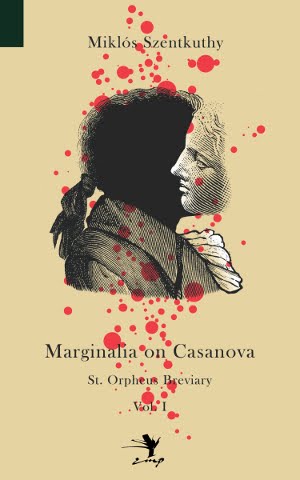
Marginalia on Casanova by Miklós Szentkuthy: introductory notes and links


Marginalia on Casanova by Miklós Szentkuthy
St. Orpheus Breviary, Vol. 1
Translation by Tim Wilkinson
Introduction by Zéno Bianu (Translation by Rainer J. Hanshe)
Afterword by Mária Tompa
(New York: Contra Mundum Press, 2012)
ISBN 9780983697244

This is one of the strangest and most enjoyable books I’ve read in quite a while. I have hesitated to write about it but I think I'm ready to give it a try. At first the book appears to be Szentkuthy’s comments on Casanova’s History of My Life, but the scope quickly expands to include a study in the underlying philosophy of Casanova’s works in addition to a commentary of his time (and a comparison with the 20th century).

So what is the St. Orpheus Breviary? From the Afterword by Mária Tompa (ellipsis in original):

In his [Szentkuthy’s] 1976 memoir Recollection of My Career, this is how he refers to it: “Among the huge amount that I learned from Antal Szerb I ought to list my real acquaintance with the eighteenth century. It was he who inspired the Casanova commentaries of Orpheus… The structure of my commentaries was determined by the structure of the 1919 magnum opus of the Protestant theologian Karl Barth to the Epistle of St. Paul to the Romans

Zéno Bianu’s introduction augments that inspiration:

In 1938, Szentkuthy read the Römebrief of the famous Protestant exegete Karl Barth, a commentary that is based on an analysis, phrase by phrase, even word by word, of the Epistle to the Romans. Literally enchanted by the effectiveness of this method—“where, in his words, every epithet puts imagination in motion”—he decided to apply it on the spot to Casanova, whose memoirs (a German edition in six large volumes) he had just annotated with gusto.

There are ten books in the St. Orpheus Breviary, the last volume (or is that the last two volumes?) unfinished. By the way, a translation of the second volume, Towards the One and Only Metaphor is scheduled to be released later this year by Contra Mundum (and more from this author is scheduled). [Thanks to reader JC Buckley for the correction] Why Orpheus in the title? From Szentkuthy’s prospectus for the first volume:

The name “Orpheus” expresses the underlying conceptual tone: Orpheus wandering in the underworld is an eternal symbol of the brain straying among the dark secrets of reality. The aim of the work is, firstly, to portray the reality of nature and history with ever more extreme precision, and secondly, to display through variations in the history of the European mind an observer’s every uncertainty, the fickleness of emotions, the tragic sterility of thoughts & philosophical systems. The reason for placing the epithet “Saint” before “Orpheus” is because the work seeks to portray both European history and the vegetative world of nature from an essentially religious, supernatural viewpoint. Although both the lives of the saints, as well as the other figures, famous books, and cultural manifestations of history are, in point of fact, nothing more than different features of a lyrical self-portrait, the various roles and masks of the author as it were, the work is in essence “religious,” because form love to politics the emphasis throughout is on the battle of the body-politic of God and the body-politic of the world.

I’m not sure I got all of that while reading the book but several points shine through in this volume. Mária Tompa’s Afterword provides a good overview of Marganalia on Casanova, highlighting the emphasis on that ‘battle’:

In reality it is a reader’s diary divided into 123 numbered sections which provides a picture of Casanova’s personality extending to highly comprehensive, balance, and minute psychological details. Szentkuthy gives an extremely detailed analysis not only with regard to his accomplishments in seducing women, but his intellectual and mental endeavors, his psychological and emotional stumbling blocks—much of it with great subjective vehemence.

I have to mention the structure of the Breviary: a Vita (Life of a Saint) and Lectio (Saintly Reading). Szentkuthy had written the first six volumes in the series without including “Life of a Saint” sections but decades after their initial writing he added them. The saint included in Marganalia on Casanova is Alfonso Maria di Liguori (1696 – 1787).

OK, more on the actual marginalia in a separate post.

Links:
Wikipedia bio on Miklós Szentkuthy
Contra Mundum’s page for the book
Review and links at the complete review
A review at the Guardian
Links at Hungarian Literature Online:
          Boudoir & Theology (used as the book’s Introduction, by Zéno Bianu)
          Excerpt (the first 12 sections)
          Review, notes