The Collected Works posted a link earlier today to a YouTube video of Leonard Nimoy as Roger in the 1963 movie version of Jean Genet's The Balcony. I have not watched the movie, but I was happy to watch these short clips. It highlights the absurdity of the play while providing Nimoy a great role. Here are three of the clips:
Yes, that's Peter Falk as the Police Chief and Shelley Winters as Madame Irma. See here for the movie's cast list. Almost as fun as the clips is their comments. Enjoy!
Showing posts with label Jean Genet. Show all posts
Showing posts with label Jean Genet. Show all posts
Tuesday, March 03, 2015

Monday, February 23, 2015
"The Balcony" by Jean Genet by The Collected Works

Saturday evening my wife and I went to see The Collected Works present "The Balcony" by Jean Genet. I've never completely connected with the play, although I do enjoy certain parts of it. I think my hesitancy with the play is in the randomness (for lack of a better word) in parts of it, a trait highlighted in some of Genet's notes on "How to Play the Balcony", such as this one: "Between Irma and the Chief of Police, their brief moments alone should reveal an old tenderness. I don't know why." (translaion by Jason Araujo)
A synopsis of the play:
Most of the play takes place in a brothel called The Balcony. The time and place are not clear, but Genet said he had the Spanish Civil War in mind when writing it. In the brothel run by Madame Irma, clients allow their fantasies to run rampant, satisfying more than just their sexual appetites. The fun with smoke and mirrors is kept alive until a rebellion cuts the house off from the rest of the city while everyone in the brothel await the arrival of George, the Chief of Police. It doesn't help Irma's business when a former employee, Chantal, runs away with a plumber and ends up becoming the face of the rebellion. When the rebellion fails, the Court Envoy, wishing to maintain consistency, 'coronates' Irma as queen and employs certain of her clients to carry out their fantasy roles in real life. The public buys it with help of a fawning media, but conflict arises between the clients and Irma & George regarding the use and sources of their new-found power.
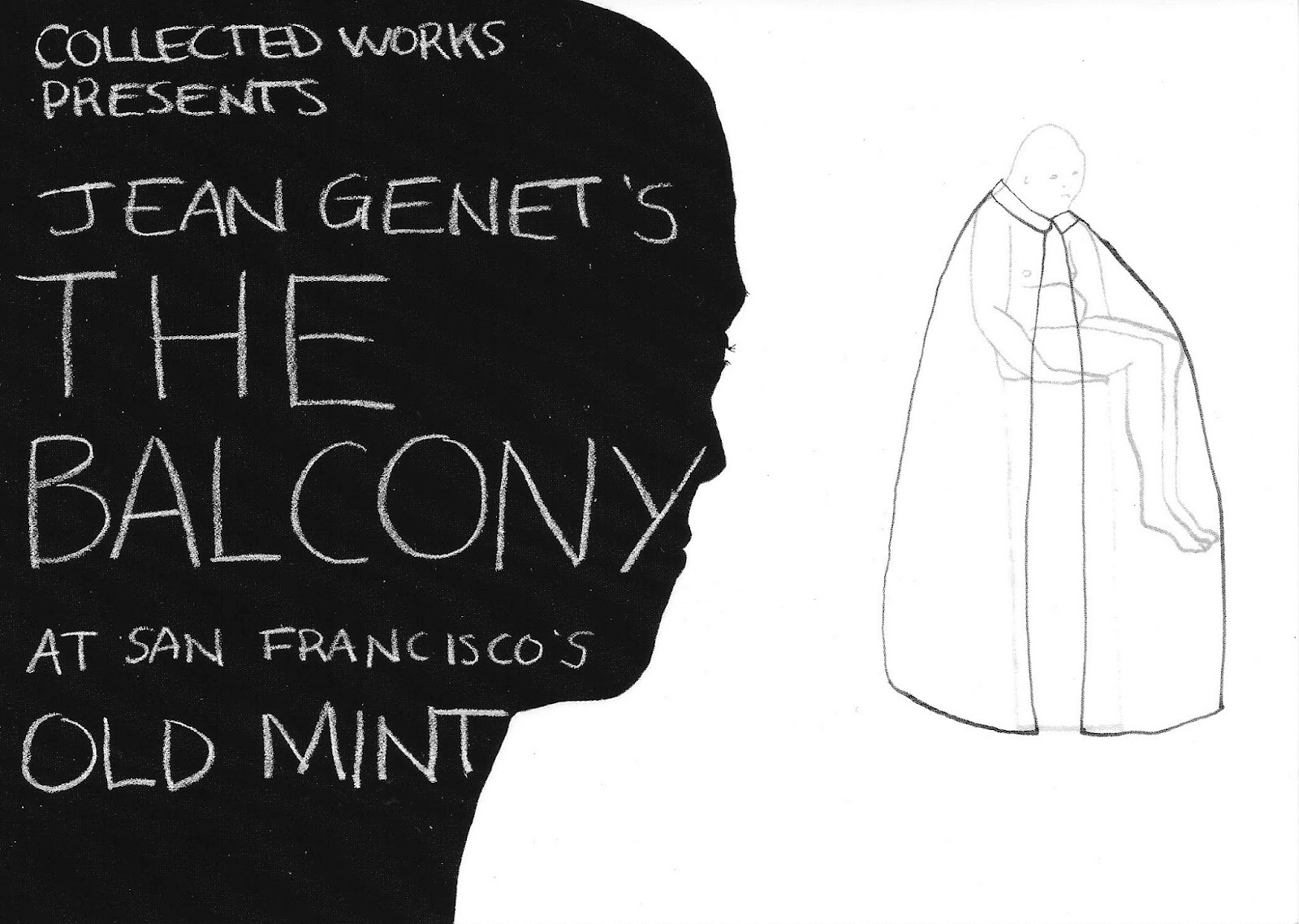
A few notes on this production:
The play was held at The Old Mint in San Francisco, and the building (completed in 1874) was part of the presentation. The first four scenes were held simultaneously in different parts of the basement, allowing us to wander in and out of different clients' fantasies. In the meantime sounds of the rebellion and screams filter in to the different rooms. Or are some of the screams coming from other rooms? I loved this part of the play and thought it a brilliant use of the building. The feel of the old rooms and vaults added to the fantasy feeling of the play. The emphasis on security (such as the "Bishop" wanting to make sure the doors were locked, sealed, shut, etc.) becomes magnified when scenes are taking place in former bank vaults.
The audience followed the action through the building, allowing us to feel like we were visiting different parts of the brothel. Instead of waiting through a scene change, you just walked down the hall to the next scene. But at just over two-and-a-half hours running time, I needed a break. The continuity, though, did allow for the tension and power of the play to build nicely. I was exhausted when the play finished.
This production included the scene from Genet's second version of the play, which provides more insight into the revolutionaries. This insight works both for and against those in the rebellion, showing both personal worries alongside blind cant and desire for personal gain.
Ryan Tacata almost stole the show as Carmen, the former prostitute turned accountant for Irma. His take on the role brought out (and added to) the humor in the play. And I'm not in love with his performance just because he put his arm around me while cooing some of his lines. No, not at all. Val Sinckler hit the right notes as Madame Irma, especially in her transformation from madame to queen. Scott Baker as the Police Chief played the role to its cock-sure hilt, fully showing his awareness of the role in the game that he and the rebels played.
The scene where media photographers take pictures of the false Bishop, Judge, and General (helping the old order to be restored after the rebellion failed) was played in a large hall where the audience had to look up to the balcony at the characters. It was a simple touch but very effective in a powerful scene. The Court Envoy responds to the photographers actions, "A true image born of a false spectacle." In such a setting we were part of that spectacle.
As with The Collected Works' previous play "Princess Ivona", the inventiveness of their productions shines through. I look forward to their future productions. I highly recommend keeping up with and attending any upcoming planned productions of The Collected Works if you're in the San Francisco Bay area.
In my previous post on "The Balcony" there are additional links to The Collected Works' site. It's well worth your time to explore their site.

Sunday, February 08, 2015
Collected Works Presents Jean Genet's "The Balcony"
I've mentioned the Collected Works theater company after going to see their production of Witold Gombrowicz’s Princess Ivona. Their current production is Jean Genet's play "The Balcony." They have some wonderful pictures available at their sneak peek page.
Making the production even more intriguing is its performance at The Old Mint in San Francisco. From the Collected Works' page about this location:
Making the production even more intriguing is its performance at The Old Mint in San Francisco. From the Collected Works' page about this location:
The Old Mint (affectionately referred to as “The Granite Lady”) was designed by Alfred B. Mullett and completed in 1874. The building sits on a concrete and granite foundation, designed to thwart tunneling into its vaults, which at the time of the 1906 earthquake and fire held $330 million, fully a third of the United States’ gold reserves. Heroic efforts by Treasury Department employees, using only a one-inch hose connected to wells in the interior courtyard (built just weeks earlier) saved the Mint from the fire that destroyed commercial San Francisco after the earthquake. With the downtown area and its banks destroyed, the San Francisco Mint was the only financial institution open for business in San Francisco, and became the depository and treasury for the city’s relief fund. The building continued operation as a U.S. Mint until 1937.
I plan on re-reading the play and posting on it soon, but for now I'll borrow their comments about it (again from their page on the play):
Genet’s play tells the story of a revolutionary uprising in the streets of an unnamed city. While armed rebels fight to take control of the city’s power structures, most of the action takes place in an elite brothel or “house of illusions,” where clients act out their fantasies of institutional power: they play judges, bishops, and generals as their counterparts in the “real” world struggle to maintain their authority. The Balcony is a landmark in modern theatre: the eminent American critic Edmund White noted that, with The Balcony’s foregrounding of the role of illusion and meta-theatricality in creating contemporary power and desire, Genet invented modern theatre.
I'm hoping I'll be able to attend a performance before the final performance on February 21. If you're in the area, I highly recommend you do the same!
Click here for more information on "The Balcony"
Many thanks to Cynthia Haven for alerting me about this production.
Subscribe to:
Posts (Atom)