Your place for all things Gatsby. Also probably the best place to post any thoughts on the book after we start the next novel.
The Great Gatsby discussion: Chapters 1 — 3
The Great Gatsby discussion: Chapters 4 — 6
The Great Gatsby discussion: Chapters 7 — 9
The Great Gatsby: overall impression
The Great Gatsby—1974 film version
The Great Gatsby resources
Shades of the Jazz Age
Will the real Jay Gatsby please stand up?
Showing posts with label The Great Gatsby. Show all posts
Showing posts with label The Great Gatsby. Show all posts
Tuesday, September 19, 2006

The Great Gatsby—1974 film version

(Click on pictures for larger image)
There was music from my neighbor’s house through the summer nights. In his blue gardens men and girls came and went like moths among the whisperings and the champagne and the stars.
Credits
Director: Jack Clayton
Screenplay: Francis Ford Coppola
Jay Gatsby: Robert Redford
Daisy Buchanan: Mia Farrow
Tom Buchanan: Bruce Dern
Myrtle Wilson: Karen Black
George Wilson: Scott Wilson
Nick Carraway: Sam Waterston
Jordan Baker: Lois Chiles
Music: Nelson Riddle
The movie had high expectations when released in 1974, but was both a box office and critical disappointment. I enjoyed watching it, but found a few bad directorial choices compounded the weaknesses (as I see them) of the book.
The transition from novel to screen was going to be difficult. The book is laden with symbolism and themes, while capturing an era that is past. The screenplay was fairly faithful, with some themes emphasized and others completely dropped. Gatsby’s dream of capturing the past is pretty much as in the book—maybe not as deep but definitely developed in the movie. The East/West theme in the book was completely missing, however.
OK, first the good things. The film is a visual joy—sets and camera work are perfect, with many stunning shots. The raw hedonism of the moneyed ‘20s as portrayed in the book came to life for me. Sets, costumes, and music were all perfect.
Redford made a decent Gatsby, doing well with an enigmatic role. Bruce Dern was perfect as Tom, even though he didn’t have the “hulking” size that the book describes. The lack of physical size undermines some of his actions, but Dern does a good job making up for it. Sam Waterston moves well from innocent viewer to active participant. Karen Black made Myrtle even more of a repulsive character (although she didn't fit the physcial description either) and Scott Wilson made George an even more sympathetic character. Lois Chiles was note perfect as the cipher that was Jordan.
 Left to right: Tom, Jordan, Daisy, Nick and Jay
In a book that has so much symbolism in so many different ways, from colors to weather to nature and more, much was not included or had other things substituted. Gatsby’s dream was presented more as an individual pursuit than generalized into “the great American dream,” for example. I had no problem with much of the symbolism being toned down because I found it overwhelming in the book. When everything stands as a symbol, the effectiveness of such symbolism loses me.
A few scenes that I thought were enjoyable:
* The preparation for the party at Gatsby’s place was overwhelming, as the sheer volume of things consumed was monstrous. The liquor bottles being carried in the produce crates was a nice reminder of Prohibition. The party itself was pure revelry.
* Redford’s face as he shows off his opulent house to Daisy captured Jay’s feelings perfectly, feeding the dream of making her love him again. This is followed by a great scene of Jay and Daisy dancing around a single candle.
* The relationship between Nick and Jay was played very well—stiff and formal at first, much chummier and almost a true friendship by the end.
* There is a nice additional scene in the movie, with Tom Wilson looking out at the T.J. Eckleburg (with ‘oculist’ misspelled for some reason) billboard while he talks about God.
Gatsby’s business dealings (particularly with Meyer Wolfsheim) are hinted at very well, even though the bond swindles are shortchanged.
On to the things I didn’t like about the movie. The relationship between Nick and Jordan is almost completely lost. I felt that played a key part in understanding Nick’s relation with the shallowness and amorality lifestyle. You see them together, but it is never developed. There is more shown between Daisy and Nick than with Jordan.
In staying so true to the book, the words and actions sometimes felt forced and wooden. What reads well doesn’t always translate well visually. And even sometimes it didn’t read well…Gatsby reaching out to the green light, for example. That just read awkward, and Redford did what he could with it. I would have enjoyed more adaptation at times that would have made a better visual impact.
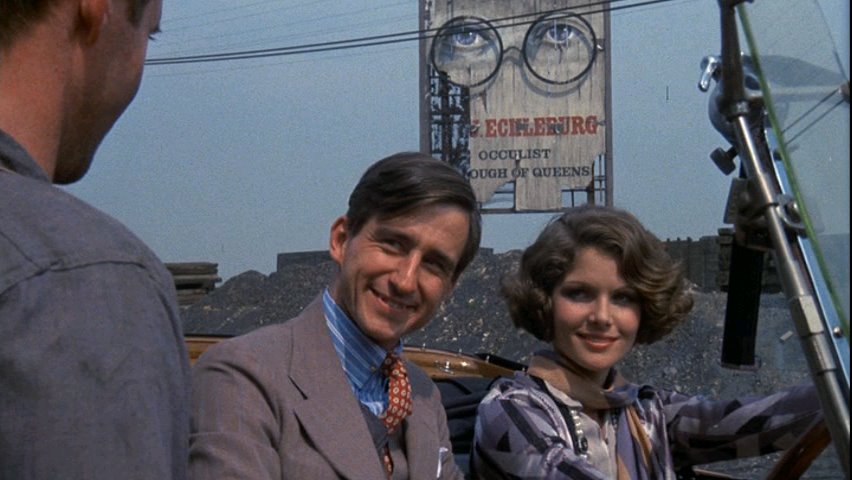 But above the gray land and the spasms of bleak dust which drift endlessly over it, you perceive, after a moment, the eyes of Doctor T. J. Eckleburg. The eyes of Doctor T. J. Eckleburg are blue and gigantic—their irises are one yard high. They look out of no face, but, instead, from a pair of enormous yellow spectacles which pass over a nonexistent nose.
I was disappointed by the introduction of Gatsby in the movie. The formal invitation to Nick to meet him in his office, while effective in showing some of the darker side of Gatsby (an armed butler, for example), misses the casual “I’m Gatsby” revelation during the party. It starts the relationship between Jay and Nick off on a different and awkward note from the book, and missed the tie-in of both characters being in the same place during the war.
The biggest offense to me, however, was the way Mia Farrow played Daisy (I’m assuming under Clayton’s direction). Daisy in the film is almost like a caricature of Daisy in the novel. Shrill, flighty, and overly shallow, it begs the question of why Gatsby (and Tom, and anyone else) would ever see in her. Much less focus your energies on obtaining her. You realize in the book after a while that she doesn’t deserve the idolatry Gatsby has given her, but the movie Daisy is grating from the first scene. I would have loved to seen Faye Dunaway in this difficult role and not have Daisy played so shrill. Ultimately that was the part of the movie that disappointed me the most, since it undermined much of the motivation of the characters.
Overall, I still recommend the movie, especially for the visual and musical beauty. While probably not doing full justice to the book, it is still rewarding. I’d love to hear how others feel about the movie, or if they have seen other versions of The Great Gatsby.
 They went up-stairs to get ready while we three men stood there shuffling the hot pebbles with our feet.
Thursday, September 14, 2006
The Great Gatsby—overall impression
I wanted to have a thread on what other’s think about The Great Gatsby because I feel I’m probably in the minority. I enjoyed the language of the book—deceptively simple but rich all the same. But there was something that kept nagging at me, keeping me from fully enjoying it. I’ll try and condense my overall thoughts to a manageable-size post, but I’m sure I’ll fail at keeping it short while at the same time conveying my thoughts successfully. But here goes anyway…
I thought the invention of Nick as the narrator was brilliant. Having someone that is at first a detached observer but who quickly becomes an active participant in the story works extremely well. Nick is far from an omniscient narrator, but the later chapters sometimes include a swing from Nick the immature participant to (after a couple of years) Nick as a more mature actor and the change in language at that point stand out.
Symbolism is everywhere in the book and at times it felt heavy-handed, but there are some places I found it enjoyable. I wonder if Fitzgerald had anything in particular in mind with the billboard of Dr. T. J. Eckleburg. Some people take it as a symbol for God, but I lean toward a constant reminder of the moral blindness demonstrated throughout the book. And he could be other things as well…which shows how ambiguous some of the symbolism is in the book.
Where Fitzgerald really started to lose me was toward the end of the book as he pushes the story as a morality tale of the American Dream. Several aspects of this just didn’t ‘feel’ right to me.
• The first was the stress between the East (glitzy, shallow, amoral, hedonistic) and the West (grounded, moral). While showing the corruption of someone like Nick or Gatsby, that fails to explain Tom and Daisy. They were like they were before they reached New York, having to hightail it out of Chicago for some unspecified reason. There is more to the East/West split in the book than just that, and even the additional intention doesn’t ‘feel’ right. It’s almost like Fitzgerald wanted to portray the West as the closest thing to the American Dream still existing, with the materialistic East was a corruption of the Dream. To which I think California…gold rush…1849…. And other western events in its very founding that don’t seem to fit that message very well. To which you could say the same things about the east, although Nick's visualizing of the discoverers being overwhelmed by the new land ties a nice bow around the dream vs. reality theme.
• There is a strong generational struggle portrayed, with the younger set personifying the amorality and hedonism. Yet there are strong exceptions to that as well—Wolfshiem and Dan Cody were clearly immoral, as well as materially successful. The timing of having read Nathaniel Philbrick’s book Mayflower couldn’t have come at a more relevant time on this topic, serving as a reminder that the “American Dream” (although that’s not what they called it at the time) was going to hell started with the Pilgrims first generation.
• There is little middle ground in the book. There is an exquisite scene when Nick imagines Gatsby’s thoughts as his dream slips away from him. As he speculates on Jay’s feelings, Nick goes from the “old warm world” to such imagery as “frightening leaves,” grotesque roses, ghosts. A powerful passage, but the possibilities (as Nick imagines Gatsby’s world) can only either be an ethereal world, where dreams are still alive, or an ashen nightmare. Fitzgerald would probably argue that is because Gatsby’s dream itself is a corruption, but given Nick’s talk after this passage it strongly felt like a projection of his own disillusionment and lack of success. Which is why Nick could identify with him strongly after Gatsby’s death.
Again, the language is masterful, and I enjoyed reading it. There were no words not needed—you pulled one word or passage out and the book wouldn’t be as well written. And as I mentioned in the previous post, his use of time throughout the book was one of my favorite pieces—the exploration into the significance of the past in the present. The human ability to transform and achieve goals still does not free us from the past. Or as part of the concept was inelegantly put in the movie Magnolia, “we may be through with the past, but the past ain’t through with us.”
There is so much more that I haven't mentioned. Feel free to add your thoughts on the book. I’m a numbers guy, so I may be way off the mark on things like this. But I always enjoy hearing how others feel about books, so add a comment!
I thought the invention of Nick as the narrator was brilliant. Having someone that is at first a detached observer but who quickly becomes an active participant in the story works extremely well. Nick is far from an omniscient narrator, but the later chapters sometimes include a swing from Nick the immature participant to (after a couple of years) Nick as a more mature actor and the change in language at that point stand out.
Symbolism is everywhere in the book and at times it felt heavy-handed, but there are some places I found it enjoyable. I wonder if Fitzgerald had anything in particular in mind with the billboard of Dr. T. J. Eckleburg. Some people take it as a symbol for God, but I lean toward a constant reminder of the moral blindness demonstrated throughout the book. And he could be other things as well…which shows how ambiguous some of the symbolism is in the book.
Where Fitzgerald really started to lose me was toward the end of the book as he pushes the story as a morality tale of the American Dream. Several aspects of this just didn’t ‘feel’ right to me.
• The first was the stress between the East (glitzy, shallow, amoral, hedonistic) and the West (grounded, moral). While showing the corruption of someone like Nick or Gatsby, that fails to explain Tom and Daisy. They were like they were before they reached New York, having to hightail it out of Chicago for some unspecified reason. There is more to the East/West split in the book than just that, and even the additional intention doesn’t ‘feel’ right. It’s almost like Fitzgerald wanted to portray the West as the closest thing to the American Dream still existing, with the materialistic East was a corruption of the Dream. To which I think California…gold rush…1849…. And other western events in its very founding that don’t seem to fit that message very well. To which you could say the same things about the east, although Nick's visualizing of the discoverers being overwhelmed by the new land ties a nice bow around the dream vs. reality theme.
• There is a strong generational struggle portrayed, with the younger set personifying the amorality and hedonism. Yet there are strong exceptions to that as well—Wolfshiem and Dan Cody were clearly immoral, as well as materially successful. The timing of having read Nathaniel Philbrick’s book Mayflower couldn’t have come at a more relevant time on this topic, serving as a reminder that the “American Dream” (although that’s not what they called it at the time) was going to hell started with the Pilgrims first generation.
• There is little middle ground in the book. There is an exquisite scene when Nick imagines Gatsby’s thoughts as his dream slips away from him. As he speculates on Jay’s feelings, Nick goes from the “old warm world” to such imagery as “frightening leaves,” grotesque roses, ghosts. A powerful passage, but the possibilities (as Nick imagines Gatsby’s world) can only either be an ethereal world, where dreams are still alive, or an ashen nightmare. Fitzgerald would probably argue that is because Gatsby’s dream itself is a corruption, but given Nick’s talk after this passage it strongly felt like a projection of his own disillusionment and lack of success. Which is why Nick could identify with him strongly after Gatsby’s death.
Again, the language is masterful, and I enjoyed reading it. There were no words not needed—you pulled one word or passage out and the book wouldn’t be as well written. And as I mentioned in the previous post, his use of time throughout the book was one of my favorite pieces—the exploration into the significance of the past in the present. The human ability to transform and achieve goals still does not free us from the past. Or as part of the concept was inelegantly put in the movie Magnolia, “we may be through with the past, but the past ain’t through with us.”
There is so much more that I haven't mentioned. Feel free to add your thoughts on the book. I’m a numbers guy, so I may be way off the mark on things like this. But I always enjoy hearing how others feel about books, so add a comment!
Tuesday, September 12, 2006
The Great Gatsby discussion: Chapters 7 - 9
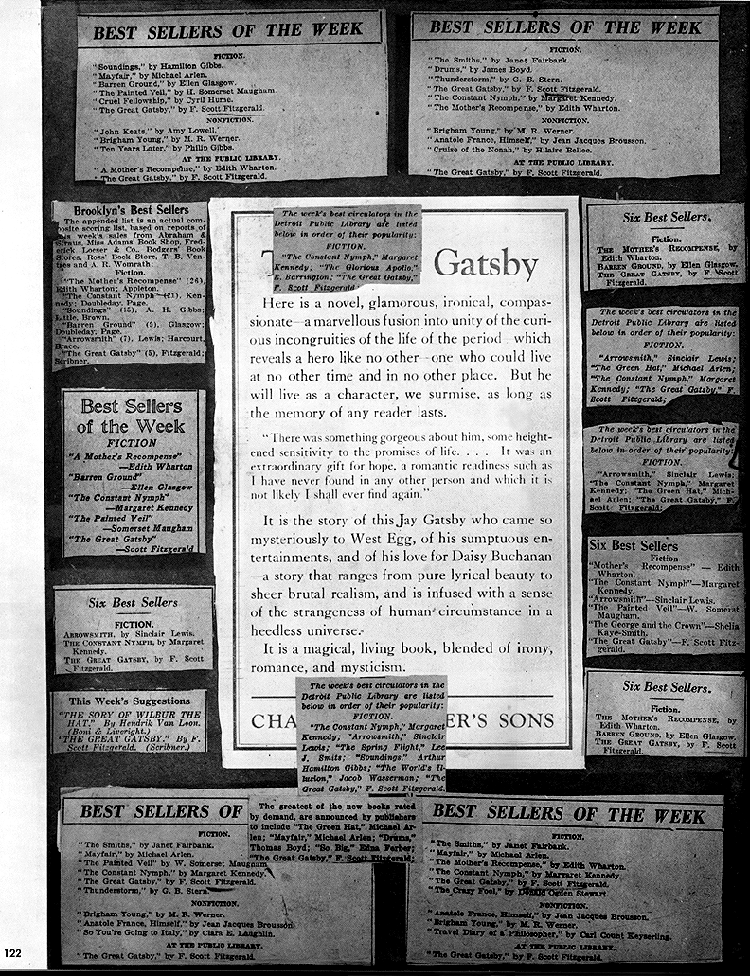
This post is to cover the last three chapters of The Great Gatsby. I’ll start another thread by Friday to post your thoughts on the book as a whole.
We arrive at the culmination of the book with infidelities uncovered and murders committed. The author ties it all together as his commentary on the state of the American dream, and exploring the role of the past on our futures.
Use the comments for your thoughts on this section of the book.
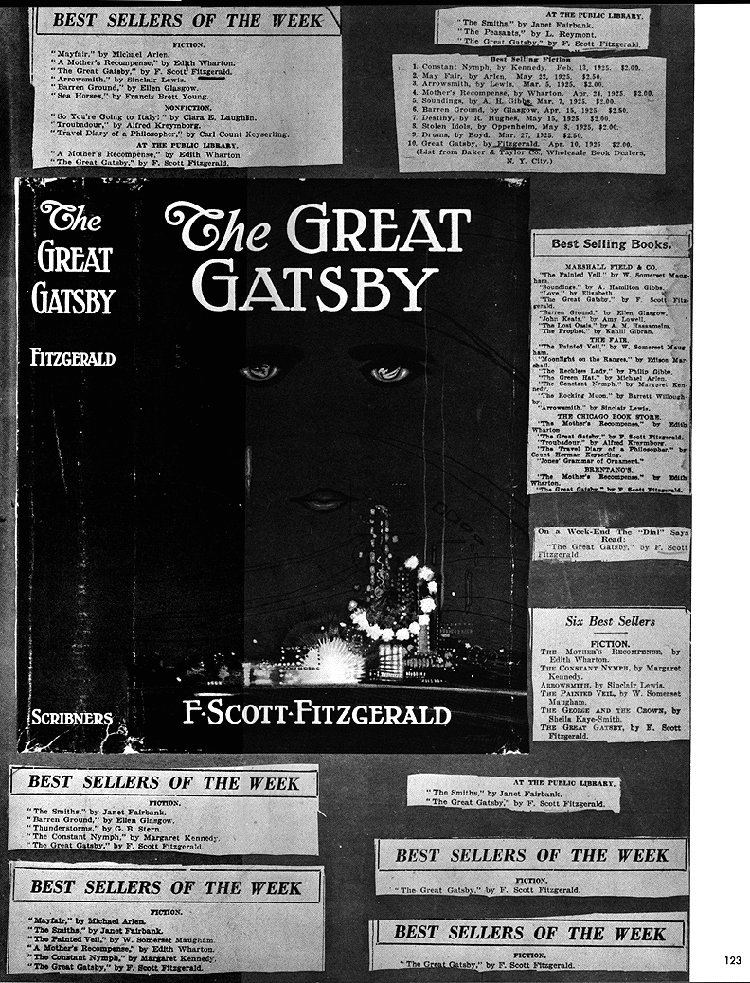
Pictures from the Fitzgerald's scrapbooks, available at the F. Scott Fitzgerald Centenary site
Friday, September 08, 2006
Will the real Jay Gatsby please stand up?
An excellent article titled Professor, private investigator team up in search of the real 'Great Gatsby', which gives a look at the man purportedly behind Fitzgerald's title character. Some detail is given on Max von Gerlach, who Zelda Fitzgerald said was the inspiration for Jay Gatsby.
However this excerpt highlights the uncertainty of that claim:
However this excerpt highlights the uncertainty of that claim:
"Jay Gatsby is not a biographical figure," Bruccoli says. "Fitzgerald … created a character from a variety of sources."
However, Bruccoli says, Gerlach was one of the figures who helped shape the Gatsby composite. Gatsby's character — giving all for the love of a woman — was pure Fitzgerald. "All of Fitzgerald's heroes turn into Fitzgerald before the novel is over," Bruccoli says. But other traits — his mysterious past, his wealth — supposedly were based on Gerlach.
Wednesday, September 06, 2006
The Great Gatsby discussion: Chapters 4 – 6
In the middle third of the book, we hear Gatsby’s story of himself, meet Meyer Wolfshiem, find out some back-story on Jay and Daisy from Jordan, witness Jay and Daisy’s reunion, tour Gatsby’s house, find out more facts about Gatsby, and attend a disappointing party at his house.
As Fitzgerald said in a different story, "Let me tell you about the very rich. They are different from you and me.”
There is much here to comment on, so add your thoughts!
As Fitzgerald said in a different story, "Let me tell you about the very rich. They are different from you and me.”
There is much here to comment on, so add your thoughts!
Thursday, August 31, 2006
Shades of the Jazz Age
A good article at the International Herald Tribune site that ties in the history of Long Island and Fitzgerald.
More on some of these characters later, but an interesting background on the area and the times. However, keep in mind that "You can never quite make Fitzgerald's fiction match up to reality," West, the Penn State professor and a conference speaker, said. "And you shouldn't try."
In "Gatsby," Fitzgerald's narrator and stand-in, Nick Carraway, says, "It was a matter of chance that I should have rented a house in one of the strangest communities in North America." But West Egg was a natural home for the Fitzgeralds. Unlike blue-blooded Sands Point, the model for East Egg in the novel, Great Neck was where the prosperous but unpedigreed could find a welcome and a comfortable life.
Zelda Fitzgerald liked to call their home their "nifty little Babbitt house," a nod to the 1920 Sinclair Lewis novel of small-town life.
Broadway stars such as Groucho Marx, Basil Rathbone and George M. Cohan lived in Great Neck in the 1920s; so did P.G. Wodehouse and Ring Lardner, whose house overlooking Manhasset Bay was a frequent haunt for Fitzgerald.
And the peninsula was home to colorful characters like the bootlegger Max Gerlach and the stockbroker Robert Kerr, who have been suggested as possible models for some of Jay Gatsby's character traits.
More on some of these characters later, but an interesting background on the area and the times. However, keep in mind that "You can never quite make Fitzgerald's fiction match up to reality," West, the Penn State professor and a conference speaker, said. "And you shouldn't try."
Wednesday, August 30, 2006
The Great Gatsby discussion: Chapters 1 – 3
What do you say about The Great Gatsby that hasn’t been said a thousand times already? Still, here I am posting on the book. I had never read the book, so I’m coming to it fresh instead of having a teacher tell me what I’m supposed to see in it. I’m interested to see if that makes a difference in how I react to it.
So in the first three chapters we meet:
Nick Carraway: “In consequence, I’m inclined to reserve all judgments, a habit that has opened up many curious natures to me and also made me the victim of not a few veteran bores.”
Tom Buchanan: “Now, don’t think my opinion on these matters is final,” he seemed to say, “just because I’m stronger and more of a man than you are.”
Daisy Buchanan: “Well, I’ve had a very bad time, Nick, and I’m pretty cynical about everything.”
Jordan Baker: “No, thanks,” said Miss Baker to the four cocktails just in from the pantry, “I’m absolutely in training.”
George & Myrtle Wilson
The sign of Doctor T. J. Eckleburg’s (OK, really just a symbol and not a character)
And finally, after much anticipation, Jay Gatsby
We are also introduced to the four main geographical locations, each fraught with symbolism: East Egg, West Egg, the Valley of Ashes, and New York City.
There is a lot going on, and once again I don’t expect anyone to cover everything, but let us know your thoughts on the first three chapters in the comments!
So in the first three chapters we meet:
Nick Carraway: “In consequence, I’m inclined to reserve all judgments, a habit that has opened up many curious natures to me and also made me the victim of not a few veteran bores.”
Tom Buchanan: “Now, don’t think my opinion on these matters is final,” he seemed to say, “just because I’m stronger and more of a man than you are.”
Daisy Buchanan: “Well, I’ve had a very bad time, Nick, and I’m pretty cynical about everything.”
Jordan Baker: “No, thanks,” said Miss Baker to the four cocktails just in from the pantry, “I’m absolutely in training.”
George & Myrtle Wilson
The sign of Doctor T. J. Eckleburg’s (OK, really just a symbol and not a character)
And finally, after much anticipation, Jay Gatsby
We are also introduced to the four main geographical locations, each fraught with symbolism: East Egg, West Egg, the Valley of Ashes, and New York City.
There is a lot going on, and once again I don’t expect anyone to cover everything, but let us know your thoughts on the first three chapters in the comments!
Friday, August 25, 2006
The Great Gatsby resources
Since I've been traveling I haven't had much of a chance to research resources for The Great Gatsby. At first glance, there is a lot available, but I'm not sure how good many of them are. I'll pass along a few I've had a chance to visit. Please add anything you found and liked in the comments and I'll include them as well.
Wikipedia's entry for The Great Gatsby, which has many more links and resources listed. I'm not providing the link to the text here since it appears the book is still in copyright.
From The Literature Network
A school project website, with background and many links as well
From Homework Online
The University of South Carolina's Fitzgerald Centenary site
Hudson Gevaert's "The Great Gatsby: A Beginner's Guide"
From Barry, some additional resources I missed:
The F. Scott Fitzgerald Society
Since the novel's time sequence takes place during the early 1920's, a review of Prohibition is salutary: Wikipedia entry on Prohibition
Wikipedia's entry for The Great Gatsby, which has many more links and resources listed. I'm not providing the link to the text here since it appears the book is still in copyright.
From The Literature Network
A school project website, with background and many links as well
From Homework Online
The University of South Carolina's Fitzgerald Centenary site
Hudson Gevaert's "The Great Gatsby: A Beginner's Guide"
From Barry, some additional resources I missed:
The F. Scott Fitzgerald Society
Since the novel's time sequence takes place during the early 1920's, a review of Prohibition is salutary: Wikipedia entry on Prohibition
Friday, August 18, 2006
Next book: The Great Gatsby
Join us in reading The Great Gatsby by F. Scott Fitzgerald. The copy I have is around 180 pages, so I'll divide it up into sections of about 60 pages for each week. I'll go with the tentative schedule below for now and see if it needs revision.
August 30: Chapters 1 - 3
September 6: Chapters 4 - 6
September 13: Chapters 7 – 9
September 20: Book vs. movie, anything else
Feel free to add anything else you'd like to see covered regarding the book!
August 30: Chapters 1 - 3
September 6: Chapters 4 - 6
September 13: Chapters 7 – 9
September 20: Book vs. movie, anything else
Feel free to add anything else you'd like to see covered regarding the book!
Subscribe to:
Posts (Atom)