Showing posts with label Boleslaw Prus. Show all posts

Tuesday, July 16, 2013

Faraon / Pharaoh (Film: Poland, 1966)

I’m going to post about a film before posting about the book for a change. Not that it matters…I’m not sure if it is harder to find the novel in the decent English translation or this film with English subtitles, but then I seem to excel in posting about things no one will ever read or see. And, as I normally recommend in these cases (for both the novel and the movie) I think they are well worth seeking out for reading/viewing.

IMDb.com page

Director Jerzy Kawalerowicz had his work cut out for him in adapting this novel to the screen—how to adapt what will look like a ‘sword and sandal’ epic but turns out to be a study in politics? Bolesław Prus’ novel looks at the dynamics of politics in Egypt during the eleventh century BCE using fictional rulers and characters. By looking at this fictional case, though, Prus was studying the dynamics in struggles for power of a state. The focus is on an Egypt in decline, bowing to local powers (militarily and/or financially) and those in power of the state. The priestly caste was responsible for Egypt having developed into a great power, but those days were past. Were the priests also responsible for its decline?

A long opening scene captures one aspect to that question: the Egyptian army is on the march but stopped in its tracks by two scarab beetles crossing the road. Instead of continuing on the road where sacred animals have crossed, the army is instructed by the accompanying priests to take a detour. This diversion causes the army to fill in a canal that a lone slave has worked on for a decade in order to free himself and his family from bondage. It turns out the army is on a drill, testing the prince Ramses XIII to see if he is ready to assume responsibility for the army. Ramses makes it clear he has little respect for the current generation of priests, complaining that the state treasury is empty while religious coffers overflow. Even more embarrassing to him is the fact that the best soldiers are mercenaries from other countries (especially Libya). He compares the state of Egypt and its forces to that of his great-grandfather, finding the current day lacking in every way. In every way other than priestly avarice, that is, which he declares to be the reason for Egypt’s decline. There are several haunting images in the opening scenes: the worker hanging from the intended canal waterworks, a sacrificial horse punctured with spears, and Ramses’ domination of a woman watching the procession go by.

Ramses complains to his father (the Pharaoh) about the priests being in charge of the country. His father declares he is really in control since he acts through Osiris. Ramses disagrees, pointing out that he believes the priests act on their own behalf instead of for the Pharaoh or Egypt. Three additional elements for influencing state power are introduced at this point. The first element beings with the character of Sarah, Ramses’ Jewish mistress. Love interests become powerful tools. The second element lies in the need for money—the moneylenders influence behavior directly and indirectly. The third element could be categorized as either a generational tension or a power struggle: those in power (the older generation and the priests) develop the young (or others) to assume power but grudgingly cede control. One example shows Ramses’ father declaring he will crush his son if he doesn’t agree to the upcoming (and already decided) negotiations.

The movie shows a developed Ramses, at least as far as his moral consciousness. His concern for the people is real, as is his desire to make their life easier at the expense of not filling religious coffers. He still falls prey to the love interest angle, though. He has a son with Sarah but rejects her and his son when he finds it is predetermined that she will be sent home so his son will be a leader of the Jews. The priests use Kama, a Phoenician priestess, to successfully influence Ramses as they wish.

The moneylending angle is a little more difficult to follow in the movie but still important. Egypt and individuals borrow from several sources, the most common source being Phoenician merchants. In the world of realpolitik this gives them more influence on the Egyptians than the Assyrians would like to see. Assyria has amassed an army three times the size of the Egyptian forces and has been withholding its tribute to the Pharaoh’s coffers. Where the priests and Pharaoh see a need for a treaty with Assyria, which little benefits Egypt other than providing a subservient peace, Ramses sees an insult. His struggle for power within Egypt against his father and the priests as well as his intentions against the Assyrians for regional supremacy provides the core of the story, which Kawalerowicz captures very well. The other area that receives emphasis is the differences between the classes. The rulers have an orgy while the dismissed Libyan mercenaries burn and pillage. The workers toil seven days a week in order to provide the elites with their luxuries.


Ramses XIII with his priests/advisers
Picture source
Pentuer (a priest): “Cheop’s tomb claimed half a million lives and how many tears, how much blood and pain?”

Ramses: “What matters is not whether the pyramids were necessary, but that obedience to Pharaoh’s will. Yes, Pentuer, the pyramid is not Cheop’s tomb, it is Cheop’s will.”

Pentuer: “Would you also like to prove your power this way, my Lord?”

Ramses: “How come you, a priest, are well disposed to me?”

Pentuer: “The gods warned me that you, if such is your will, could extricate the Egyptian people from poverty.”

Ramses: “What do you care about the people?”

Pentuer: “I originated from the people. My father and my brother would draw water from the Nile and would be cudgeled.”

Ramses: “How can I help the people?”

Pentuer: “The people work too hard. They pay too many taxes. They suffer poverty and persecution.”

Ramses: “Peasants, always peasants. For you, priest, only someone eaten by lice deserves pity. Why don’t you count the Pharaohs who were dying in pain, who were murdered? But you don’t remember them. Death is no more generous with me than with your peasant.”

Pentuer: (hearing the people chant prayers) “Why are they praying at this time?”

Ramses: “You’d better tell me why they are praying at all when nobody can hear them.”

The power struggle between Ramses and the priests brings many of these themes together. Ramses wants to supplant the priests, ruling on his own without their influence. He seeks to wage war with Assyria in order to become the regional power Egypt used to be (in this the machinations of Phoenician moneylenders help and manipulate him). Ramses also wants to improve the lot of the commoners. In order to accomplish these goals Ramses has won over the army with his leadership style. He also deals with the Phoenicians in order to finance some of these goals, but he seeks control of the vast treasury held deep in a labyrinth (to which the priests control access). Ramses fails for several reasons, mostly because of the strength of the priestly class but also from his personal failings. The religion of the people play a crucial role, too, while Ramses is ignorant of celestial events the priests knew were going to happen. Interestingly enough, Jerzy Zelnik plays both Ramses and the Greek sent by the priests to assassinate him, highlighting a duality or split within the young Pharaoh that has been emphasized at other times. My only real complaint with the movie would be that it ends with the death of Ramses and doesn’t show the novel’s ending, which has the successor Herhor (a priest) carry out many of the reforms Ramses started. The movie clocks in at three hours as it is, so I guess Ramses’ death and failure provides a good stopping point. The movie contains much of the same pessimism as the novel, although without the eventual reforms the message seems even more bleak.

There are several long shots in the movie, taking up plenty of time to establish what seems like narrow points. I found them effective, though, and well done. The English subtitles were poor, often with many misspellings. I watched the VHS tape copyrighted 1998 by Polart.com (I believe this is now Polart Video), which I’ve cut some slack in the past for its poor subtitles because they are the only source with English translations for many Polish films I’ve watched, usually based on Polish novels. This was a particularly poor job, though. Looking for stills of the movie I was surprised to see how much richer the colors were in the photos versus the washed out feel of the print I watched. This movie (and the novel it’s based on) deserves a much wider audience in translation with an improved print and translation.
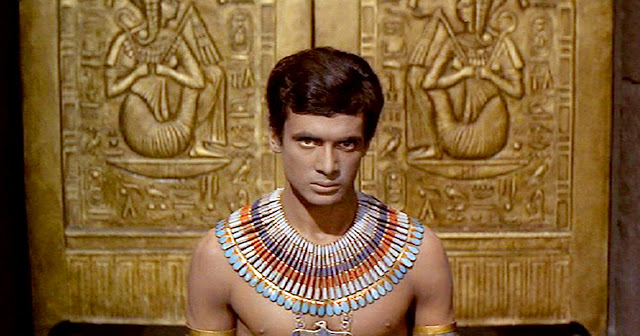

Jerzy Zelnik as Ramses XIII
Picture source

Wednesday, December 26, 2012

The Doll by Bolesław Prus: List of characters

I mentioned in an earlier post that I have a list of most of the characters by Bolesław Prus' The Doll. I enjoyed the novel quite a bit and hope that others will take the plunge on reading it. Toward that end I'm posting my list of character names. As you can see there are a lot of them, many are only in the story for a page or two, others resurface at various points along the way. Hopefully this "roster" will help the reader keep the names and characters straight.

The list of characters is roughly in their order of their first appearance or mention in the novel. I don't claim completeness and realize there may be some inaccuracies. If I wasn't completely sure in my description I added a question mark. If in your reading of the novel you find an error or think my description could be improved, please send me an email or leave a comment and I'll update the list.

(My summary post on The Doll.)

Wednesday, May 30, 2012

The Doll (movie), Poland: 1968

Mariusz Dmochowski as Stanisław Wokulski

Continuing with my sort-of-biweekly foreign movie posts for this year...

For more foreign movies, check out Caroline's World Cinema Series 2012 and Richard's monthly Foreign Film Festival round-up.

I am always interested in watching movie adaptations of books I’ve read and enjoy passing along the ones I watch. In the case of The Doll, I realize the English translation edition is not easy to find (WorldCat shows 15 libraries have it available in VHS format) but this movie, directed by Wojciech Jerzy Has, is definitely worth a mention. Since the plot can be found elsewhere I'm going to take a quick look at how the movie compares to the novel by Bolesław Prus.

So how do you condense an almost 700 page novel into 2 ½ hours? Obviously by cutting a lot. Major characters (Helena Stawska and the students) and storylines (the trial that leads to the title of the book or Wokulski’s visits to Mrs. Stawska) are notably absent. Several characters are shown but are given no introduction or explanation of their relationship to Wokulski, such as Szuman and Suzin. Ochocki, representative of the younger generation, has limited appearances in the film. Significant events, like Wokulski’s trip to Paris, are only mentioned and their absence creates a jarring effect. Even with those omissions and slights, the movie remains fairly faithful to the novel and I was surprised at how much was included.

The biggest disadvantage the movie has to overcome is the lack of the inner world of the characters that Prus takes time to explore, such as entries from Rzecki’s journal or Wokulski's and Izabela's monologues. Wokulski's character provides an interesting challenge on how to portray him. In the novel there are several factors that cause his downfall, the most important being the combination of his romanticism and idealism. Wokulski’s bitterness at not being accepted in the upper classes (causing him to question his own ability) and Izabela’s inability to fully commit to him also play roles in his tragedy in the novel. These last two causes are what Has stresses in the movie and Mariusz Dmochowski does a fantastic job portraying the resulting tensions. There are other nice touches that remind me of the novel, such as Has repeatedly showing Wokulski’s hands, covered and uncovered, a symbol of his lowly station as well as reminders of his exile (they were frostbitten while he was in Siberia). In addition, Beata Tyszkiewicz plays Izabela perfectly. In the novel Izabela proves to be a little hollow at the center. Has and Tyszkiewicz use that to their advantage in the movie where many pages are compressed into brief scenes, giving the viewer the same feeling of her character's emptiness.

Has adds some nice touches that expand certain scenes, such as the gypsy band and feast after the duel between Wokulski and the Baron, making a bizarre scene even more peculiar. Wokulski’s farewell to Izabela at the train station is expanded, making it clear he understood her flirtations conducted in English and amplifies her shock. At times Has uses similar action in different scenes to add to the dramatic effect, such as the prostitute and Ochocki shadowing Wokulski at different times through a poor district of Warsaw.

The English subtitles (on the version distributed by Polart) leave a lot to be desired. The frequent misspellings were distracting. And did the country dweller have to have a Cockney accent in print? But that’s the only real complaint I have about the movie other than the occasional jerkiness due to time constraints. I don’t believe reading the novel is necessary but knowing something about the book will be helpful to fill in the blanks or place unintroduced characters. Given those qualifications, I highly recommend the movie.

The YouTube video below shows the opening of The Doll. While it doesn't have subtitles, I wanted to include it in this post because the first scene hints at Has' focus on poverty in Warsaw at the time of the movie (1878-9), a situation he highlights several times with good results. The second scene in the clip shows Ignacy Rzecki (in top hat, with goatee) meeting a young Stanisław Wokulski. Rzecki sees some of the inventions Wokulski had worked on as well as the prank the other clerks at Hopfer's grocery play on him, ridiculing him and his desire to go to the university.

Friday, May 18, 2012

The Doll by Bolesław Prus

By coincidence, tomorrow marks the centenary of the death of Bolesław Prus (real name Aleksander Głowacki). You’ll be hearing more about him from me since I thoroughly enjoyed The Doll and plan to read his later novel Pharaoh soon.

The Doll takes place over an eighteen-month period during 1878-9 and looks at Polish society, with most of the focus on the growing conflict between the upper classes and the emerging tradesmen. Two ideologies are contrasted in the novel—the older Romantic ideal and the newer Positivist outlook. From the New York Review Books’ page:
Prus’s work centers around the stories of three men from three different generations: Wokulski, the fatally flawed and hopelessly love-struck hero; Rzecki, the methodical and romantic old clerk; and Ochocki, a bright young scientist who hopes for universal progress in the midst of a darkening political climate. As the stories of the three men intertwine, Prus’s novel spins a web of encounters with an embattled aristocracy, the new men of finance, and the urban poor. Written with a quasi-prophetic sensibility, The Doll looks ahead to the social forces of imperialism, nationalism, and anti-Semitism that would soon hound the entire continent.

I think the last statement might be a little strong, but they did qualify it with “quasi”—Prus makes it clear that there are no easy solutions to the many problems raised in the novel. Furthermore, he recognizes that advancements, economic or social, come at a cost. As I noted in my first post, the book has its flaws, especially when Prus is a bit heavy-handed on his message, but I still highly recommend it.

I focused on only a few particular characters and a couple of issues in the posts listed below. I hope the excerpts provide a good sample of what you’ll find in the novel, at least as far as style, wit, and humor. I’ll note here that the New York Review Books has the introduction by Stanisław Barańczak to their edition of the book online—it provides a good background to the author and the novel.

Posts

Introduction
Prus intended The Doll "to present our Polish idealists against the background of society’s decay."

Miss Łęcka and her enchanted world

Stanisław Wokulski
“So we may well be witnesses of a tragedy"

Ignacy Rzecki
"I can’t leave Warsaw and the store even for a little while."

The younger generation
"You cads!"

The Polish question
"By wiping out everything that was good, we have produced an artificial selection and protected the worst."

Comments on the 1968 movie adaptation of The Doll directed by Wojciech Jerzy Has.

Update (26 Dec 2012): A list of characters in the novel.

Thursday, May 17, 2012

The Doll: the Polish question

There are many other topics included in The Doll that would make interesting posts, such as Prus’ view of women’s rights (or simply the relationship between men and women) and the Polish-Jewish conflict, but I’m going to end with excerpts that look at the author’s view on some of the problems of Poland. These quotes are only a few of the ways Prus painted the country as a provincial backwater with a stagnating aristocracy that drives out innovation and commerce. I have shown examples similar to these in earlier posts but I wanted to highlight a few more. There are many more examples in the book that I don’t discuss, ranging from the insanity in the upper classes (the relationship between the Baroness and her husband has to be read to be believed) to the inferiority of the cultural life (all of Warsaw gets hoodwinked by a second-rate violin player). Exceptions to this pessimistic view exist, such as the benevolent policies of the Duchess toward the people living on her land, but they stand out more because of their rarity. On to the excerpts…

Wokulski muses on a recurring theme about Poland’s fetid social environment, and also highlights some of the occasional heavy-handed touch Prus displays:
‘This is a microcosm of Poland,’ he thought, ‘where everything tends to make people wretched and to extinguish them. Some perish through poverty, others through extravagance. Work is taken from other people’s mouths to feed the useless; charity breeds insolent loafers, while poverty is unable to acquire tools and is besieged by perpetually hungry children, whose greatest virtue is to die a premature death. Individuals with initiate are of no use here, for everything conspires to chain initiative and waste it in a vain struggle—for nothing.’ (page 69)

A description of the Prince, demonstrating he would fit in well today with his emphasis on good intentions over results:

He [the Prince] believed it was a citizen’s duty to hold committee meetings, to encourage trade and to grieve, grieve continually over his unhappy country. Had he been asked whether he ever plated a tree to provide shade for people or the earth, or whether he ever removed a stone from a horse’s hoof, he would have been frankly astonished. For he felt, thought, yearned and grieved for millions. He had never done anything useful. He thought that continual fretting about the whole country was far more valuable than wiping the nose of a grubby child.
page 150)

Dr. Szuman harps on a recurring theme about scientific ability:

‘Upon my word, it would have been impossible to invent or even print logarithmic tables in Poland. Your true Pole starts to sweat at the second decimal place, at the fifth he runs a temperature, and at the seventh has a stroke….’
(page 191, ellipsis in original)

A subject Prus alludes to often but rarely confronts directly is the original source of money for the upper classes. The Polish aristocracy looks down on tradesmen, forgetting (or ignoring) their families’ unsavory acts of the past. While there are other quotes I could provide, this one sounds like a reference to the slave trade:

‘Bela, Wokulski has never sold what your aunt’s grandfather sold…’
(page 426, ellipsis in original)

Wokulski visits Paris and realizes how provincial Warsaw is in comparison. In Paris, “Even the most paltry [Paris shop] looked better than his, although it [his shop] was the finest in Warsaw.” (page 352) In such a setting Wokulski reevaluates his life during his trip to Paris:

Then it occurred to him to ask what he had squandered his powers and his life on? ‘On struggling with an environment into which I didn’t fit. When I wanted to study, I could not, because in my country scholars aren’t needed—only peasants and store clerks. When I wanted to serve society by sacrificing my own life if need be, fantastic dreams were put forward instead of practical programme and then—were forgotten. When I sought work, I was not given any, but shown an easy way to marry an old woman for her money. When I finally fell in love, and wanted to become the legal father of a family, the pastor of a domestic circle, the holiness of which everyone acclaimed, then I was placed in a situation from which there was no way out. So much so, that I don’t know whether the woman I was crazy about was an ordinary flirt whose head had been turned, or perhaps a lost soul like myself, who had not found her proper way. Judging by her behaviour, she is an eligible young lady looking for the best possible husband: when one looks into her eyes, she is an angelic spirit, whose wings have been clipped by human conventions. If I’d had some tens of thousands of roubles a year, and a passion for whist, I’d have been the happiest man in Warsaw,’ he said to himself, ‘but because in addition to a stomach I have a soul which is greedy for knowledge and love, I would have had to perish there. That is a region where certain kinds of plants cannot grow, nor certain kinds of people either…’ (page 369)

After his return from Paris, Wokulski gushes to Izabela about the achievements he saw there, praising the ingenuity and work he saw. Izabela, safely entrenched in her enchanted world, praises the Polish aristocracy for what they collected, condensing one of Wokulski’s frustrations throughout the novel in this collection/creation contrast (see pages 433-5 for their conversation).

I will end with an excerpt that directly touches on the Jewish question but could be applied to the results of Polish society in general. Rzecki voices his concern on potential trouble while Wokulski’s answer seems to implicate himself—his rise is based solely on money. As mentioned several times already, the ambiguity in the novel shows Prus' concerns that there are no easy answers to the problems he confronts:

‘There’s going to be trouble with the Jews,’ I muttered.

‘There already has been a great deal, it’s gone on for over eighteen centuries, and what’s the outcome? Very noble individuals have perished in anti-Jewish persecutions, and the only ones to survive were those who could protect themselves from destruction. So now what sort of Jews do we have? Persistant, patient, sly, self-reliant, quick-witted, and commanding a mastery of the one weapon left to them—money. By wiping out everything that was good, we have produced an artificial selection and protected the worst.’
(page 511)

Wednesday, May 16, 2012

The Doll: You cads!

The introductory post on The Doll mentions that Prus wished he had titled the book Three Generations. I’ve provided excerpts for the older generation (full-blown Romaticism represented by Ignacy Rzecki) and the middle one (Romanticism mixed with idealism, embodied by Stanisław Wokulski). The younger generation does not have quite the central role as the older two but the mixed nature of their character adds to Prus' pessimistic view of Poland.

The character of the younger generation that has the most promise is Julian Ochocki, a scientist and inventor. His introduction to Wokulski starts off on the wrong foot, though, as Ochocki insults him by asking when the older gentleman’s interest in women weakened. Even though Ochocki isn’t seen doing much in the novel he has already accomplished notable achievements and makes it clear his work is his primary interest. To further that goal he leaves Poland—does Prus consider leaving the country necessary for further development? I think that is part of his message and no small part of the pessimism underlying the novel. With people like Ochocki and Wokulski abandoning Poland what will become of the country?

Miss Łęcka falls in the age-range for the younger group as well, although whether or not Prus meant to include her as part of the three-generation comparison isn’t clear. Her self-absorption, characteristic of many of the younger characters, seems intended more as an indictment of the aristocratic class and their enchanted lives. There are several young clerks in Wokulski’s store who provide examples of the younger generation and Prus paints one clerk’s flirtation with socialist politics sympathetically. His final judgment is less than clear, though, since few of the clerks show the same drive or integrity as Rzecki or Wokulski.

There are several students in the novel and their inclusion, mostly as a source of humor, reflects a negative view by Prus on the younger generation. Also spouting socialist slogans, the students seem interested mostly in pranks and sex (although one reply could be “And your point is…?). Here’s the introduction to the students (on the third floor of an apartment building), which left me wondering “Did I really just read that?”:
He [Wokulski] went into the yard and looked around. Almost all the windows were open. In the rear block, on the ground floor, was a laundry describing itself as ‘Parisian’, on the third floor could be heard the beating of a shoemaker’s hammer, and below, on a parapet, a couple of pigeons were cooing, while on the second floor of the same block the monotonous sounds of a pianoforte and a shrill soprano singing scales could be heard: ‘Do re me fa…’

High above, on the third floor, Wokulski heard a strong masculine bass voice, which said: ‘There, she’s been taking cascara [a laxative] again…The tape-worm’s coming out…Marysia, come up here!’

At the same time, the head of a woman looked out of a second-floor window, shouting: ‘Marysia, come back at once…Marysia!’

‘That must be Mme Krzeszowska [the Baroness],’ Wokulski thought. Then he heard an unmistakable sound, and a stream of water poured down from the third floor, hitting the outstretched head of the Baroness and splashing all over the yard. ‘Marysia, come up here!’ the bass voice shouted.

‘You cads!’ Baroness Krzeszowska cried, looking upwards. Another stream of water shot out of the third-floor window and cut off her words in midstream.
(page 173, ellipsis in original)

Their antics don’t get any better from there but they do provide many more humorous moments.

There is an interesting parallel, or rather a continuation, of the idealistic principles between Wokulski and Ochocki. Several times the aristocracy scolds Wokulski for importing cheaper goods from Moscow since it hurts local businessmen and craftsmen. Wokulski dismisses those claims, replying that more people can afford the goods he sells (as well as pointing out the local craftsmen have to wait a year or more for their money because of the bankrupt or miserly upper class). In other words, he provides benefits that outweigh the damage done. Ochocki makes a similar argument at the end of the novel, although his focus was not on economics but on social progress and it seems to be a natural extension of Wokulski’s argument. The subject is the funding of a technological workshop by the Baron, using the proceeds of his divorce (his wife was unfaithful):

Wokulski: ‘That the technological workshop will grow from the sufferings, the ruins of human happiness. And you don’t even ask yourself the question as to how the Baron passed from love for his wife to a workshop.’

‘What’s that to me?’ cried Ochocki, shrugging. ‘The purchase of social progress at the cost of the sufferings of individuals, however terrible—is well worth it.’
(page 626)

I would venture to highlight this point, one I haven't seen stressed in any summary of The Doll. Prus is acutely attuned to the cost as well as the benefit of societal and economic improvement, whether in looking at individuals or classes in the winners or losers of the cost/benefit divide. The author clearly longs for an improved Poland, but he is also aware there is a cost associated with such an improvement. I think a lot of the ambiguity in the novel lies in this point. Things have to improve, but what is the best approach? Who bears the costs? It doesn't take much to cast Ochocki's ideals in a similar light to that of the socialist clerks and students...eggs, omelets, etc.

Rzecki, the old clerk, has the final word on the direction things are moving, which doesn’t rely on the overall qualities of the generations but is very pessimistic nonetheless:

And yet it is difficult to live in this world. Sometimes I ask myself whether there’s really any plan according to which all mankind is moving towards better things, or whether it isn’t all the work of chance, and whether mankind isn’t going in the direction in which a greater force is pushing? If good people are on top, the world moves towards better things, but if rascals are stronger, then it goes to the dogs. And the last limit of good and evil is a handful of dust. (page 654)


Note: all page numbers refer to the first edition of the Central European University Press version of Bolesław Prus' The Doll (Hungary, 1996).

Tuesday, May 15, 2012

The Doll: Mr. Rzecki is in charge of appraisals

Ignacy Rzecki, oldest of the main characters and intended to represent the older, Romantic generation easily became my favorite character of the novel. The excerpts from his journal provide the reader flashbacks to important events in his as well as showing some of Wokulski’s formative years. During the Hungarian revolution of 1848 Rzecki and friends joined a revolutionary army fighting the Austrian armies. As I’ve mentioned in an earlier post the chapter on the fighting in which he was involved is one of the best battle scenes I’ve read in literature. Rzecki constantly looks back on his younger days and the glory he earned from the fighting as well as his the loss of his Jewish friend Katz during that war.

Rzecki proves to be a comical figure or, maybe better said, provides comic relief. He is always the last person to find out about something, his assumptions or guesses about what will happen inevitably turns out wrong. This “gift” is something to keep in mind when trying to figure out what happens to Wokulski at the end of the novel—it’s a safe bet to choose the opposite of Rzecki’s opinion. Rzecki devotes his life to Wokulski and the shop, watching the younger man’s rise and admiring his talents. The other major figures in Rzecki’s life are the Bonapartes and when Napoleon III’s son, Prince Loulou, is reported dead fighting in Africa for English troops, Rzecki’s despondency is just as great as when Wokulski sells his shop. Rzecki ages quickly after these two losses and is the subject of a beautiful, moving final scene. The excerpts below are taken from chapters that quote Rzecki’s journal.

While lamenting Wokulski’s single status and how he should take a wife, he notes the interest many of the local citizens have in attracting his attention for just such a purpose (as well as providing an example of the tongue-in-cheek humor of the novel):
Dozens of such suitors pass through our store. Some mothers, aunts or fathers simply bring their eligible young ladies to us. The mother, aunt or father will buy something for a rouble, and meanwhile the young lady walks about the store, sits down, shows off her figure, puts forward her right foot, then her left, displays her hands…All with the aim of trapping Staś [Wokulski], who, more often than not, isn’t even in the store, or—if he is—doesn’t even look at the property, as much to say: “Mr. Rzecki is in charge of appraisals…”
(page 121, ellipses in original)

The following excerpt focuses on two types of relationships Rzecki mulls over often—with women and with Jews:

Only on one point do the old and the new gentlemen agree, and here Zięba is even a help—in teasing our seventh clerk, Szlangbaum. This Szlangbaum (I have known him for years) is of the Hebraic persuasion, but an honest fellow for all that. Small, dark, bent, unshaven—in a word, you would not give tuppence for him when he sits at the cash desk. But as soon as a customer comes in (Szlangbaum works in the department of Russian textiles), good gracious, how he twirls like a top! Now he is at the highest shelf on the right, now at the lowest of the left. When he begins hurling rolls of cloth about, he resembles a steam-engine rather than a man; when he begins unfolding and measuring, I think he has three pairs of hands. Also he is a born salesman, and when he starts recommending goods, making suggestions, guessing taste, all in an exceedingly grave tone, then I give my word that not even Mraczewski comes anywhere near him. It is too bad, though, that he is so small and plain; we shall have to get him a stupid but handsome young man as assistant with the ladies. For although it is true that ladies linger longer with a handsome clerk, yet they also complain and bargain less. (Heaven protect us from lady customers! Perhaps I lost my taste for marriage by seeing ladies in the shop all the time. The Creator, when he formed that miracle of Nature known as Woman, cannot have realized the misfortune He would bring down upon tradesmen.)

Thus, though Szlangbaum is a decent citizen in the fullest sense, yet no one likes him since he has the misfortune to be a Hebrew… In general, I have noticed over the last year or two that dislike of the Hebrews is increasing; even people who, a few years ago, called them Poles of the Mosaic persuasion, now call them Jews. And those who recently admired their hard work, their persistence and their talents, today only see their exploitation and deceit.

When I hear such things, I sometimes think a spiritual twilight is falling on mankind, like night. By day all is nice, cheerful and good; at night, all is dark and dangerous. I think this, but can say nothing; for what does the opinion of an old clerk matter in the face of well-known journalists who can prove that Jews use Christian blood on their matzos, and should have their rights restricted. The bullets overhead, Katz, whistled a different tune…
(pages 135 – 136, ellipsis in original)

For the final section I’ll pick some miscellaneous quotes from Chapter XXXV (still a part of Rzecki’s journal) since it highlights many common themes of novel:

Somehow, my health isn’t what it should be. I won’t say that anything ails me, but there it is…I can’t do much walking, I’ve no appetite, I don’t even feel very much like writing. Ini the store, I have hardly anything to do, for Szlangbaum rules there, and I remain only to deal with Staś’s affairs. By October Szlangbaum will have paid us off entirely. I shall not be poor, for honest Staś assured me fifteen hundred a year for life; but when a man thinks that soon he will not mean anything in the sotre, that he won’t have the rights to anything… Life isn’t worth living…If it weren’t for Staś and young Napoleon, this earth is sometimes so painful to me that I could do away with myself…Who knows, my old colleague Katz, that you didn’t act for the best? True, you have no hopes, but you don’t fear disappointments wither. I won’t say that I do, for after all, neither Wokulski nor Bonaparte…But, all the same…How tired I am; already it’s hard for me even to write. I’d gladly travel somewhere…Good God, for twenty years I haven’t been beyond the Warsaw toll-gates! And sometimes I have a great yearning to visit Hungary once more before I die…Perhaps I’d find the bones of my comrades on those former battlefields. Ah, Katz! Do you remember the smoke, the bullets, the signals? How green the grass was, and how the sun shone!
(pages 587-8, ellipsis in original)

I must be off…away! If only Klein [a young clerk] doesn’t get mixed up in some foolishness. It’s terrible how childish they [the younger generation]are; they’d like to rebuild the world, but at the same time they perform such silly antics.
(page 594, ellipsis in original)

Brr! So I left. I bought a ticket to Cracow, got into the train at the Warsaw-Vienna railroad station and then, after the third departure bell had rung, I jumped out again. I can’t leave Warsaw and the store even for a little while. I got my luggage back from the railroad on the next day, it had gone as far as Piltrków. If all my plans go like this, I must congratulate myself.
(page 596)

Note: all page numbers refer to the first edition of the Central European University Press version of Bolesław Prus' The Doll (Hungary, 1996).

Monday, May 14, 2012

The Doll: we may well be witnesses of a tragedy

There are few instances in world literature of a novel’s hero acquiring in the public eye all the characteristics of a live and tangible person, as did The Doll’s principle character, Stanisław Wokulski. Thus, between the two world wars, Prus’s admirers expressed their feelings by attaching a plaque to the wall of a Warsaw apartment house (which could be identified from an exact description in the novel), with the inscription: “Here lived Stanisław Wokulski, hero of The Doll by Bolesław Prus.”

(from The History of Polish Literature by Czesław Miłosz)


A self-made man, Stanisław Wokulski works his way up the social ladder by his enormous willpower and drive. He is never accepted at any level of society during his rise, though. One of the questions he and others keep asking center on his achievements and what they are for—how grand are his plans and what is the motivation behind them? The chief clerk in his store, Ignacy Rzecki, asks the same thing in his journal, expanding on the question:

Even so, today, almost every hour, I wonder the same thing about Staś Wokulski. He had a good living after his wife’s death, so why did he go to Bulgaria? He made a fortune there so he would wind up the shop; so why is he creating a new trading company? Why has he rented a huge apartment? Why has he bought a carriage and horses? Why is he striving to get into the aristocracy and avoiding tradesmen, who will never forgive him for it? And why has he concerned himself with the carter Wysocki and his brother, the railwayman? Why has he established workshops for several poor apprentices? Why is he taking care of that harlot, who, although she lives at the Magdalenes, is doing his good name so much harm?
(page 129, and a good summary of the first 120 pages of the novel)

A little later, Wokulski has his haberdashery shop blessed and during the celebratory, elaborate dinner following the rite Rzecki gets a partial answer. He turns to one of the other clerks and asks what all this is for. The other clerk answers “For?" he echoed, gazing blankly at me, "it’s for Miss Łęcka.” After the dinner, Rzechi wants more insight from the old friend Szuman. Rzechi asks him about Wokulski’s “peculiar change in his character.”

“I see none,” Szuman replied, “he always was a man of action who carried out whatever came into his head. He decided to go to the university, and went; he decided to make a fortune, and did so. If he has got some folly or other into his head, he will not hesitate to commit it. It’s his character.”

“But for all that,” I said, “I see many contradictions in his behavior…”

“That is hardly to be wondered at,” the doctor interrupted, “for two men are merged in him: a Romantic of the pre-1863 kind, and a positivist of the ‘70s. What onlookers find contradictory is perfectly consistent with Wokulski himself.”

“But has he not been involved in any new…incidents?” I asked.

“I know of none,” Szuman replied drily.

I fell silent and it was a moment before I began again: “What will become of him in the long run?”

Szuman raised his eyebrows and clasped his hands: “Nothing good,” he replied. “People like him either reconcile themselves to everything, or come up against a great obstacle and break their heads open on it. Hitherto things have gone well with him…but no man wins every time in his life.”

“What then?” I asked.

“So we may well be witnesses of a tragedy,” Szuman concluded. He drank a glass of tea, then went home.

I could not sleep that night. Such terrible predictions on what should have been a day of triumph… But the Lord knows more than Szuman and surely He will not let Staś go to waste…
(page 143, ellipsis in original)

And there you have one key to The Doll. But there’s more…so much more, even regarding Wokulski. He makes clear his disdain for the aristocracy yet he doesn’t feel comfortable in their midst. He’s infatuated with Izabela but feels he can’t get close to her which feeds his wretchedness. It is when he is unsure about what he needs to do that he flounders. The battle within him between logic and passion needs the drive of his enormous goals to keep him balanced. Wokulski, replying to Rzecki’s request to retreat from the trouble he has gotten into, explodes:

“I will not retreat!” he exclaimed, “a thirsty man does not draw back from a well. If I am to perish, let me at least perish drinking… In any case, what is it you all want from me? Since childhood I have lived like a caged bird—in service, in prison, even in that unhappy marriage I sold myself into. But today, when my wings are opening, you all begin to hoot after me, like domestic geese at a wild one which has taken flight… What is some stupid shop or partnership to me? I want to live, I want…”
(page 204, ellipsis in original)

One overarching source of conflict, internal and external, in The Doll is that expectations are out of alignment with reality. Wokulski feeds this conflict, both within himself and in society, on many levels. Somewhat related to this source of conflict is the bad feelings Wokulski brings about in other people—not through what he actually does but how others perceive and react to him.

As my initial post on The Doll highlights from Stanisław Barańczak’s introduction, Wokulski is part of the middle generation of the three shown by Prus, a blending of both the older “Romantic” views and an evolving idealist outlook. The old friend Szuman identifies some of the source of Wokulski’s Romaticism:

”And yet he,” Szuman went on, “in Hopfer’s cerllar [as a grocer’s clerk] and on the steppe [in exile], fed himself on the heroines of Romantic poetry and such-like chimeras, so that he sees a divinity in Miss Łęcka. He doesn’t merely love her, he adores her, he worships her, would gladly fall on his knees before her… A bitter awakening awaits him! For, although he’s a full-blooded Romantic, he isn’t going to imitate [Polish poet Adam] Mickiewicz who forgave the woman who mocked him, even yearned for her after the betrayal, bah! then made her immortal. A fine lesson for our young ladies; if you want fame, betray your most fervent admirers! We Poles are condemned to act as fools even in a matter as simple as love.”
(page 509, ellipsis in original)

Mickiewicz’s poetry plays an important role in The Doll, providing shorthand at times for what the characters are feeling. The longest quote from Mickiewicz captures Wokulski at his most Romantic:

And after many days or many years,
When I am summoned to abandon my tomb,
You will remember your sleeping friend
And journey down from heaven to revive him.

Once more will I be drawn to your white breast,
Once more will your dear arm encircle me;
I will awake—as from a moment’s sleep,
Kissing your cheeks, gazing into your eyes.
(page 569)

Note: all page numbers refer to the first edition of the Central European University Press version of Bolesław Prus' The Doll (Hungary, 1996).

Friday, May 11, 2012

The Doll: the enchanted world of Izabela

As I mentioned in the previous post on The Doll Izabela Łęcki, love of Stanisław Wokulski, seems to be more of a caricature than many more-rounded central characters Prus includes in the novel. The author still provides plenty of enjoyment during her appearances such as this extended quote, introducing her and providing some of her background. In addition to showing her as accustomed to the finer things in her insular life, it explains what it takes for “ordinary mortals” to penetrate such a world. Implied here is the decay and stagnation of the upper classes, made more explicit later in the book. This unreal world of the upper classes is a staple in many novels but I particularly liked Prus’ imaginative take on it:
From her cradle, Izabela had lived in a beautiful world that was not only superhuman but even supernatural. For she slept in feathers, dressed in silks and satins, sat on carved and polished ebony or rosewood, drank from crystal, ate from silver and porcelain as costly as gold.

The seasons of the year did not exist for her, only an everlasting spring full of soft light, living flowers and perfumes. The times of day did not exist for her either, since for whole months at a time she would go to bed at eight in the morning and dine at two at night. There was no difference in geographical location, since in Paris, Vienna, Rome, Berlin or London she would find the same people, the same manners, the same objects and even the same food—soups from Pacific seaweed, oysters from the North Sea, fist from the Atlantic or Mediterranean, animals from every country, fruits from all parts of the globe. For her, even the force of gravity did not exist, since her chairs were placed for her, plates were handed, she herself was driven in carriages through the streets, conducted inside, helped upstairs.

A veil shielded her from the wind, a carriage from the rain, furs from the cold, a parasol and gloves from the sun. And thus she lived from day to day, month to month, year to year, above other people and even above the laws of nature. Twice in her life she experienced a terrible storm, once in the Alps, later in the Mediterranean. The bravest shrank in terror, but Izabela smiled as she listed to the thunder of the battering waves and the shuddering of the boat, never even considering the danger. Nature was staging a splendid spectacle for her, with thunderbolts, waves and chaos, just as on another occasion it had shown her the moon over the Lake of Geneva, or had drawn aside clouds veiling the sun over a Rhine waterfall. For mechanics in the theatre did the same every day, and even nervous ladies were not alarmed.

This world of everlasting spring, where silks rustled, only sculptured trees grew and where clay was covered with artistic paintings—this world had its own population. Its proper inhabitants were wealthy aristocrats of both sexes. It also included wealthy women and married men who played hosts, matrons who watched over elegant manners and behavior, and elderly gentlemen who took their place at the top table, spoke kindly to young people, blessed them and played cards. There were also bishops, the likenesses of God in this world, high officials whose presence protected this world from disturbances and earthquakes, and finally there were children, little angels sent from Heaven so that their elders could arrange Kinderbale.

Amidst the permanent population of this enchanted world an ordinary mortal would sometimes appear, who had succeeded in reaching the heights of Olympus on the wings of fame. He might be an engineer who had linked two oceans or drilled through mountains, or a captain who had lost his entire company in a battle with savages and, although gravely wounded, had himself been spared by the love of a Negro princess. He might be a traveler who was said to have discovered a new part of the globe, had been shipwrecked on a desert island and even tasted human flesh.

There were also eminent painters and in particular there were inspired poets who wrote charming verses in the albums of the princesses, poets who might fall hopelessly in love and render the charms of their cruel goddess immortal, first in the newspapers then in slim volumes printed on vellum.

All these people, among whom there carefully moved a crowd of uniformed footmen, female companions, poor cousins and relatives seeking promotion—all these people were on a permanent holiday.

From midday they visited one another and returned visits, or drove to the shops. In the evenings, they amused themselves before, at and after dinner. Then they drove to a concert or the theatre, there to see another artificial world, in which heroes rarely ate or worked, but frequently talked to themselves, where the infidelity of a woman caused tremendous catastrophes and where a lover, slain by the husband in Act Five, would rise from the dead next day to perpetrate the same mistakes and talk to himself without being heard by the person standing next to him. On leaving the theatre, they gathered in drawing-rooms again, and servants carried cold or warm drinks about, artistes sang, young married ladies listened to the wounded captain talk about his Negro princess, unmarried young ladies talked to the poets about affinities of the soul, elderly gentlemen gave the engineers their views on engineering and middle-aged ladies fought one another with hints and glances for the sake of the traveler who had eaten human flesh. They they sat down to supper, at which mouths ate, stomachs digested and little shoes under the table talked about the feelings of frozen hearts and the dreams of unfeeling heads. Then they would separate, to regain their strength for the dream of life in real sleep.

Outside this enchanted world was yet another world—the ordinary one.

The moments Izabela (Miss Łęcka) escape caricature revolve around the glimpses of her inner life because, if for no other reason, her desires and fantasies can be bizarre. Her dreams often portray troubling violence around her while she moves unmolested. At times she venerates the statue of Apollo in her room, imbuing it with the looks of the actor or musician she adores. She envisions herself surrounded by such types while retaining Wokulski as a love-struck confidant and adviser. Such dreams and fantasies struck me as adolescent, especially in contrast to her correct navigation through the wiles and mazes of her aristocratic social life. But then this contrast was meant to be, as hers is just one of many examples in the novel of the chasm between appearances (or dreams) and reality.

Thursday, May 10, 2012

The Doll by Bolesław Prus: "to present our Polish idealists against the background of society’s decay"

I have been reading the Central European University Press version of Bolesław Prus' The Doll (Hungary, 1996 paperback edition pictured above) and thoroughly enjoying it. The translation is by David Welsh with an introduction by Stanisław Barańczak. What looks to be the same translation is now available from the New York Review Books. I'm going to spend several posts on this book, with plenty of excerpts, and hopefully you can get an adequate flavor of the book. Prus can be a little heavy handed at time, explicitly repeating central points a few too many times, which ends up being the only thing keeping me from giving this book my highest recommendation. (Maybe that's partially a product of its serialization?) Even so, as I hope my posts will show, Prus' novel is well worth reading.

Bolesław Prus (real name Aleksander Głowacki) proves to be an interesting character. His participation in Poland's 1863 uprising against Russia may have provided the source for one of the greatest battle scenes in literature I've read (in Chapter X). The novel follows the fortunes of Stanisław Wokulski, a parvanu to upper-crust Warsaw in the late 1870s and his love for Izabela Łęcki, a lovely but shallow young woman from an aristocratic (but financially challenged) family. Unfortunately Izabela may be the weakest character in the novel, more a caricature than a real person. Even with that limitation, she ends up being a compelling character at times, such as when Prus introduces her (as I hope to show in the next post).

The New York Review Books' page for the book includes a link to the introduction by Stanisław Barańczak. Barańczak includes this insight from Prus about the novel: “In the most revealing of his self-commentaries written after The Doll, an extensive letter to the editor published in 1897 in Kurier Warszawski, Prus succinctly defined his intention as the desire ‘to present our Polish idealists against the background of society’s decay.’” I'm sure I will be quoting from this introduction now and then but I want to include this excerpt, starting on page xiii, in this post to give part of an overview of what's in the novel:

The less ‘accidental’ title that he came up with later was Trzy pokolenia, Three Generations. Such a title would certainly have helped Prus’s contemporary reviewers avoid many misreading and misunderstandings. In particular, the identification of ‘the doll’ with Izabela can only result in a considerably flattened, one-dimensional image of the novel. It is, of course, among other things, also a great novel about a middle-aged man’s ill-fated love for a pampered and affected young woman. But Wokulski’s infatuation is just part of his psychological profile and is not the only force animating the plot. Wokulski, while The Doll’s dominant figure, is flanked by two other characters vital to the novel: the old store-clerk Rzecki and the young scientist Ochocki. These three serve as representatives of the ‘three generations’ of ‘our Polish idealists.’ The thoroughly honest and humane but also disarmingly naïve Rzecki is a late child of the Napoleonic era, able to think only in outdated, Romantic categories of sacrifice, conspiracy, and messianic mission. Wokulski is an ‘idealist’ of the transitional phase in history: from the years he spent in Siberia as a punishment for his involvement in the January Uprising until his current position as a highly successful Warsaw businessmen, his life connects the end of the Romantic era with the beginning of the new Positivist one. (His commercial success actually stems from trade with Russia—one of the novel’s many pregnant ironies.) His ‘idealism’ is incomparably more concrete, active and rational than that of h is elderly subordinate and confidant. Wokulski’s own Utopia can be built,or so he claims, through wise investment and sound economic policy, for only a nation with economic independence has a right to political independence. Finally, Ochocki is a new type of ‘idealist’, one of those who, buoyed up by their faith in scientific and technological progress, pin all their hopes on society’s intellectual maturation.

… ‘The decay’ which, in Prus’s own words, forms a background for their dreams and deeds, is not just the decay of the obsolete Romantic ideology. It is also, and perhaps even more so, the decay of Positivist beliefs. The fundamental idea of both Western and Polish Positivists—their concept of society as a gigantic organism, whose parts function harmoniously for the benefit of the whole—could not sound more ridiculous than it does here, when confronted with a starkly realistic picture of contemporary Polish society, chronicled so accurately by Prus the journalist. If this society is a living organism at all, it is the organism of a Colossus with clay feet and a very little brain. It has a disenfranchised, hopelessly vegetating lower class at the base and aristocratic nincompoops, like Izabela’s father, at the top. For a former enthusiast of Positivism such as Prus, who had placed so much hope in the enterprising spirit of the middle class, it must have been painful that between the workers and the aristocracy there was little more than isolated figures like Wokulski, whose every effort at lasting social improvement (not merely philanthropic improvisation) is doomed to fail. Lll prus’s ‘social decay’ is a mire of stagnation. Every effort that carries some weight has to sink sooner or later.

… His keen observation dissects society not merely along its vertical axis. It also moves horizontally, revealing, for instance, the immobilising, destructive results of ethnic animosity. Polish-Russian and Polish-Jewish conflict can find, in the eyes of Prus, neither a rational explanation nor an easy solution. It tears the fabric of society even more irreparably than the class distinctions.