Showing posts with label Online resources. Show all posts

Saturday, January 16, 2021

Dædalus now online

In January 2021, Dædalus became an Open Access journal. The editors of Dædalus thank you for your patience while they work to digitize the back catalog.

The current edition of the quarterly journal Dædalus is available online, and as you can see from the above quote from their "About" page they are working to make their back catalog available online, too. Many thanks to M. A. Orthofer at the Literary Saloon for noting this. As he mentions, the archive "will be something to return to again and again."

The entire Winter 2021 issue, "On the Novel" edited by Michael Wood, is available for free online. The articles feature

fourteen essays, written by scholars with a variety of approaches and interests, that offer remarkable insights into the behavior of this versatile literary form—how old the novel actually is, shifts in dominant patterns, the art of word-play, connections between the novel and TV and videogames, and the novel in the classroom—glimpses of where and what it has been and where it may go in the future.

The articles and their authors in the Winter 2021 issue
Introduction: In This World
(Michael Wood)

The essays in this volume of Dædalus do not survey or summarize the fate of the novel, but they do offer remarkable insights into the behavior of a versatile literary form, glimpses of where and what it has been and where it may go.

What Is It Like to Write a Novel?
(Lorrie Moore)

Two Theories
(Franco Moretti)

Finding the Time for Ancient Novels
(Simon D. Goldhill)

Some Endangered Feeling
(Nancy Armstrong)

Henry James in—and out of—the Classroom
(Ruth Bernard Yeazell)

The Hole in the Carpet: Henry James’s The Bostonians
(Sharon Cameron)

“A Woman Is a Sometime Thing”: (Re)Covering Black Womanhood in Porgy and Bess
(Daphne A. Brooks)

We “Other Victorians”? Novelistic Remains, Therapeutic Devices, Contemporary Televisual Dramas
(Rey Chow and Austin Sarfan)

The Survival of the Unfit
(Wai Chee Dimock)

Poets in Prose: Genre & History in the Arabic Novel
(Robyn Creswell)

Organic Reformations in Richard Powers’s The Overstory
(Garrett Stewart)

Video Games & the Novel
(Eric Hayot)

Losing Track of Time
(Jonathan Greenberg)

Sunday, March 29, 2020

Amadeus by Syracuse Stage available on video: ticket sales ends today

Many thanks to Terry Teachout for the article on Syracuse Stage's video production of the stage play Amadeus by Peter Shaffer. As Teachout notes,
Syracuse Stage’s revival of Peter Shaffer’s “Amadeus,” directed by Robert Hupp, is a thrilling staging of one of the best English-language plays of the 20th century, and it comes across online with exhilarating clarity. You’ll have to move fast to see it: Online “tickets” are only available at syracusestage.org through this coming Sunday [today]. Once you purchase a ticket, though, you can view “Amadeus” at any time during the next two weeks, so I suggest you buy your ticket now, then come back and finish reading this review.

I know this is last minute since the deadline for ordering is today, but I just saw this and wanted to pass it on to any readers and hope you'll pass on the information as well. From the Syracuse Stage site:

The production was recorded by our good friends at WCNY on our opening (and also our closing) night. Capturing the magic of live performance on tape is a tall order, but WCNY has done an excellent job. You’ll be drawn into the story just like we all were in the Archbold Theatre, and, as an added bonus, you’ll see the emotion of the actors up close and personal in ways we can’t always see in the theatre. ... Access to the recording is $35 and only on sale through Sunday, March 29. Once purchased, you will receive an email with instructions to access the video for any 48 hour period through April 12.

I've only seen the movie adaptation, so I'm looking forward to seeing the original play. For what it's worth, here are my ramblings on Pushkin's "play" Mozart and Salieri, the basis for Shaffer's work.

Monday, March 16, 2020

Art Museums You Can Tour Online, and Much More

Travel & Leisure recently posted an article titled Stuck at Home? These 12 Famous Museums Offer Virtual Tours You Can Take on Your Couch. The twelve museums are
  • British Museum, London
  • Guggenheim Museum, New York
  • National Gallery of Art, Washington, D.C.
  • Musée d’Orsay, Paris
  • National Museum of Modern and Contemporary Art, Seoul
  • Pergamon Museum, Berlin
  • Rijksmuseum, Amsterdam
  • Van Gogh Museum, Amsterdam
  • The J. Paul Getty Museum, Los Angeles
  • Uffizi Gallery, Florence
  • MASP, São Paulo
  • National Museum of Anthropology, Mexico City
All see the link at the end of the article for more of Google Arts & Culture’s collection of museums.


A few years ago Mental Floss had a similar article titled 12 World-Class Museums You Can Visit Online. There isn't much overlap between the two lists.
  • The Louvre
  • Solomon R. Guggenheim Museum
  • National Gallery of Art
  • British Museum
  • Smithsonian National Museum of Natural History
  • The Metropolitan Museum of Art
  • Dalí Theatre-Museum
  • NASA Space Center
  • Vatican Museums
  • National Women's History Museum
  • National Museum of the United States Air Force
  • Google Art Project

Last for the Museum virtual tours is the massive list from Lifehacker: You Can Virtually Tour These 500+ Museums and Galleries From Your Couch.

Plenty of sites are providing lists of things to do and helpful links, such as Open Culture's Use Your Time in Isolation to Learn Everything You’ve Always Wanted To: Free Online Courses, Audio Books, eBooks, Movies, Coloring Books & More. If you have to be stuck inside, it's amazing how much is so easily available.

Sunday, April 02, 2017

Streaming Films: Pedro Almodóvar, Grant Hart (update)

I'm updating this post because of Grant Hart's recent death. My range of focus online has narrowed quite a bit, but I was surprised how little I saw about this as it was happening. What he contributed to me is difficult to quantify, but I have to say the influence was substantial. I guess I wanted to highlight that.

Original post:

Interesting news:
Hulu has set new multiyear agreements with Telemundo and Sony Pictures Television that will add several hundred episodes of popular telenovelas, as well as nine Pedro Almodóvar films and other Spanish-language programming from Telemundo to the subscription video-streaming service.

I currently see seven of Almodóvar's films available. I find I have to be in a particular mood to watch some of his films, but I always find them rewarding when I do. I've watched a few this weekend and I found myself focusing on the stories told within the movies and finding many of them as rich as the movie.

And now for a stroll down amnesia lane... Amazon Prime has Every Everything: The Music, Life & Times of Grant Hart available for viewing. I think this is at least the third time I've watched it and have enjoyed it every time. Hüsker Dü remains one of my favorite bands, but I've found Nova Mob's and Hart's solo work more interesting with each listen. I have yet to listen to The Argument, though. Yeah, I'm behind on listening just as much as I am on reading. The movie delves into Hart's personal life, stories behind some of his songs, and the losses he has accumulated and weathered over the years. Highly recommended if you were into that scene. And even if you weren't.

Wednesday, January 22, 2014

Tom Sawyer resources

We are a couple of chapters away from finishing The Adventures of Tom Sawyer, just in time for the class the oldest boy is taking. The ladies at LitWits have posted resources pages at their site and on their Pinterest board. Be sure to check out their other book resources if you're reading books with kids…there may be something there for you.

Monday, September 09, 2013

A collection of Miklós Szentkuthy links

Since my notes on several books I've read have been lost, I thought I would start posting on what I'm currently reading...which is many articles about Miklós Szentkuthy as well as the recently released translation of Towards the One and Only Metaphor. Instead of having 20 tabs open in my browser I'm going to collect links related to Szentkuthy in this post. It's meant to provide a starting point for anyone interested in the author and not a comprehensive overview, especially since only two of his books have been translated into English.

Hyperion, the online magazine published by Contra Mundum Press, has devoted Volume VIII, Issue 2, July 18, 2013 to Szentkuthy (the full 326-page pdf version can be found here). More on some of these articles in separate posts. This is a treasure trove of articles about and excerpts from Szentkuthy's books. Highly recommended.

Contra Mundum Press has also devoted itself to translating most (if not all) of Szentkuthy's work. So far there has been two books released. Each of their publicity pages below contains many helpful links (some of which I'll duplicate here). I'm sure more links will be added to the second book as reviews are published:
Marginalia on Casanova
Towards the One and Only Metaphor

I've never gone beyond introductory notes on Casanova, something I intend to correct before the end of the year, but do check out the links provided on its publicity page.

I'm not sure what order I'll go in for more posts on Szentkuthy. Since I haven't finished Metaphor yet, I'll probably start with some of the articles about him in Hyperion. Regarding Towards the One and Only Metaphor, the introduction to the English translation release by Rainer J. Hanshe can be found at Asymptote and The Quarterly Conversation. My jottings on the introduction can be found here.

Since Metaphor is the recent release, I'll include a link to Asymptote's excerpt from the book. Hungarian Literature Online has two posts with excerpts as well. The first sample contains the first two 'entries' that are important in understanding what Szentkuthy is attempting to do with the book. Or at least what he says he is trying to do. The second sample helps round out the picture on what it's like to read the book.

Speaking of Hungarian Literature Online, they have plenty of helpful articles on Szentkuthy. All of their articles tagged with the author's name can be found here. Some posts you may want to check out are Outprousting Proust (an overview to his work), A Comedy of Ideas (about his first book, Prae), and two excerpts from his Recollections: one and two. Entry 25, in the second excerpt, focuses on Metaphor.

Besides his biography, Szentkuthy's Wikipedia entry includes a bibliography and additional links.

Related posts:

Thursday, May 23, 2013

Keys by Bruno Jasieński; translated Hungarian texts online

Thanks to Michael Stein at literalab for his notice that Twisted Spoon Press' tumblr had published "Keys" by Bruno Jasieński, from their forthcoming release The Legs of Izolda Morgan.

The Hungarian Electronic Library may no longer be active but it still has several translated works available online, including several plays by György (George) Spiró. Yes, there will be posts on some of them.

Tuesday, May 14, 2013

Thucydides on Strategy by Athanassios G. Platias and Konstantinos Koliopoulos (excerpt—first chapter)

I recently discovered the Chief of U.K. Defence Staff's Recommended Reading site and have been browsing through it. One book stood out since it addresses one of my favorites: Thucydides on Strategy by Athanassios G. Platias and Konstantinos Koliopoulos.
This slim volume shows that the theory of grand strategy can be traced back to Thucydides’ famous History of the Peloponnesian War. In a readable 20-page first chapter, the authors set out a useful typology of grand strategies applicable across history. This summary of what classical strategy has to offer reminds us that modern governments often fail to apply the wisdom of the ancient thinkers.

Click on the link and you'll find the extract is the first chapter they mention , "Grand Strategy: A Framework For Analysis."

The main argument of this study is that Thucydides' text is a classic masterpiece of strategy that contains significant strategic insights and a wealth of strategic concepts (see Appendix). Seen in this light, Thucydides' History has at least equal right with Clausewitz' On War to be considered 'the strategist's toolkit'. Needless to say, Thucydides did not use contemporary strategic jargon. One has to delve in the text in order to uncover these insights and concepts. This is where our own contribution lies: to bring to the surface and translate into modern strategic parlance the aforementioned concepts and insights.

Be sure to click on the Archive page for the core of expected reads for developing strategic thinking.

Saturday, December 03, 2011

Henry Green links

In his own words: The Paris Review interview with Terry Southern in 1958.
INTERVIEWER: I'd like to ask you some questions now about the work itself. You've described your novels as “nonrepresentational.” I wonder if you'd mind defining that term?

GREEN: “Nonrepresentational” was meant to represent a picture which was not a photograph, nor a painting on a photograph, nor, in dialogue, a tape recording. For instance, the very deaf, as I am, hear the most astounding things all round them which have not in fact been said. This enlivens my replies until, through mishearing, a new level of communication is reached. My characters misunderstand each other more than people do in real life, yet they do so less than I. Thus, when writing, I “represent” very closely what I see (and I'm not seeing so well now) and what I hear (which is little) but I say it is “nonrepresentational” because it is not necessarily what others see and hear. … People strike sparks off each other; that is what I try to note down. But mark well, they only do this when they are talking together. … I got the idea of Loving from a manservant in the Fire Service during the war. He was serving with me in the ranks, and he told me he had once asked the elderly butler who was over him what the old boy most liked in the world. The reply was: “Lying in bed on a summer morning, with the window open, listening to the church bells, eating buttered toast with cunty fingers.” I saw the book in a flash.


INTERVIEWER: In your work I believe this reached such a high point of refinement in Loving as to be indiscernable—for, with all the critical analyses that book received, no one called attention to the absurdity of one of the basic situations: that of English servants in an Irish household. Now, isn't that fundamental situation, and the absence of any reference to it throughout the book, intended to be purely absurd?

GREEN: The British servants in Eire while England is at war is Raunce's conflict, and one meant to be satirically funny. It is a crack at the absurd southern Irish and at the same time a swipe at the British servants, who yet remain human beings. But it is meant to torpedo that woman and her daughter-in-law, the employers. As to the rest, the whole of life now is of course absurd— hilarious sometimes, as I told you earlier, but basically absurd.

James Wood on The Leonard Lopate Show. In the twenty-minute segment Wood highlights many of his points in his essay on Green in The Times Literary Supplement (“The Last English Modernist”), which was included in his book The Irresponsible Self: On Laughter and the Novel (the chapter “Henry Green’s England”). Wood seeks to rescue Green from the “soft obscurity” into which his works have settled.

Jeremy Treglown's biography on Henry Green: Romancing - The Life and Work of Henry Green is a short article on the contrast between a writer and his work. A review of the biography can be found here.

Edward Champion’s entry on Loving in the Modern Library Challenge. Edward makes it clear that the book (or maybe its pace) doesn’t resonate with everyone, as Grant Faulkner makes clear, too.

Update (5 Dec 2011): "The Double Life of Henry Green: The 'Secret' Vice of a Top British Industrialist is Writing Some of Britain's Best Novels" by Nigel Dennis. From the August 4, 1952 edition of Life magazine (check out the ads, too).

Tuesday, April 26, 2011

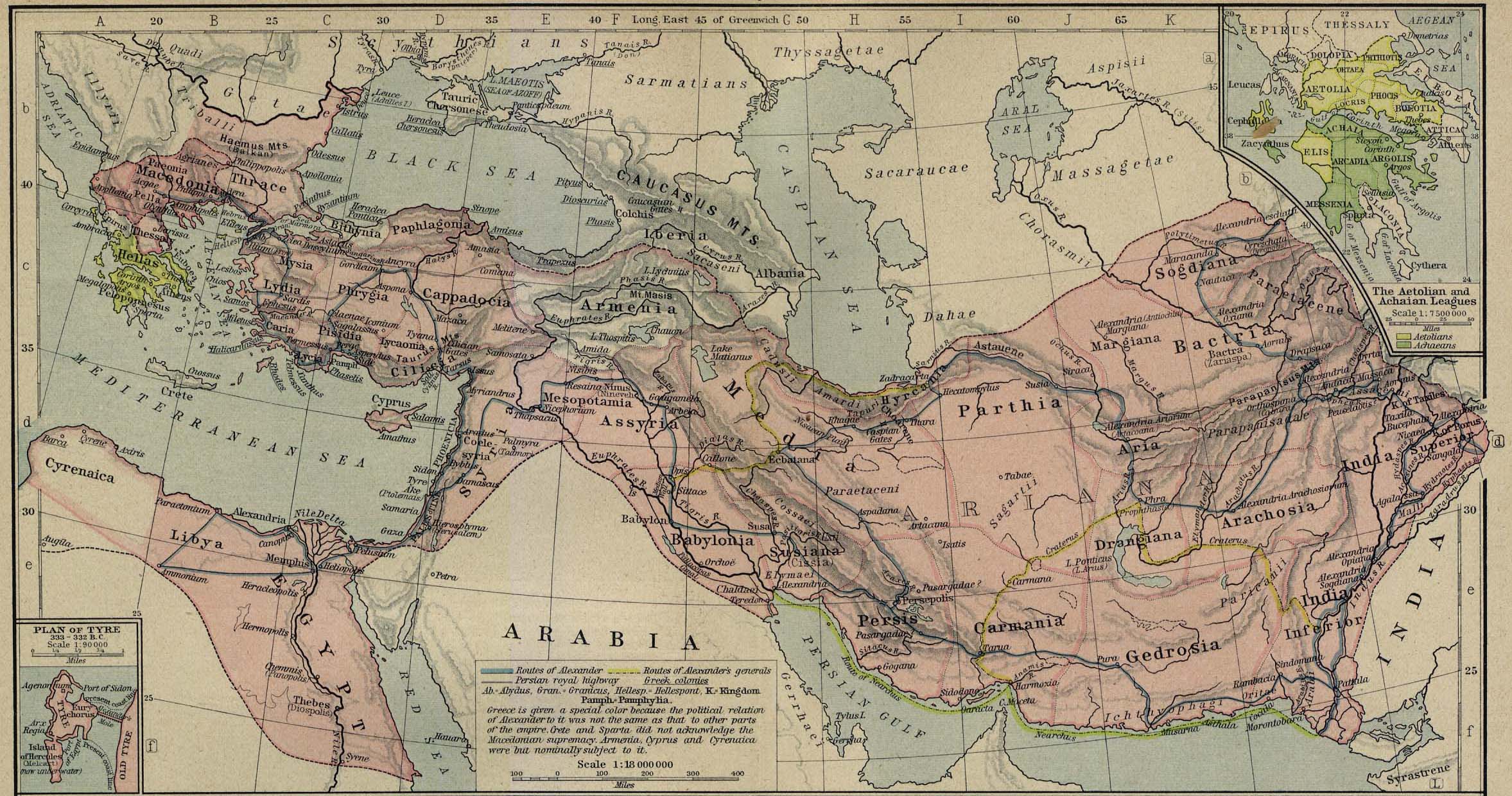
The Landmark Arrian: The Campaigns of Alexander online resources

Picture source

One great thing about the Landmark editions is the support provided within each book: maps, indexes, annotations, appendices help make reading the work more rewarding and enjoyable. Providing an online resource post for a book from the series seems unnecessary but I like to do it anyway.

A database with links to major and minor ancient sources on Alexander’s history. The Arrian work is the translation by E.J. Chinnock (1893).

The Internet Ancient History Sourcebook links related to Alexander

pothos.org, billed as Alexander the Great's home on the web

Excerpts from Penguin Books’ The Campaigns of Alexander, translated by Aubrey de Sélincourt. The introduction by J. R. Hamilton appears to be complete.

The article “The Loneliness of Alexander the Great” by Conrad Clough, focusing on the same topic of Ernst Badian’s Alexander the Great and the Loneliness of Power. Also note the “related article” section in the sidebar.

Alexander's Last Days: Malaria and Mind Games? - an article by John Atkinson, Elsie Truter, and Etienne Truter. Originally published in Acta Classica.

Alexander the Great on the Web: links, links and more links

You can find any post regarding Arrian on my site here, including all the posts at Forbes’ “Booked” blog with historians James Romm and Paul A. Cartledge

The Reading Odyssey should have podcasts, book by book, available on their site after each conference call this year. More information on the schedule can be found in this post.

A review of The Landmark Arrian: The Campaigns of Alexander by Victor Davis Hanson


Some resources from university or class sites:

The University of Warwick’s module for Alexander. Not everything in the sidebar is currently available.

Prof. Nicholas K. Rauh’s site for Purdue’s Spring 2010 class on Alexander the Great and the Hellenistic World. I have only checked out a few pages in the section of lecture notes but they look helpful.

The syllabus, with a few links, of Barbara Saylor Rodgers’ Fall 2006 course on Alexander the Great at the University of Vermont

A Lego version of Alexander (from the FC Historical Figure contest)

Update (10 Oct 2011): Mary Beard has an article titled "Alexander: How Great?" at the New York Review of Books which covers several books on Alexander (and one on Philip)

Update (16 Jan 2012): Scott McCulloch at Ancient Life has a discussion on 5 Recommended Books On Alexander The Great. Be sure to check out the comments for additional recommendations.

Saturday, April 23, 2011

Apology: online resources

I have linked to a few resources during my posts on Plato’s Apology but I thought it might be helpful to have all of them in one place. As I’ve mentioned in an earlier post, a simple internet search will turn up a wealth of information but these are a few I thought looked helpful to anyone reading the dialogue.

My posts on the Apology can be found at the listing for Plato: Complete Works

I just discovered the Commentary on Plato's Apology of Socrates by Kelley L. Ross, Ph.D. Click on through to the History of Philosophy page for a treasure trove of links. High on my “must explore” list.

A short walkthrough the work at Dale E. Burrington’s Guides to the Socratic Dialogues

John Protevi’s outline looks at the context, dramatic setting, structure, and three themes of the Apology

The Classical Origins of Western Culture: The Core Studies 1 Study Guide by Roger Dunkle, Brooklyn College Core Curriculum Series

A good short write-up of the Apology and other dialogues at Garth Kemerling's History of Western Philosophy

Doug Linder’s essay “The Trial of Socrates”, which includes a look at the debate between Socrates' conviction for religious vs. political crimes

The Ancient Library’s entry on Meletus

Leo Strauss’ 1966 fall course on “Plato’s Political Philosophy: Apology and Crito"
Recordings 2 through 10 cover the Apology

My post on online resources for Plato (a post in progress)

Audio series of discussions by Allan Bloom about Plato’s Apology of Socrates on YouTube. It sounds like excerpts from a lecture.

As always, if you know of a good online resource to add to the list, feel free to email me or leave a comment.

Wednesday, March 30, 2011

Plato: online resources

I'm a little overwhelmed at what is available online to help in reading and understanding Plato's dialogues. Many sites or posts I found focus on one or two of the dialogues so I will link them when I get to that particular work. If you know of any general resources, let me know in the comments or via email and I'll be happy to include them. I realize this will not be a complete list but hopefully it can grow and provide help for anyone interested in reading Plato.

Approaching Plato: A Guide to the Early and Middle Dialogues by Mark Anderson and Ginger Osborn,
an online text designed to provide aids to the study of Plato‟s early and middle dialogues. Here you will find material covering 15 of Plato‟s works. For each of the dialogues there is a list and brief description of the main characters, outlines (both a short and a longer, more detailed version), and an interpretive essay. Other supplementary material is included as well, such as an imagined letter from Xanthippe to her mother reflecting on the actions of Socrates and his friends during the days leading up to the philosopher‟s execution; and an account of the various ways Socrates characterizes his relation to the oracle of Apollo in the Apology. The longer outlines are supplemented with Greek text so that those who know the language can see for themselves the original words and phrases behind our translations.
We have designed the material included on this site to be of use to students and professors of every level.

History of Philosphy without any gaps by Peter Adamson, Professor of Ancient and Medieval Philosophy at King's College London. While the podcasts cover more than just Plato, there are already several on Plato with a new podcast added each week. The list of episodes might be the fastest way to find the topic you want.

The Stanford Encyclopedia of Philosophy appears to have several entries covering Plato, as does the Internet Encyclopedia of Philosophy.

I'll mention The Leo Strauss Center again as they continue to add to their collection of tapes and transcripts of various Strauss' courses.

Open Culture lists several courses available under the "Philosophy" and "Classics & Classical World" sections that cover Plato. A search at their home page will turn up more resources.

Friday, February 18, 2011

History of Philosophy without any gaps

For those that might be interested--History of Philosophy without any gaps podcasts:
Peter Adamson, Professor of Ancient and Medieval Philosophy at King's College London, takes listeners through the history of Western philosophy, "without any gaps." Beginning with the earliest ancient thinkers, the series will look at the ideas and lives of the major philosophers (eventually covering in detail such giants as Plato, Aristotle, Avicenna, Aquinas, Descartes, and Kant) as well as the lesser-known figures of the tradition.

Be sure and check out the links tab for more resources.


Update: This weekend I am going to add a section on the right sidebar for online courses, podcasts, and the like. If there are any links to sources in those categories that you particularly like, please feel free to leave me a message or email me.

Update 2: While pulling together the list for online courses, I see The Leo Strauss Center has added audio recordings for Strauss' courses on Kant and Plato's Apology and Crito.

Thursday, December 30, 2010

Thucydides and The Peloponnesian War online resources


My resources posts intend to link to sites I think may be helpful in understanding a work as well as posts or sites I want to explore while reading the book. I never intend these posts to be comprehensive, and in approaching Thucydides I’m not going to pretend to cover more than a fraction of what is available online regarding his book. Keep in mind that many posts about Thucydides will tend to have political baggage added to them--I'm only interested in trying to understand Thucydides and his book, regardless of political leaning as long as posts or evaluations add something positive to that understanding. As always, if you know of sites or links you’ve found useful on a work, please let me know! With that in mind, here are a few links that I find may be helpful.

Text of The Peloponnesian War

Several versions of the text can be found online, usually translated by Richard Crawley. One locations is at Project Gutenberg.

For those predisposed to audio versions, Richard Crawley translation can be found at LibriVox.com

In the article I linked regarding The Landmark Herodotus, Paul Rahe mentions the previous release of The Landmark Thucydides. Despite praise for the Landmark series, Rahe notes some weaknesses in the Thucydides book, one being the translation used:

The second defect in The Landmark Thucydides is far more serious. Strassler is competent neither in Latin nor Greek, and he chose not to commission a new translation, which would have increased his costs considerably. Instead, on the advice of a number of classicists, he republished Richard Crawley's rendering, which had first appeared in 1874 and was in the public domain. With regard to the narrative, this was not a bad choice. Crawley's translation retains something of the force and power of the original Greek. With regard to the speeches and the handful of crucial digressions in which Thucydides hints at his own analysis of events, however, Crawley's rendering is grossly inadequate, for it is wildly inconsistent in its translation of the key terms that Thucydides and the Greeks of his time deployed to convey their evaluation of events, policies, and persons.

Despite this drawback and because of all the other benefits it offers, I plan on using The Landmark Thucydides but will supplement it with the online version translated by Thomas Hobbes. I’m not sure if this is going to work, but I’ll give it a try.


Ancient Sources

Aristophanes wrote several plays that deal directly or comment on the Peloponnesian War.

The Orations of Lysias compile many of the resident Athenian’s speeches, providing a flavor of life during the war.

Books 12 and 13 of Diodorus Siculus’ The Library of History cover the Peloponnesian War. Written in the first century B.C., he relies on Thucydides but also uses other sources (such as Ephorus) no longer extant. (Source: Bill Thayer’s Web Site)

Plutarch’s Lives of the Noble Grecians and Romans, written several centuries after the war, provides information from lost sources as well as framing them in a personable format. Figures included from the Peloponnesian War include Pericles, Alcibiades, Lysander, and Nicias.

Peloponnesian War history that continue Thucydides' book: Xenophon’s Hellenica (which I plan on reading around May) and the Hellenica oxyrhynchia.


Other books on Thucydides or the Peloponnesian War

There are dozens of books about Thucydides and the Peloponnesian war, but I’ll highlight one written about 100 years ago as well as reviews of some recent books.

Thucydides Mythistoricus by Francis Macdonald Cornford: argues “that Thucydides' History of the Peloponnesian War was informed by Thucydides' tragic view.” (Quote source)

Thucydides: The Reinvention of History by Donald Kagan looks at the agenda Thucydides might have had by looking at deviations from other sources. The review by Anthony Grafton begins well but goes horribly wrong when attempting to discern Kagan’s motives, not just with this book but with his (Kagan's) life.

E. Christian Kopff provides a review of A War Like No Other: How the Athenians and Spartans Fought the Peloponnesian War by Victor Davis Hanson. Hanson looks at themes from Thucydides and compares possible parallels in recent history and warfare. Don't expect Barry Strauss, working with Hanson on several projects, to be totally objective, but his review outlines Hanson's approach well.

Speaking of Hanson (and of Kagan), I remember sitting on the back porch during a California brown-out and beginning Donald Kagan's summary of the Peloponnesian War in the twilight and continuing under Coleman lantern. I was familiar with the concept of "the thin veneer of civilization" but reading about the atrocities during that war redefined what the phrase could mean.

In looking through links, I found this review of The Humanity of Thucydides by Clifford Orwin, a book new to me. From the review:

The "humanity" of Thucydides with which Orwin is concerned is not his humaneness, his empathy with human suffering, but his sense of the human predicament, his combination of "an unflinching presentation of the harshness of political life with an element that transcends this presentation" (p. 9). The greatest insight Thucydides can offer, it seems, comes in the speech of Diodotus: "a more terrible truth than that human beings are evil; namely, that they are not" (p. 203).


Video, essays, posts

From Academic Earth’s video course Introduction to Ancient Greek History, Donald Kagan has four lectures specifically on the Peloponnesian War. (I’m listening to the first lecture while I compile this list—concise, complicated at times, but very enjoyable)

In these course notes, John Porter (University of Saskatchewan) provides an introduction to Thucydides and looks at his methodology compared to contemporary medical writers.

At Davidcharleslowe97′s Weblog, he looks at “the reliability and accuracy of Thucydides' account of the Peloponnesian War.”

The posts on Thucydides at A Reading Odyssey appear helpful, plus they include a Q&A session with Robert Strassler (editor of the Landmark series). Note: I just found this interview with Strassler shortly after the release of The Landmark Herodotus and added it to the Herodotus online resources.

Andreas Kluth of The Hannibal Blog looks at Thucydides’ presentation of the Melian dialogue.

The New Risks Weblog provides a link to a chapter from Theory of War and Strategy by R. Craig Nation (published by the U.S. Army War College). The chapter “Thucydides and Contemporary Strategy” looks at the relevance of the ancient work in contemporary strategic planning.

Thoughts on Thucydides at the New Centrist, focusing on Pericles and the politics of fear.

Update (15 Feb 2012): My series of posts on Leo Strauss' lectures on Thucydides, including links to the recorded lectures at the Leo Strauss Center.


Update (24 Jan 2011): While I haven't had a chance to listen to any of these videos, WorldNews has several videos regarding Thucydides and his work.

Update (17 Feb 2011): Reviews and links for any of the Landmark Series books can be found here.

Update (24 Apr 2011): Leo Strauss' year-long course on Thucydides (1972-73 at St. John’s College, Annapolis): 17 files

Update (26 Apr 2011): The U.S. Army War College Guide to National Security Issues, Vol I: Theory of War and Strategy, 4th Edition, is availalbe online. Chapter 8 looks at "Thucydides and Contemporary Strategy".

Update (24 Nov 2011): CBC Radio's podcast of Thucydides: The First Journalist (54 minutes): "IDEAS producer Nicola Luksic explains why his account of the Peloponnesian War is relevant today."

Update (5 Dec 2011): An address to the NYU Medical School on The Athenian Plauge. Be sure to check out the Postscript for an update including recent research and its findings/problems.

Update (30 Dec 2012): Analysis of teeth from a girl that died from the plague--typhoid fever? Here's a reconstructed picture of the girl based on her facial bones.

Update (24 April 2013): The blog titled "He has a Wife You Know" provides a great map of the activity during the Peloponnesian War.

Update (14 May 2013): Here's the first chapter, titled "Grand Strategy: A Framework For Analysis," of Thucydides on Strategy by Athanassios G. Platias and Konstantinos Koliopoulos.

Update (19 May 2013): Was the Peloponnesian War inevitable after 435 BC?:

Abstract: Based heavily on the account of the Greek historian Thucydides, the paper outlines the events leading up to the outbreak of the 2nd Peloponnesian War in 435, and analyzes whether the outbreak of the war was inevitable, i.e. if the political conditions in Greece would have led to war no matter what the specific events were that, in the end, were the straw that broke the camel’s back.

Tuesday, December 07, 2010

Take one of Leo Strauss' courses

The Leo Strauss Center at The University of Chicago has begun to make available audio files from some of the courses Strauss taught and will add transcripts starting next year. The first course released is “Plato’s Political Philosophy: Apology and Crito”. From the page noting the release of this course:
The Leo Strauss Center is proud to publish the digitally remastered audio files of the course given by Leo Strauss on “Plato’s Political Philosophy: Apology and Crito” in autumn quarter, 1966 at the University of Chicago.

This is one of 26 courses (and one reading group) for which a partial or complete audio record exists. The Leo Strauss Center’s goal is to publish the 27 sets of audio by the end of April, 2011. We expect to begin publishing edited transcripts in the spring of 2011 and to complete the publication of all 44 of the course transcripts (and the transcript for one reading group) within the next four years, if sufficient funding is obtained. The Center will not distribute any transcript until it has been published.

If you go to the “Audio & Transcripts” link you will see the list of courses planned for release, many from The University of Chicago but several from Claremont Men’s College and St. John’s College Annapolis as well.

Thursday, December 02, 2010

The Way We Live Now online resources


Lionel G. Fawkes, Chapter 37: 'The Board-Room", The Way We Live Now
"My Lords and Gentlemen," said Melmotte. "I hope that you trust me."

This is part of The Classics Circuit, which is currently reading and posting on Anthony Trollope’s novels. Never having read anything by Trollope, I thought I would take the plunge with The Way We Live Now. Maybe I should have checked to see how thick the book was before I made my choice. I won't meet the December 8th date I’m slated to review the book, but I’ll do my best to provide my usual posts on what I’m reading as soon as I can.

While this is an abbreviated resources post on Trollope, and in particular, The Way We Live Now, if you know of additional links that are helpful feel free to drop me a note or leave a comment.

The text can be found at Project Gutenberg or an audio version at LibrVox.com

A map of locations in the novel

Anthony Trollope on The Victorian Web, which includes the essay
Reimagining Heroism in The Way We Live Now
by Rachel Hannah Beck

AnthonyTrollope.com from The Trollope Society

Harvard’s Trollope Prize has a few of its winning essays available online

Tuesday, October 05, 2010

Petersburg online resources

Map of St. Petersburg, 1893
Picture source

I wasn’t sure what I would read next but after opening Andrei Bely’s Petersburg and reading the two-page prologue, I am hooked. So Petersburg it is. I am reading the Pushkin Press release, translation by John Elsworth.

A quick internet search on the author and title shows more available on the book than I expected. I made the decision to avoid reviews on the book because I wanted to come to the work fresh. All of which means this online resource post will contain fewer links (at least initially…as with other resource posts I may add more links later), focusing on historical context and biographical information. On to some links:

The Wikipedia entry on Bely (Boris Nikolaevich Bugaev), which also has links at the bottom of the page for a short story and a few of his poems

For some context of the historical setting of the novel, the Russian Revolution of 1905

Mapping Petersburg “explores the everyday life and the material, political, and literary culture of St. Petersburg (renamed Petrograd during the First World War) at the beginning of the twentieth century”

The book’s epigraph comes from Alexander Pushkin’s The Bronze Horseman, probably worth visiting before starting the book

Professor Elizabeth Beaujour’s page for her Modern Russian Literature course at Hunter college provides several links for Petersburg (and several other 20th century Russian writers)

The prologue and first chapter can be found here, translated by Robert A. Maguire and John E. Malmstad

Update (7 Dec 2011): "The Moving Tide of Abundance: Petersburg by Andrei Bely", an essay by Malcolm Forbes, can be found at The Quarterly Conversation


Demonstration on October 17, 1905 by Ilya Yefimovich Repin
Picture source

Wednesday, May 26, 2010

The Histories online resources


(I expect this post to be updated as I find more helpful links—there are more resources on the web for this work than I thought possible.)

For someone that loved books, my reading habits have always been very random and I realized I could not remember important details of works I read. Understanding that I read a book differently knowing I was going to write about it, I began keeping notes on what I read. Longer write-ups soon followed for two reasons: a) If I was going to read a work only once I wanted to get everything I could out of that one reading, and b) if I revisited a book I wanted to compare and contrast what I thought of it to my previous reading. That’s basically the background and direction I have been trying to take this blog—it's solely for me, but if anyone else finds it useful then so much the better.

A quirk about one reading habit that I’ve mentioned already is my tendency to associate a work with where I was when I read memorable parts. So that is the long lead-in to say The Histories represents a re-read for me. I first read it during the summer of 2004. The part of the book that stands out in my mind was finishing an entire section one afternoon in an eastern Sierra Mountains inn while my oldest boy (then about 9 months old) napped. It was an epic nap, probably due to crawling around and exploring new places. I did have a brief introduction to Herodotus during my junior year in high school. I took a library copy of The Histories to that year’s graduation so I would have something to read during the commencement address but nothing ‘stuck’ and I didn’t bother to read more after that night.

The version I read was Penguins Classics with translation by Aubery de Selincourt and I was surprised how much I enjoyed the book without any background knowledge. For this reading, I’m going with the Landmark Herodotus (translation by Andrea L. Purvis) that my wife gave me as a present. I hope there are many more works coming in the Landmark series. That being said, there have been issues raised about the translations, or so I’ve read, used in the first two volumes—my knowledge of Greek is limited to scanning my brother’s college textbook (photo at the bottom of this post). You would think translation issues would be a fatal flaw but the layout and additional content are wonderful and tailor-made for a geek like me.

I am surprised by how many online resources there are for Herodotus and The Histories but I’ll initially limit how much I include here. As I find helpful or interesting links I will add them to the list.


Herodotus on the Web might be the only link you need for help in reading The Histories. There are links to overviews, articles, images, Greek history, and so much more. Unfortunately some of the links are dead, but it is still a well done and impressive resource.

The Online Books Page provides a list of online texts of all or part of The Histories.

LibriVox has The Histories in downloadable audio format. The translation appears to be by A. D. Godley.

Jona Lendering’s Herodotus of Halicarnassus page has an eight-piece article on the writer in addition to a summary and commentary on each of the 28 logoi of The Histories

Wikipedia’s page for The Histories highlights the major storylines in each book, providing links to names, events, and places

Parallel English/Greek texts can be viewed side by side (using the G.C. Maculay translation) at Sacred Texts

Paul Rahe reviews The Landmark Herodotus in The Claremont Institute (in addition to other commentaries)

Articles linked at History of the Ancient World about Herodotus

Update (29 Dec 2010): I just found this interview with Robert Strassler, editor of the Landmark series, shortly after The Landmark Herodotus was released.

Update (24 Jan 2011): The Marathon2500 Project--"Commemorating the 2,500-year anniversary of The Battle of Marathon. Free phone/web-based lectures, reading groups & more".

Update (17 Feb 2011): Reviews and links for any of the Landmark Series books can be found here.

Update (9 Nov 2012): Robert B. Strassler again, this time on The Landmark Herodotus and The Landmark Xenophon at the New York Society Library on Wednesday, November 11, 2009:
The NYSL page
The YouTube video

Update (23 Feb 2013): see my post on the Herodotus Project, another source for the text, photos, and more links.


Sunday, March 28, 2010

Parade's End online resources (Updated)

Some Do Not
Illustration by Stella Bowen
Picture source

Note: check back for updates

I will probably stay close to my usual pattern of posting during the read-along for Parade's End. With "online resources," I try to find sites or pages that are useful in understanding a work. If anyone would like to add a resource to these lists, feel free to email me or leave a comment.


Ford Madox Ford

Wikipedia entry

The Ford Madox Ford Society page

The International Ford Madox Ford Studies series

Ford’s Training, an article by Sara Haslam at The Open University

Julian Barnes' essay for The Guardian: The Saddest Story

Ford Madox Ford's personal life was deeply complicated, made worse by his own indecision and economy with the truth. No wonder unreliability, shifting identities and the turmoils of love and sex are the hallmarks of his greatest novel. Julian Barnes admires The Good Soldier.

A review in The New York Times on a couple of books covering Ford and his work

Update: Autobiography, biography and Ford Madox Ford's women by Ros Pesemen at the Women's History Review looks at the appearance of Ford's partners in his work. After the Affair explores the post-breakup works of Ford and Jean Rhys (Thanks to Mel U for the links)


Parade’s End

If your country’s copyright laws are similar to Australia’s, the first three books can be found at Project Gutenberg Australia

The Penguin Classics edition has an introduction by Robie Macauley. Two-thirds of his essay can be read at Questia

A summary of the series can be found at jrank.org

A review of No More Parades in the March 20, 1926 edition of The Literary Review. The article includes a picture of Ford, James Joyce, and Ezra Pound.

While I’m on old articles, there is a short review of A Man Could Stand Up in the May 27, 1927 edition of State College News of the New York State College for Teachers (see the middle column, page 2).


World War I literature

The Wisconsin Library Association website provides a select list of WWI Fiction and Memoirs

In addition to the WLA list, here are a few additional books on World War I and the literature it generated:
George Walter, ed., The Penguin Book of First World War Poetry
Paul Fussell, The Great War and Modern Memory
Trudi Tate, Modernism, History and the First World War
Bernard Bergonzi, Heroes' Twilight: A Study of Literature of the Great War
John Brophy, The Long Trail: Soldiers' Songs and Slang, 1914 – 1918
Dorothy Goldman, Jane Gledhill, and Judith Hattaway, Women Writers and the Great War
Guy Chapman, Vain Glory: a Miscellany of the Great War 1914-1938
Allyson Booth, Postcards from the Trenches: Negotiating the Space between Modernism and the First World War

Update: The WLA site mentions Edmund Blunden's Undertones of War. In the past week, Stephen Pentz (at his blog First Known When Lost) has a couple of posts on Blunden's memoir. The first post provides an overview of the book and his method as well as a couple of memories. The second post covers one of the sad, humorous features of the war (and the name of one of his poems)--"Trench Nomenclature". Also check out Stephen's comment with additional recommendations and information.

I have added some links to color photographs from World War I.

Tuesday, February 16, 2010

The Quest online resources

The Quest by Pío Baroja
Translated by Isaac Goldberg
(Alfred A. Knopf, Inc., 1922)


"Before [1898], in the period of adventures, Spain was led by Don Quixote. From now on, it would be directed by Sancho Panza." - Pío Baroja

I am duplicating the online resources for Baroja that I listed in The Restlessness of Shanti Andía resources since there is not much information in English available online.

Pío Baroja

The Wikipedia entry for Baroja

More on the Generation of 1898 at Wikipedia


H. L. Mencken on Baroja, in the introduction of Youth and Egolatry

Baroja, then, stands for the modern Spanish mind at its most enlightened. He is the Spaniard of education and worldly wisdom, detached from the mediaeval imbecilities of the old regime and yet aloof from the worse follies of the demagogues who now rage in the country. Vastly less picturesque than Blasco Ibanez, he is nearer the normal Spaniard--the Spaniard who, in the long run, must erect a new structure of society upon the half archaic and half Utopian chaos now reigning in the peninsula.


From the biographical sketch at the The University of Texas’ Baroja collection

Baroja lived a fairly quiet and sedentary life in Spain, but would occasionally travel through Europe, especially to France, England, and Italy. During his travels he met other literary luminaries like Oscar Wilde and Spanish poet Antonio Machado, and he accumulated an impressive library of books about witchcraft and the occult. In July 1936, at the start of the Spanish Civil War, Baroja was imprisoned as "an enemy of tradition." Even though a member of the army recognized Baroja as a famous author and released him after a single night in jail, Baroja was outraged and moved to France. He didn't return until the end of the war in 1939.


Here is an excerpt of one of Baroja’s stories, The Labyrinth of the Sirens. The influence on Hemingway can be seen just from this short passage, translated by V. Stevenson.


Chapter 5 of Rosinante: To The Road Again by John Dos Passos, titled “A Novelist of Revolution”. Excerpt:

From the first Spanish discoveries in America till the time of our own New England clipper ships, the Basque coast was the backbone of Spanish trade. The three provinces were the only ones which kept their privileges and their municipal liberties all through the process of the centralizing of the Spanish monarchy with cross and faggot, which historians call the great period of Spain. The rocky inlets in the mountains were full of shipyards that turned out privateers and merchantmen manned by lanky broad-shouldered men with hard red-beaked faces and huge hands coarsened by generations of straining on heavy oars and halyards,--men who feared only God and the sea-spirits of their strange mythology and were a law unto themselves, adventurers and bigots.

It was not till the Nineteenth century that the Carlist wars and the passing of sailing ships broke the prosperous independence of the Basque provinces and threw them once for all into the main current of Spanish life. Now papermills take the place of shipyards, and instead of the great fleet that went off every year to fish the Newfoundland and Iceland banks, a few steam trawlers harry the sardines in the Bay of Biscay. The world war, too, did much to make Bilboa one of the industrial centers of Spain, even restoring in some measure the ancient prosperity of its shipping. …

"I have never hidden my admirations in literature. They have been and are Dickens, Balzac, Poe, Dostoievski and, now, Stendhal . . ." writes Baroja in the preface to the Nelson edition of La Dama Errante ("The Wandering Lady"). He follows particularly in the footprints of Balzac in that he is primarily a historian of morals, who has made a fairly consistent attempt to cover the world he lived in. With Dostoievski there is a kinship in the passionate hatred of cruelty and stupidity that crops out everywhere in his work. I have never found any trace of influence of the other three. To be sure there are a few early sketches in the manner of Poe, but in respect to form he is much more in the purely chaotic tradition of the picaresque novel he despises than in that of the American theorist.


At the blog Oreneta is a “translation of the chapter in Pío Baroja’s serialised novel The adventures, inventions and mystifications of Silvester Paradox / Aventuras, inventos y mixtificaciones de Silvestre Paradox (1901) in which Silvester takes up with an English conman, quack, amateur pugilist and exponent of inventions such as the translatoscope called Macbeth.”

The opening lines of Camilo José Cela’s Nobel prize acceptance speech:

“My old friend and mentor Pío Baroja - who did not receive the Nobel Prize because the bright light of success does not always fall on the righteous - had a clock on his wall. Around the face of that clock there were words of enlightenment, a saying that made you tremble as the hands of the clock moved round. It said ‘Each hour wounds; the last hour kills’.”


The Quest

The Quest (La Busca) is the first volume in the trilogy The Struggle for Life (La lucha por la vida ).
The second volume is Weeds (Mala hierba) and the third volume is Red Dawn (Aurora roja).

The text for The Quest can be found at either
        Project Gutenberg, or
        Wattpad, or
        the Internet Archive

John Dos Passos' thoughts on the trilogy, continuing the above excerpt:

Baroja's most important work lies in the four series of novels of the Spanish life he lived, in Madrid, in the provincial towns where he practiced medicine, and in the Basque country where he had been brought up. The foundation of these was laid by El Arbol de la Ciencia ("The Tree of Knowledge"), a novel half autobiographical describing the life and death of a doctor, giving a picture of existence in Madrid and then in two Spanish provincial towns. Its tremendously vivid painting of inertia and the deadening under its weight of intellectual effort made a very profound impression in Spain. Two novels about the anarchist movement followed it, La Dama Errante, which describes the state of mind of forward-looking Spaniards at the time of the famous anarchist attempt on the lives of the king and queen the day of their marriage, and La Ciudad de la Niebla, about the Spanish colony in London. Then came the series called La Busca ("The Search"), which to me is Baroja's best work, and one of the most interesting things published in Europe in the last decade. It deals with the lowest and most miserable life in Madrid and is written with a cold acidity which Maupassant would have envied and is permeated by a human vividness that I do not think Maupassant could have achieved. All three novels, La Busca, Mala Hierba, and Aurora Roja, deal with the drifting of a typical uneducated Spanish boy, son of a maid of all work in a boarding house, through different strata of Madrid life. They give a sense of unadorned reality very rare in any literature, and besides their power as novels are immensely interesting as sheer natural history. The type of the golfo is a literary discovery comparable with that of Sancho Panza by Cervántes.


The December 27, 1922 edition of The Nation has a review of the book, but it is a for-purchase item. Here is the description of the article, which at least gives a rough idea about the book:
Manuel, the central character of "The Quest" and the two subsequent novels, moves through the story in the traditional manner of such heroes [Note: the golfo, or vagabond/rogue/loafer]. He is the servant in a boarding-house, a shoemaker's apprentice, a ragpicker's assistant and the associate of thieves, passing through the strangest scenes and constant fluctuations of good fortune. But the career of a vagabond nowadays has little of the lighthearted freedom of olden times, his revolt is somber and tinged with a philosophy undreamed of by Gil Blas and his companions.

Unfortunately that is about all the useful information on the novel I could find (in English). Hopefully my discussion will add something useful and stimulate some interest for the novel and the author.

Update: I'm expanding the resources to include the rest of The Struggle for Life, but that only means an additional link for Weeds. Baroja has evidently dropped off the radar for English readers and/or press.

Weeds text online