Wednesday, October 10, 2018
At the risk of excessive exultation
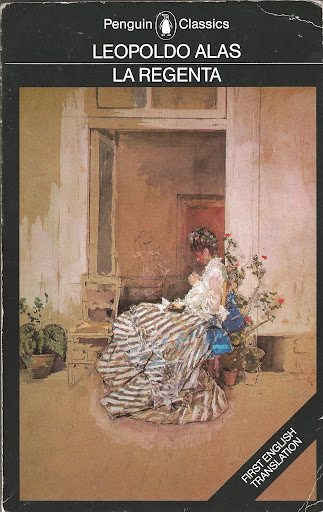
The other major find yesterday was a "new" used copy of La Regenta, retiring the pictured copy being held together by rubber bands. While I have many fond memories of piecing together the old copy (literally) while reading it, I'm hoping this one survives re-readings. Which I hope to do soon. First, though, I'll need to finish and post on Galdos' La desheredada / The Disinherited, a pivotal book in an impressive career.
Monday, April 18, 2016
His Only Son by Leopoldo Alas...upcoming from NYRB
To be included with His Only Son is the novella "Doña Berta," something I thought would be a great introduction to Alas in my post on it, with translation by Robert M. Fedorchek. In addition, I called it rich and perplexing (and ambiguous), so I'm also happy to see it included in the NYRB release.
I hope readers will take advantage of this opportunity!
Thursday, February 14, 2013
Ten Tales by Leopoldo Alas: Doña Berta
Translated from the Spanish by Robert M. Fedorchek
Introduction by John W. Kronik
Lewisburg: Bucknell University Press, 2000
ISBN 0-8387-5436-8
In this post I’m going to focus on the story “Doña Berta,” one of the richest and most perplexing short stories/novellas I’ve read. I commented on the other nine stories in this collection in this post. I’m hurrying to post this today because I think it makes a great Valentine’s Day story (just like “The Burial of the Sardine” is the perfect Ash Wednesday story).
I’m going to rely on John W. Kronik’s introduction on Alas to highlight the difficulty of this story (emphasis is mine):
Students of Alas, availing themselves of differing criteria, have made efforts to classify his body of stories. Such attempts have demonstrated, more than anything else, the broad range of themes that they treat, their multiple aims, the disparate techniques on which their confection relies, in sum, their rich variety of styles and content. These studies, as any reader of his stories quickly confirms, have also discerned common denominators among them, notably two main components: on the one hand, an acerbic sense of humor borne as a piercing critical weapon; on the other, a sensitivity, a consummate tenderness that elevates the lowliest of creatures to the highest emotional pitch.
What I found in “Doña Berta” was one or both of these components. While I’m not sure which of the two he intended I have my suspicions through Alas’ plot devices, so the usual notice of spoilers is in place here. A summary of the story: Doña Berta de Rondaliego lives with her four brothers in an estate in the Asturian countryside. The family remains withdrawn from society, valuing honor and “purity” over everything else. During the first Carlist War a captain from the Whites (followers of the queen regent Doña María Cristina) stumbles onto Posadorio (their estate). Even though the brothers are firmly on the Black (Carlist) side, they take pity on the captain and, while his body is mending, his company. Berta falls in love with him and …well, I’ll let Alas cover what they valued, how romanticism warped Berta’s mind, and what happens next:
All the brothers were confirmed bachelors; they were cold and apathetic, although kindhearted and courteous. Their idol was their untainted honor, their immaculate noble blood. The sanctuary of that purity was to have been in Berta, the sister, but Berta, even though like her brothers—fair-skinned, stout, gentle, and relaxed in her gestures, voice, and walk—had inside her tender qualities unknown to them. The second-oldest brother, somewhat of a man of letters, would bring home contemporary novels, translations from the French. They all read them. On the men they left no impression; on Berta they wreaked interior havoc. Romanticism, which for so many men and women in cities and town was merely a topic of conversation, at most a pretext for roués, in Posadorio had a veritable priestess, even though it arrived there as an echo of itself in ponderous newspaper serials. The brothers could never have suspected the existence of the flames of idealism and pure sentimentality under their roof in Posadorio. Not even after the misfortune did it occur to them that romanticism had caused it; they attributed it to chance, to opportunity, to treachery, which were also to blame. Perhaps the most evil-minded of the four [brothers] even ascribed it to lust, which was nonexistent in Berta, whereas nobody gave any thought to innocent love, to a heart that melts on making contact with the fire it adores. …
The captain had departed from Zaornín the day after he knew happiness in the garden; nothing was learned of the dishonor that he left there until, to the amazement and horror of the brothers, and to the amazement and lack of horror in Berta, the wretched young woman fell ill with a disorder that ended up in a mysterious, secret baptism that was treated like a disgrace.
The brothers entrust the infant to the care of a religious order, telling Berta that he had died. Feeling betrayed by their sister, the brothers leave the estate. Two die in the second Carlist War, the other two bankrupt themselves in supporting the losing side. Berta stays on the estate, insulated from the rest of the world until one day at 70 years old, she meets an artist tramping around the countryside. They feel a connection and the artist provides her with two new paintings of his: a copy of a portrait of the young Berta, capturing her better than the original, and the bust of the subject of his last painting. The subject, the painter’s friend killed in the second Carlist War, looks just like “her” Captain joined with herself—she believes the subject to be her son. She mortgages the estate and sets off to Madrid with only her cat to find and acquire the original painting. A rich Latin American tycoon has bought the painting and is about to ship it to his mansion in the new world, but he allows Berta to visit every day and look at the painting. On the day the painting is to be packed for shipment, Berta is hit and killed by a horse and streetcar. Her cat, caged because it could not conform to city life, dies forgotten in the attic of the boarding house.
This summary obviously doesn’t do the story justice. I would have expected to hear such a story in the Gentleman’s Club of Vetusta (yet another La Regenta reference). The excerpt gives a hint at Alas’ wonderful prose, the subtlety building over the course of the story until you realize you’ve been hooked by this haunting tale. The story follows a razor’s edge between satire and tenderness. Other characters laugh at this old deaf woman, sheltered all her life from an evolving society, but the narrator doesn’t. There is the obvious contrast between settings—the idyllic, verdant country, untrampled and undisturbed (except, of course, when it is), and the busy, dusty Madrid, with dangers of death or theft at every turn. But there’s plenty of irony housed in these settings. Berta is “disgraced” in the countryside. Even though the family helps with local charities, officials turn a blind eye (through “their slowness and apathy”) to thefts of estate property. The local notary fleeces Berta with “cold shears” in her business dealings with him. Offsetting the cold Madrid side, residents of Madrid turn out to be friendly toward the seemingly mad woman, helping her in the streets and providing contacts she had no rights to expect.
One of the most interesting details for me is Berta’s love of romantic stories. In Alas’ longer books, characters enjoying such fare are clearly inferior readers and people. In this case, it’s almost all she has—the estate library is limited to “religious tomes of withdrawn, secluded devotion and books of heraldry.” Her love of these stories doesn’t condemn her because that is all she has…she’s limited by her experience and capabilities. Mimicking this symbolism is her deafness—she can’t hear because of her old age while other characters refuse to hear or understand (through a choice she doesn’t have).
But getting back to the ambiguity of the story…
The bust that the artist gave to Berta provides certainty for her that the subject was her son. She mortgages her estate, knowing she will never see it again, basing everything on the bust. Once she sees the original work of the artist, though, she’s not so sure. She debates whether the subject might be her son until she surrenders certainty for faith: “In the end Doña Berta felt the sublime, austere joy of faith in doubt.”
In the end, though, she meets a similar fate to that of her son—a death in the fog of war/city that would be completely forgotten if it weren’t for art. The son’s last charge is perfectly captured by an artist. Doña Berta’s last moments (OK, and the son’s) by Alas. Both works capture a look, whether in the painting or in the story, of certain defeat as well as determination. In either setting, both carry through on the faith of their mission.
So we come to the ending, anticlimactic in several ways, but I don’t think Alas could have done it differently if he wanted to convey sympathy for Berta. In the end she loses everything—son, estate, painting, life. The denouement focusing on the fate of her cat adds to my certainty that Alas means Berta to be viewed sympathetically instead of critically.
It’s a beautiful story and I highly recommend finding a copy to read (it’s about 50 pages in this version). There are some issues, and if you’re of a practical nature you’ll note a few. But for anyone that has tried to tackle La Regenta and felt there were too many moving pieces and storylines, this is Alas telling a complex story with a tight focus. It’s a great introduction to his work.
Wednesday, February 13, 2013
Ten Tales by Leopoldo Alas
Translated from the Spanish by Robert M. Fedorchek
Introduction by John W. Kronik
Lewisburg: Bucknell University Press, 2000
ISBN 0-8387-5436-8
Reading and posting had suffered of late, so I’ll try and get caught up with a couple of posts on this collection of short stories by Leopoldo Alas. Ten Tales includes stories
which are singled out by the above mentioned critics [who acclaimed his short stories], and others, as representative of Clarín’s best pieces of short fiction. They span a sixteen-year period, from 1883 to 1899, and explore themes—a frustrated artistic ideal, religious belief, spiritual love, loss, death, tenderness, social division—that reflect the “interior man, his thoughts, his feelings, his wishes” cited by the author in the preface to his Centos morales [Moral tales] (1896).
(From the preface by Robert M. Fedorcheck)
The stories in Ten Tales are listed below:
- The Two Boxes
- Doña Berta
- The Lord
- A Day Laborer
- Change of Light
- The Golden Rose
- Queen Margaret
- Torso
- The Burial of the Sardine
- Two Scholars
I’ll run through a few comments on each of these stories (excluding Doña Berta which will have a separate post). John W. Kronik provides an extremely good introduction to Alas and these stories. I’ll try to highlight aspects of these stories that are different from his introduction but there will be overlaps and quotes from his essay.
Underlying many of the themes in these stories listed by the translator (above) lurks a frustration…a disappointment…an inability of a character to accomplish something. Alas can be lighthearted about this tension or he can be serious. In the same manner his narrator can be ironic, providing a distance that allows the reader to laugh at failures, or let him sympathize with the character’s plight. Many of the stories provide characters or actions that call to mind La Regenta or His Only Son, whether through similarity or contrast.
“The Lord” (El Señor) describes a priest, Juan de Dios, who turns out to be the opposite of Fermín de Pas in La Regenta. Where Fermín gives in to his passions about Ana Ozores, directly and indirectly, Juan’s suppression and sublimation of his love creates a perverse martyrdom. It’s difficult to tell if Alas is criticizing the Catholic Church for the celibacy requirement of its priests or if he’s parodying romance stories by going over the top in the suffering. This ambiguity is common in many of these stories and provides much of their enjoyment in trying to figure out Alas’ intention.
Despite Alas’ anticlerical barbs an abiding religious faith comes through in his work. It’s when the church fails in its mission, whether through personal failings or through its politics, that Alas delivers his harshest criticism. “The Golden Rose” (La rosa de oro) provides an example of a leader of the church eschewing the expected politics of the day and helping those the church should serve. “The Golden Rose” also makes use of a folktale tradition while adding to its structure. As Kronik points out in the Introduction, “it is a story about storytelling” that
reveals the distance that Alas put between his stories and the narrative practices of his time. Even the descriptive details are at the service of an esthetic order different from that of the realistic novel. In this instance, Alas subordinates the psychological component to the creation of image and mood. That is achieve through the special manipulation of language, through the lavish use of metaphor, and through an associative process between writing and painting.
Another story addressing religion and faith, anticipating later writers (I’m looking at Unamuno’s “San Manuel Bueno, Martyr” in particular) is “Change of Light” (Cambio de luz). Jorge Arial wanders through different occupations but his crisis begins when he begins to doubt the existence of God. Or rather he contemplates there may not be a God. Even though he maintains a façade of belief for his family’s sake, matters worsen with the loss of his sight. Alas focuses not just on the capacity of human suffering but the sources of creativity within. Jorge’s faith strengthens from music (playing and listening), even when totally blind. “Queen Margaret” (La Reina Margarita) draws on the power of music, too, in this case through mediocre performers (both of Alas’ novels have plenty of those). Alas ruthlessly portrays a society unable to appreciate art, showing spectators more interested in money, appearance, and gossip at the theater than the compositions and performances they hear. His sympathy is clearly with the two performers who refuse to pretend to be more than their meager talent allows. Even so, they are able to find happiness with each other. Another story where the power of music can fail is in “The Two Boxes” (Las dos cajas), which follows the labors of the violinist Ventura as he tries to develop a natural, sincere music that captures the listener’s inner feelings as a poet would. His frustration in developing such a sound implodes when he sees his wife’s apparent unfaithfulness, followed by his son’s death.
As I’ve highlighted in previous posts on the author, Alas is always the critic. Two of these stories specifically target scholarly activities and tendencies of his day, satirizing the vanity of the profession: “A Day Laborer” (Un jornalero) and “Two Scholars” (Dos sabios). Fernando Vidal in “A Day Laborer” has to defend what he does to an unruly mob, providing a hilarious send-up through his description of his sufferings in his work. The unjust resolution of his defense can't help but bring a smile to the reader, showing Alas' masterful use of irony. “Two Scholars” provides a good example of what Alas does in several of these stories, revealing bits of information as the story unfolds in order to continually add irony to the situation. The changing points of view in the narrative are, as Kronik points out in his introduction, a “clever exercise” “whose crossings allow the reader to see as the characters do, yet with knowledge superior to that of any given character.” The scholars end up being anything but wise men, instead providing perfect examples of Sayre’s law.
“Torso” (El Torso) and “The Burial of the Sardine” (El entierro de la sardine) are included in the English translation of Alas’ story collection titled Moral Tales (to be reviewed here soon) because of their parable-like nature. “Torso” looks at class relationships in the Spain of his time (a common theme, come to think of it, in Galdós). In La Regenta Alas skewered students leaving the village to study in Madrid, returning with superficial knowledge that they ignorantly and incorrectly applied. The same goes with the young duke of this story who goes to England for his education. He has failed to learn, though, the strength of human bonds, preferring social convention instead. The young duke learns all the politically correct things of the day but acts like less of a man than the peasants he derides. The elder duke resigns himself to what the education has created while the son notes the apparent hypocrisy of treating servants as equals (ellipsis and italics in original):
[T]his did not prevent him [Don Juan, the elder duke] from sighing when he noticed that Diego [the son] had adopted ideas, habits, and tendencies that were a far cry from the Castilian simplicity that for Don Juan constituted good manners and character. Their son looked more like the duchess than the duke, and the education that he called rigid, proper, and cold accentuated the differences between them, differences that Don Juan sincerely regretted. But the duke did not complain. To each his own, he believed. Neither Diego nor anyone else would change his ways now, but his successor, well…let him become what God had ordained. Don Juan had demanded freedom for himself, and he allowed others to live as they wished. One thing, however, was clear: while the old duke was alive, his house, no matter how annoyed the young master appeared to be, would bend to his will.
Diego, as a matter of fact, felt an insuperable repugnance for his father’s ways. He, who had had student servants, who from his time at the boarding school had learned to measure the distances that reality out of necessity establishes between different classes, even saw a kind of hypocrisy, or at least a ridiculous illusion, in bad taste, in this apparent equality of treatment which did not go beyond the surface, which could only be skin-deep. All of this, he thought, is a grotesque comedy that annoys the rest of us and would humiliate the poor peasants themselves if they were more sensitive.
The “poor peasants” understand much more of the world than Diego does, although he figures things out after his life falls apart. The other point to note in "Torso" is the abdication of responsibility by Diego and others of his generation toward the peasants. His concern for their well being was as skin-deep as his complaints about their humiliation. An evolving or modernizing society doesn't necessarily seem to bother Alas, it's the nature of certain aspects of this evolution (lost personal ties and responsibility, especially) that concern him.
It’s difficult to say which story is my favorite (after the novella “Doña Berta,” that is) but for some reason “The Burial of the Sardine” sticks with me. It’s also why I wanted to post on it on Ash Wednesday, even though this post isn’t ready for prime time. See here for a description of what the ceremony represents. While describing the ceremony in one village, Alas directs the focus toward the people participating in it, similar to the focus of Ana Ozores participating in the religious procession of La Regenta. There is another echo to that procession of the novel with the character of Celso Arteaga, the principal of the local secondary school. Celso provides the speech at the end of the ceremony , half-drunk, calling to mind the teacher in La Regenta that walks each year in the religious procession as a penitent. “The Burial of the Sardine” provides an implicit criticism of the clergy suppressing joy for 364 days of the year. The one day each year Celso is allowed to experience unbridled happiness isn’t enough to bring him together with the woman he believes may be intended for him. Even though Alas builds on powerful emotions he grounds the story in realistic characters and situations, balancing his technical skills with a rendering of personal stories at odds against a superficial, stifling society.
OK, more on this collection, especially “Doña Berta” in the (intended) next post.
Update: see this post for comments on “Doña Berta.”
Picture source
Wednesday, January 02, 2013
Tristana by Benito Pérez Galdós: far from the desired feminist manifesto
I had originally planned to have several posts on the main characters of Tristana and then talk about the opposing viewpoints on the novel but I realized that order only makes sense for someone that has read the book. So I’m revising the schedule and posting on two differing opinions and reactions to the novel, relying heavily on Colin Partridge’s essay. A very general summary of the storyline can be found in the post on Don Lope, Tristana’s guardian.
From Partridge’s essay:
When viewed narrowly as a feminist novel, Tristana disappoints—a response clearly articulated when the book first appeared in 1892. The most celebrated expression of dismay came from the prominent novelist and polemicist Emilia Pardo Bazán. Soon after the first copies appeared she pinpointed accurately, from a feminist viewpoint, the novel’s potential—and failure.
Bazán herself was an active advocate of female freedom. She had written a study La muher Espãñola and was soon to provide a prologue to the first Spanish translation of John Stuart Mill’s The Subjection of Women (1892). She and Galdós had been lovers in the years preceding his composition of Tristana and some of his insights into his young heroine’s dreams of libertad honrada derive from this important relationship. Although Galdós had always been critical of the limited roles permitted women at all levels of Spanish society, Pardo Bazán exercised her formidable powers of lucid persuasion to help him see their condition more compassionately and more profoundly. She corresponded regularly with him as the writing progressed and probably held high expectations about the novel’s value to the emergent feminist cause. So her disappointment, when she finally read the published work and learned the outcome of Tristana’s struggles, was personal as well as ideological.
In her review of the book she voices her regrets at the opportunities Galdós lost by failing to present what she thought was the central drama raised by Tristana’s life. This was the young woman’s loneliness and isolation as she lived divided between Don Lope’s restrictions and her personal aspirations. Pardo Bazán considered that Tristana’s awakening to a fuller understanding of her own position and a broader awareness of the position of women generally in Spanish society had given Galdós the opportunity to write a novel of personal and symbolic liberation. She saw the fictional Tristana representing many contemporary women in real life whose only choices were to become wives, nuns, actresses or prostitutes. … Instead of allowing Tristana to gain a degree of freedom through her patient, naïve efforts, he shows his heroine losing personal power as her sufferings increase and her young lover’s attentions diminish; in the final scenes Don Lope’s oblique manipulations are renewed and all three characters are finally absorbed within irrevocable patterns of traditional behavior.
Pardo Bazán’s disappointment is what makes the novel appeal so much to me. Galdós didn’t go for the simple solution. Any transformation by other characters to promote Bazán’s message would have been simplistic and superficial. Instead of an easy fix and happy ending, the characters are human. In addition, the novel’s focus isn’t solely on Tristana. Yes, there’s the focus on her exploitation and her limited outlets for ambition, but other characters evolve and develop in addition to her and she reacts accordingly. Partridge also highlights Galdós’ consideration of the novel’s setting:
He could have chosen to develop the fictional Tristana into a figure of success and shown her, like Theodore Dreiser’s near-contemporary Carrie Meeber, gaining celebrity status as an actress. But [1892] Madrid was no Chicago or New York; conservative Catholic Spain was not the protestant, individualistic United States.
Galdós’ literary faithfulness, avoiding an ideological resolution that would have felt false, still provides a powerful novel highlighting the limitations and restrictions imposed on women in Spain at the time. And, without blaming the victim, Tristana has her own shortcomings that hinder her independence. She repeatedly begins studies in areas where she could support herself, realizes she has an aptitude in the area and pursues improvement in it…then tosses it aside for some other subject to pursue. Like many other topics in the novel, Galdós doesn’t clarify this, leaving an ambiguity as to its cause—is this a personal failing or is she shaped by her limited role in society? I find myself closer to agreement with the second viewpoint Partridge presents, that of the critic Clarín (Leopoldo Alas), who
saw Tristata as representing another type of female experience. She is the woman conemned to immaturity by forces larger and more powerful than she could ever hope to confront successfully. Hers becomes a “gray destiny” as she grows to realize the constrictions placed on her by an inadequate education, Don Lope’s domestic arrangements and the absence of opportunities for a woman to make an honest and respectable career. Tristana is:…“a spirit like many others in our mediocre world which are full of ideals and energy, but lack an ongoing clear purpose.”In this interpretation Tristana is seen as a psychological contradiction—a static being who, at the same time, bubbles with repressed energies. Her only freedom is to imagine; but her fantasizing perpetuates her immaturity. In Clarín’s reading she embodies not the rebellious young woman who dreams of carrying new values to social reality but the many Spanish women doomed to life-long non-fulfilment beneath structures of man-made social conventions. She is more like Clarín’s own heroine Ana Ozores, in La Regenta (1884-1885), seeking self-knowledge in traditional Catholic Spain than like Nora Helmer seeking self-liberation in Ibsen’s Lutheran Norway.
So, soon after its publication in 1892, Emilia Pardo Bazán and Clarín established opposing viewpoints on Tristana which exist to the present-day.
The comparison to Ana Ozores is appropriate since that is exactly what I thought of while reading the novel. It’s not an exact similarity but there are many features that overlap, whether through looking at constraints limiting women or at the individual’s limitations. And again, there's the ambiguity as to her 'immaturity,' as Clarín puts it.
OK, the next posts will look at the two remaining main characters: Tristana and her lover, Horacio.
Friday, December 14, 2012
His Only Son by Leopoldo Alas
Translation and introduction by Julie Jones
Baton Rouge: Louisiana State University Press (1981)
ISBN 0-8071-0759-x
His Only Son proves to be a difficult novel to describe but one that should be every bit as notable as La Regenta. Or rather, every bit as notable as La Regenta **should** be. Once again I’d like to thank Dr. Julie Jones for her patience in answering my questions on the novel.
Previous posts on the novel that cover the plot and several of the characters:
Story, part 1
Story, part 2; Bonifacio Reyes
Two women: Emma and Serafina
While His Only Son shares many similarities with La Regenta, there are some changes in emphasis and approach that make it more disturbing. Set in a "third-rate capital" city in Spain, His Only Son looks at the past in two seemingly contradictory ways—romanticizing the past while at the same time satirizing that romanticism. We also get to see many (but not all) the inner thoughts of the characters. This combination of an ironic, naturalist novel with a psychological approach causes some of the difficulty in the novel. From The Decadent Vision in Leopoldo Alas by Noël Maureen Valis (also LSU Press, 1981):
How did one reconcile the idealism of the hero Bonifacio Reyes’ paternal quest with the pitiless realistic satire and irony which succeeds in leaving one with a bitter aftertaste?
The two strains of the satirical/ironical and the psychological, in my view, do not blend very well in Su único hijo; indeed, they set up a jarring effect on the reader because each tendency is heading in a different direction. The humorous vein debouches into the traditional current of Spanish realism which, since Cervantes, has characteristically been leavened with the agent of satire and/or irony. But the pshychological treatment in Su único hijo points to a different form of novel writing, a form which has more in common with the contemporary decadents, symbolists, and psychological idealists than with traditional realism or naturalism.
Clarín’s [Alas’ pen name] inner unrest was finely attuned to the same uneasiness which had spread through Europe. He too sought more profound realities through the exploration of the psyche and the dream and the intriguing relationship between the arts—in particular music—and life. These preoccupation which are manifest in Su único hijo lead Clarín to neglect to a certain extent the external in order to concentrate on and enhance the internal.
(page 109)
The ending, which I haven’t gone into because of the plot twists involved, highlights the difficulty in resolving these two approaches. Bonifacio (Bonis) has the son he has always dreamed of. Sort of. He dreams of what he will provide for the boy, yet at the same time the reader is painfully aware of what Bonis’ daydreaming has gotten him so far. Not to mention the complete rejection of motherhood by his wife, Emma. Even with the caveats the novel provides while leading to the ending, a guarded feeling of hope and regeneration resides in the novel. I sometimes talk about unasked questions at the end of a novel, and the obvious one at the end of His Only Son is what’s in store for Antonio Reyes, the son?
It turns out that Alas left a fragment titled “Una medanía” (I’ll assume that would be A Mediocrity…please correct or let me know of other connotations) that helps define where he was going with His Only Son. I’ll be quoting liberally from Valis’ book (noted above) since this compiles a lot of what is available on the intended sequel (or at least what was available 30 years ago). The context and content of the sequel helps clarify how Alas wanted His Only Son to be viewed. Valis discusses one observation
from Carolyn Richmond, who views Su único hijo as an introduction to the projected but unfortunately never completed triptych of “Una medanía,” “Esperaindeo,” and “Juanito Reseco,” and who offers a solid explanation of why these novels were never finished. In her view,Su único hijo represents the search and hope for faith, [while] “Una medanía” is the complete disillusionment. Perhaps the necessity Alas felt to write Su único hijo before “Una medanía” reflects a need on his part to understand, and even justify, the negative and rebellious Antonio Reyes. His suicide, however, would symbolize the destruction of Bonifacio’s only hope, and we would indeed be left with “el vacío total.” Quite possibly this prospect so appalled Leopoldo Alas (who, himself, was going through a period of tremendous pessimism and doubt) that he could not bring himself to describe it. And without the “center panel” of his “triptych,” he may have eventually lost interest in, and a reason to finish, the “panels on either side.
(pages 183-4)
Here are a couple of quotes that help provide some overview and context for the sequel:
Most of the fragment centers upon the problem of Spain’s intellectual life with the focal point on one individual, Antonio Reyes. Unlike the Ateneo members, Antonio is no intellectual fraud, but in a larger sense he typifies the fin de siècle crisis in Hispanic thought and life because he is a paralyzed intellectual. Because he is unable to exercise his will, to put into practice the desires and illusions he nourishes within himself, he is as anemic as any of his peers, but he is cursed with an awareness of his abulia. Like his father Bonifacio, he prefers daydreaming to activity, but unlike the older Reyes, who is a highly emotional and intellectually untutored fellow, Antonio Reyes is, above all, an intellectual. Antonio’s abulia stems not from a lack of ideas to stimulate him but from the crushing influence of thought itself.
(page 185)
This refusal to participate [in public life] extends to nearly all forms of activity and, in sum, signifies Antonio’s removal from life itself. Like many of Alas’ characters, he behaves negatively, taking “evasive action,” hence, not coming to grips with life and, indeed, defeated by life, he withdraws more and more from it and encloses himself in a world of daydreams.
(page 187)
In an ideal world of translated books, His Only Son would be available with the fragment “Una medanía” as an appendix. Although I realize I’m daydreaming just like Bonis…I should settle for an in-print version of His Only Son so people can easily enjoy this remarkable novel.
His Only Son by Leopoldo Alas: Emma and Serafina
Emma’s capriciousness leads her to take revenge for every perceived slight against her. Ruing her whimsical decision to marry her childhood sweetheart she determines to make Bonis’ life a living hell. Bonis seeming indifference to her actions makes her even madder. Emma also takes a perverted revenge against her uncle managing the family estate—she suspects him of lining his pockets, so she determines to spend her money as fast as possible. Yep, that'll show him.
Emma takes to her bedroom after a miscarriage but her hysteria is mostly an act. While luxuriating in her bedroom she heals and her sexual appetite returns. Even her erotic nature takes a perverse turn in the seduction of her husband (and not stopping with him) until she finds she is pregnant. Hysteria strikes for real as she believes she will die in childbirth. Even though she doesn’t, she rejects the role of motherhood before and after the child is born.
Serafina, the soprano in the visiting opera troupe, is the other woman in Bonis life. He rhapsodizes and romanticizes everything about her, dreaming that she provides everything feminine (in a positive manner) that his wife does not. Serafina allows Bonis to dote on her, although the reader is initially left in the dark as to her motivations. It’s easy to believe that she plays along with Bonis' wooing for the same reasons that Mochi, the leader of the troupe, does—to cadge money out of Bonis. It turns out Serafina also acts out of revenge against Mochi, echoing some of Emma’s actions. Emma’s pregnancy changes things for all the relationships. Bonis, wanting to be a model father, ends the affair. Serafina struggles with the termination—she seems to truly want to abandon the artist lifestyle and settle down. Her role for Bonis has changed, though. Wanting to live only for his son he abandons her, shutting her out of his life and rejecting any fact she tries to tell him.
There are many other topics I could cover in this wonderful novel. The importance of music, the unconscious, use of archetypes…there’s plenty packed in the book. For the next post, though, I think I’ll try and provide a summary and add some information about the unfinished sequel.
Wednesday, December 12, 2012
His Only Son by Leopoldo Alas: Bonis as a character? Imagine a cross between Emma Bovary and Walter Mitty
Bonifacio Reyes finds himself in a dilemma. First he was unfaithful to his wife with Serafina, the soprano of the visiting opera troupe. His wife’s unexpected advances one evening cause him to be an unfaithful lover, too. Bonis didn’t know…no one knew…that Emma’s health had improved while during her hysterical and cruel actions. After she has let slip that she is feeling better Emma’s visit to the opera hooks her on the theater, not for the singing but because of the envy she sees and feels from the crowd of the third-rate capital. Most importantly, though, it added to her plan to torture her uncle (the estate’s bookkeeper) and her husband:
Her plan was to make fun of her uncle and her husband, to toy with them, to try to discover even newer ways to deceive and ruin them, ways that might offer her great entertainment. For some time she had known what methods to use against the uncle. She planned to throw, as it were, the whole house out the window by spending money wildly on herself. Bonifacio was another matter. Strictly speaking, she did not dislike him nearly so much as she disliked the uncle, nor until this moment had she decided on any specific form of punishment for him. She had only thought of keeping him on the rack for the rest of his days, of treating him like a slave subject to unknown torments; but when Minghetti’s smile [the opera troupe’s baritone], his look, smote her with a lightning flash, then she suddenly saw how she might punish her unfaithful spouse. Yes, she had guessed that he was unfaithful long before; yet when she would meditate in her bedroom alone (with hysteria for a Sybil), Emma had reached the same conclusions about all men: in her eyes, they were animals with only gross and cruel instincts. She could not conceive of a husband who was totally faithful to his wife. Further, the very existence of such a creature seemed ridiculous, and she freely admitted to herself that if she were a married man, she would not be satisfied with just a wife. She would not admit that women had the same right, except in extraordinary cases, because “it would appear ugly,” because “a woman is different.” However, once a husband’s infidelity was discovered, the case changed. Then there was a right to reprisal. This was true, too, if the husband were brutal. If Bonis hit me as I hit him, he would pay for it, Emma thought. This much was evident. And if he deceives me… Here Emma hesitated and returned to her considerations for excusable feminine infidelity. If he deceives me, I would deceive him as well, she mused…if anyone inspired great passion in me. Emma’s moral excesses had little to do with the decadent literary romanticism of her town and her time; she was original in her temperament.
And so everyone continues using or screwing each other, whether through infidelity, misappropriating funds, or some other deception. The uncle invests the family’s funds in a scheme destined to fail. The investment, though, does help his amorous cause with the schemer’s daughter. The family’s financial ruin is all but guaranteed when, out of the blue, Emma becomes pregnant. Everyone thought her earlier miscarriage made pregnancy impossible. The news electrifies Bonis, filling him with joy and resolve. He will have the son he has always wanted, someone to fulfill “all the clichés of fatherhood” for him. Like most other emotions Bonis feels, it is the ideal or concept of fatherhood that entices him. There are several more twists and turns before the end that make this the remarkable novel it is.
I read back through the overview and nothing about it sounds notable, and yet I think it is almost every bit as good as La Regenta. Almost. There are a lot of “little” things that make the novel difficult to describe or classify, as I mentioned in the first post. Let’s start with the central character, Bonifacio Reyes (Bonis) since his nature defines much of the ambiguity of the novel. Bonis was an “antihero,” or rather unheroic, before being an antihero was cool. Bonis, though, sees himself as a potential hero.
Alas uses names in His Only Son to add to the story's irony. Bonis wife may be named Emma, causing the reader to think of Emma Bovary, but that role is reserved for Reyes. His adultery is the obvious similarity but the more meaningful parallel comes from dashed expectations which were fed by literature. Bonis is a dreamer, a Walter Mitty-like character that cherishes ideals even though he eventually finds everything tainted. He believes in the ideals provided by literature and music even though fate cruelly dashes all his hopes for his happiness. He adheres to the role of husband (despite the adultery) long after his shrewish wife destroys the idylls he expected.
Usually called “Bonis” (can be loosely translated as'good'), he does little that could be termed good. In fact, Bonis does little at all. Most of his action is passive, allowing things to happen around or to him. His goodness, such that it is in the novel, comes from limited action—if he does little, he limits the amount of bad things he can do (especially in comparison to the other characters). Nobility lay somewhere in his lineage but he is a long way from that now. This deterioration over the generations is a common theme in the novel.
The narrator compares Bonis to Ulysses at one point, a man who has lost his home and wife. That may be the only apparent similarity since Bonis is far from kingly but he does make an inward journey, exploring his father’s and his own nature. That journey, though, comes after many flights of daydreaming, which he does frequently (especially when listening to music...the role of music in the novel deserves its own post). The daydreams aren’t just a coping mechanism for Bonis, it’s what he is—aloof and mediocre. Even the narrator heaps irony on the character by often referring to him as “poor Bonis” or “poor Reyes.” There is no sympathy in the epithet, though. Like Don Quixote, he pictures himself as a hero out of a novel. Unlike the older gent, though, Bonis is not mad, just self-deluded. He also abandons his delusions of heroism as he makes his inward journey, although he does replace them with daydreams of other heroic activity (writing, music, art). His dreams of heroism culminate in his raptures about fatherhood, one of the rare dream-come-true events for Bonis. Because of the importance of the fatherhood dream, though, Bonis will not allow any other reality to intrude on it after he realizes it. All of which makes the reader mutter “Poor Bonis” upon the closing of the book.
There is much more that can be said on Bonis, especially the father/son theme Alas explores in the final chapters, but I want to end with an excerpt that is more typical of the character during the novel. In the following passage the opera troupe is throwing a feast and Bonis is the only non-member invited. Of course the only reason they put up with him is so he will pick up the tab. Having had a little too much to drink, Bonis stands up to propose a toast but ends up showing he understands how he is viewed in the city while still idealizing the artist’s soul, at least as he sees it (ellipsis in quotes are in the original):
”I read novels. I am aware of the dog’s life I lead in this godforsaken town. I abhor it! Here everyone despises me! They look upon me as they would a useless mongrel, old and toothless. Why? Only because I am gentle-natured and detest worldly things: vile gold and, above all, industry and commerce. I know nothing of trading, scheming or exhibiting myself in society. Therefore, I am called a louse. Absurd! I understand, I feel, I know that there is something inside me, something… You artists, whom these sedentary shopkeepers, these barnacles, these provincial oysters ridicule, you understand me, tolerate me, accept my company, take me in, even applaud me, you…”
…
“Ah, my comrades! My dear friend Mochi, dear Gaetano (this to the baritone), you have no idea how deeply it affects me to know that artists such as you sympathize with and even love this poor Reyes, otherwise abandoned, despised, humiliated. If I had the courage, I would actually join you. I would, of course, bet the least of you, but an artist nonetheless: independent, free, indifferent to my income, dedicated to music alone. Do you think I don’t understand you? How often have I read in your faces the nagging preoccupations which afflict you, the worries about an uncertain future! But little by little, art draws you back to your peace of mind, to your carefree existence.”
Monday, December 10, 2012
His Only Son by Leopoldo Alas: she felt a fondness for her husband akin to the affection felt by the Roman emperor for the horse he made a senator
I’m going to spend a couple of posts going through this novel since it isn’t as well-known as his first, then another post or two looking into the characters and the satire of the novel. I will be quoting from the 1981 LSU press edition, with translation and introduction by Julie Jones. I want to thank Dr. Jones for her patience in answering my questions and taking the time to go into detail on this book and her recommendations for additional topics to explore.
Bonifacio Reyes (Bonis), the protagonist of His Only Son, turns out to be an inept hero on the level of Don Quixote. On the day he is dismissed from his clerical job in a “third-rate capital”, the headstrong boss’ daughter follows through on her desire to elope with him. The couple is stopped before they get too far and Emma is sent to a convent, Bonis shipped off to Mexico. After her father dies, Emma, now rich and as headstrong as ever, chooses a wealthy older man to marry. He lasts a year as her husband before he dies. Convinced that her love from the age of fifteen was still true, she has Bonis tracked down and returned to Spain. They marry but the week after the wedding “Emma realized that this was not the man of her dreams.”
Emma targets her hatred directly at her husband, becoming a literary shrew of epic proportions. The contempt in which she holds him becomes palpable whenever he is around. It doesn’t help that she suffers a miscarriage which damages internal organs—she holds Bonis responsible for everything. Emma’s uncle, keeper of the books for her estate, is ignored while Emma spends well beyond the family’s means, depleting her inheritance while satisfying every luxurious whim. As heir to her father’s estate, Emma enjoys the obsequious attention she receives from the rest of her family and regrets she did not follow up on her cousin’s amorous advances. And Bonis…poor Bonis…all he wants is to be left alone and follow his interests. In the meantime, he tries to inconvenience everyone around him as little as possible while their contempt rains down on him:
The courtiers [family members] of that violent and temperamental princess made up for the inevitable humiliation [of their obsequiousness] by openly mocking Reyes. Emma came to experience a fondness for her husband analogous in certain respects to the affection felt by the Roman emperor for the horse he made a senator. Another family dogma, a tacit one, was this: the dear child had wrought her own unhappiness by attaching herself to that man. Cousin Sebastian confessed between sighs that the only act in his life of which he repented (and, after all, he was a man who had lost his mother’s entire estate on the turn of a single card) sprang from the time when his mad passion for Emma had driven him to agree to undertake all the necessary steps for hunting, finding, employing and marrying off Don Diego’s stupid clerk [Bonis]. He could never forgive his weakness, his passionate blindness. And Sebastian would sigh, and the other relatives would sigh, and Emma, too, would sigh occasionally, taking a melancholy pleasure in playing the role of a resigned victim who must suffer the disastrous consequences of a childhood folly for the rest of her life.
Bonis bears all of this stoically but suffers from his own sorrows, especially knowing he would not have a son after Emma’s miscarriage. Valuing peace above everything else, Bonifacio feels more alive when outside of the house away from his wife’s harangues. His favorite stop is a tertulia that wistfully reminisces about times gone by in the third-rate capital. The “moribund romanticism” proves silly, although it does promote a love for the sincere lyricism of times long gone (highlighting some of the ambivalence on such romanticism).
Things change in the little town after an opera company appears. Bonis finds himself dreaming of the soprano Serafina. Most of all, though, he becomes enamored with the ideal of the company, focusing on the romantic idea he has associated with their life and elevated in his mind. Mochi, the leader of the troupe, recognizes an easy mark and encourages Bonis to “lend” the opera company money. Reyes, who has never spent more than his allotted allowance, begins to borrow money in order to finance the troupe. Mochi treats him as the opera company’s savior while Serafina eventually becomes his lover despite his clumsy and reticent behavior (he swoons after their first kiss). Bonis "ideal" of her provides him with superhuman strength and patience in dealing with his wife, something that irritates Emma even more:
Her growing exactions served to multiply Reyes’ duties, responsibilities and patience. The husband’s air of resignation became so extreme that it finally struck Emma as being almost supernatural, and it annoyed her immensely. She could not say why absolute submission created suspicions. A short time ago, when subjected to any dreadful humiliations, he had protested timidly, but now—now even that! He only held his tongue and rubbed. He responded to insult, to all provocation, with the kind of charity that immortalizes saints. In certain cases not only was sacrifice of the heart necessary, but also sacrifice of the stomach; well, now he sacrificed everything. With his new attitude, Bonis was neither proud nor easily nauseated; his sense of smell seemed to have disappeared with this self-esteem. What was this? What before had been for the autocratic wife her husband’s only virtue suddenly became a source of suspicions and nagging doubts. Why is he so quiet? Why does he obey so blindly? Does he despise me? Is he finding compensation elsewhere for these miseries?
And then things get weird. I’ll finish up the story in the next post.
Friday, September 07, 2012
La Regenta by Leopoldo Alas
Even with several long posts on La Regenta I've barely scratched the surface of this wonderful novel, but I want to wrap things up so I can get to other books. Here are the posts to date on the book:
Introduction: summary, introduction, technique, illustrations, references
Excerpts: extended quotes on Ana's boredom, attending Don Juan Tenorio, rivalry and hypocrisy in Vetusta, and Victor's rude realization
Alas the critic, part one: Alas' career as a critic and his literary theory, influence of Krausism, and possible benefits of literature
Alas the critic, part two: on Alas' use of literature and other arts in La Regenta
Alas the critic, part three: provincialism and moral corruption in Vetusta
1995 TV serives (Spain)
In the introductory post I mentioned two resources I found helpful in understanding La Regenta. I have used Albert Brent’s dissertation in several posts but haven’t talked about John Rutherford’s critical guide (Rutherford is also the translator of the novel edition I read). The guide (Rutherford, John. 1974. Leopoldo Alas: La Regenta, Critical Guides to Spanish Texts. London: Grant & Cutler Ltd in association with Tamesis Books Ltd.) focuses on a straightforward analysis (characterization, story, setting) in looking at the novel, but the key is that these elements are essential in understanding the story’s development. Rutherford’s introduction to each of these areas provides good overviews of his approach. Regarding his contention that characterization is a “permutation of themes” and how this approach applies to this novel:
A consensus of published opinion about the vision of life presented in La Regenta could be state in the following terms: Man seeks to direct his life towards spiritual fulfilment, but he is disastrously unsuccessful because he lives in a world of hypocrisy in which spiritual activities have been debased and converted into material and worldly activities. The themes involved here could be conveniently formulated as four pairs of opposite concepts: control/abandon, fulfilment/frustration, sincerity/hypocrisy, and spirit/matter. (page 12)
Rutherford looks at each of the pairs and how the many characters fit into the opposing groups. The last pair is further broken down to include religion/ritual, love/lust, and culture/snobbery. Going through these pairs help lay out the principal themes and shows how the characters (major and secondary) help advance them. One of the strengths of the novel lies in its complexity of its characters—there are no absurd caricatures (although Mesía, the Don Juan approaches one). Each character occupies a different position on the axes of these pairs of opposites.
The wide range of these themes and the complexity of their patterning are, arguably, characteristics of the realistic novel. Rather than representing single concepts, each character, even minor ones, assembles and interrelates many themes in a special permutation; caricature, in other words, is avoided (caricature could be tentatively defined, in the terms of this analysis, as the drastic reduction of the number of main themes and the total polarization of those pairs of opposite concepts involved, so that characters are simple magnifications of single concepts). The relationship between characters, too, are complex: they are so frequently marked by an ambivalent combination of attraction and repulsion, of admiration and envy, that some such pair of opposites could almost be postulated as a fifth major theme. (page 28
Even when little happens in the way of action or storyline, through character introduction for example, the characters embody and advance the themes of the novel through these opposing qualities. La Regenta is very much a novel of frustration—the four main characters (husband Victor Quintanar, wife Ana Ozores, canon Fermín de Pas, and Mesía) finds themselves in undesirable situations. How they deal with fulfilling their desires and where they can be plotted on the axes of opposites drive the story. There are so many touches, obvious and subtle, that focus on the choices the characters make and their outcome, whether intended or not. The duel provides examples on this on many levels, highlighting what the characters choose to do—especially before the duel. This includes not just in the actions that led to the duel but including whether or not a participant went to the bathroom before shots were fired.
La Regenta is a remarkable novel, one of the greatest 19th-century novels in any language. It has a few flaws, particularly around the loose ends from such an attempted all-inclusive novel about a provincial Spanish town in this timeframe. Alas' critical background can show a baser side, making him sound like a scold at times. Even so, this novel has been one of my biggest enjoyments in reading since I’ve started this blog. Highest recommendation.
All quotes from the referenced guide by Rutherford when he was a Fellow of The Queen's College, Oxford. I've tried to maintain the spelling provided in the book, but automated spellchecking may change words to an Americanized spelling.
Wednesday, September 05, 2012
La Regenta: 1995 TV series, Spain
Picture source
I’m always happy to post about a good adaptation from novel to screen and this one is a pretty good one. The IMDb.com page gives more detail on the cast and other details. As usual, I focus more on the differences between the novel and the adaptation rather than provide a full movie review. (If unfamiliar with the story, please see the posts on the novel.)
The TV series format works much better for a lengthy novel like La Regenta. There were two main concerns I had before watching the series:
- How will a screen adaptation show the rich inner world that Alas develops in the novel? Overall this was done fairly well. There were some additions in dialogue to help fill the backstory or allow the actors to provide inner thoughts without seeming forced or contrived. Unfortunately some of the characters still felt a little two-dimensional, reduced to foils of the main characters. On the whole, though, I thought they did an admirable job on this issue.
- How much would have to be cut or condensed in the adaptation? Even at 4 ½ hours in length, the series still had to make quite a few cuts to the novel. Certain characters weren’t developed, as mentioned above. The major characters fare well for the most part, although the depiction of Mesía, the least developed of the major characters in the novel, seems even more of a caricature. On the whole, though, I was impressed with how little of the central storyline was cut. The major shortfall is the reduction of time spent developing and showing the Vetustans. As has been pointed out in many other reviews of the novel, Vetusta is the main protagonist of Alas’ novel but at times the city and the secondary characters are shortchanged in order to cover the main storylines revolving around Ana.
Picture source
There were other areas where the series excels, taking advantage of the different medium to highlight certain areas. Very little was changed for the canon Fermín de Pas, for example, but in seeing his vanity, quest for power, and cravenness before his mother he seemed even more of an oily character. In addition, minor changes help drive home a point about certain characters. Seeing the canon’s mother chomp on a cigar reinforces her tough-as-nails character. While Ana watches Don Juan Tenorio we see her on the stage with Mesía playing the central roles of the play (at times) instead of just reading about Ana’s feeling of being transported to the time of the play.
With almost no changes to his character from the novel I couldn’t help but wonder how Victor Quintanar became a judge, a question that didn’t occur during my reading of the novel because of the history provided. Only after he discovers his wife’s infidelity does the richness of his character shine through on the screen, becoming more than just an irritating clown at soirees. The novel had provided much more of his background and the extraordinary circumstances of his marriage to Ana, providing more depth to his character earlier than in the film. Another example where the novel was followed faithfully but still came across differently was seeing the importance of Petra, Ana’s maid, to many of the events and intrigues. Although Alas makes clear how central her role is in the novel, seeing her initiate or abet so much on the screen made it clearer for me--I don't think it a stretch to call her one of the major characters. One thing the series didn’t attempt to replicate was the “free indirect style,” mentioned in my introductory post on the novel. While this reduces insight into the characters the series did a good job of filling in some of these blanks through other means (as noted above).
The scenery is gorgeous, providing a glimpse of what Alas saw since many of the settings are in Oviedo (Vetusta) and around Asturias. As one of the crew members mentions in one of the extra features, to prepare some of the locations all they had to do was cover the power lines. There is some nudity, which I don’t usually mention, but (speaking from experience) it may be an issue to people around you on a plane.
Highly recommended. The three episodes appear to be available online (without subtitles).
Picture source
Friday, August 31, 2012
La Regenta by Leopoldo Alas: The critic, part three
The progressives would present objections, upholding the solidarity of the dogma and the priest, and then Don Pompeyo would have to take sides with the reactionaries, up to a certain point, and say, ‘Let us not confuse one thing with another, gentlemen, the very roots are diseased. The clergy is neither good nor evil, it is as it has to be.’ But on hearing this everybody would oppose him, some for defending the clergy and others for attacking the dogma. He was so right to say that he was utterly alone, that he was unique. From these arguments, which he sought and provoked every day, he affirmed that ‘his spirit—for want of a better word—emerged full of bitterness’ (which was untrue, as his guilty feelings made clear to him), full of bitterness because nobody ever thought in Vetusta, people merely vegetated. Plenty of intrigues, plenty of petty politicking, plenty of material interests (though not even these were properly understood)—but no philosophy, no elevation of the mind to ideal regions. There were one or two scholars, various canonists, a few jurists, but not a single thinker. There was not a thinker in town—apart from himself.
(page 445)
Vetusta the noble was scandalized, horrified. Behind looks of hypocritical compunction the worthy Vetustans concealed from each other the intimate pleasure which that great scandal, just like a novel, gave them, something to interrupt the eternal monotony of the sad city. Very few of them showed that they were pleased about what had happened. It was a scandal! Adultery, discovered! A duel! … A few hours after the catastrophe became known in town, Obdulia Fandiño swept out of her house wearing her largest hat and her most clinging skirt and her most rustling petticoats, to breathe the air of slander, to catch a whiff of scandal, to savour the after-taste of crime being passed from mouth to mouth like a bon-bon which everybody was licking, careful to hide the pleasure afforded by its sticky sweetness.
(pages 706-707)
La Regenta focuses on the provincial world Alas would have been familiar with in Oviedo. The previous post looked at the importance of literature in Vetustan life and Alas’ use of the arts to develop his characters. Alas spent a lot of time showing the poor cultural aspects of Vetusta, of which literature was only one piece. In this post I’ll touch on another aspect of the culture Alas focused on criticizing that I’ve mentioned several times, that of the desire of the upper classes to copy what they see happening in Madrid and foreign cultural centers in order to soften their small-town ways. The main focus of the post, though will look at the central criticism of the novel—his depiction of the moral corruption in the town.
The novel opens with the canon theologian, Fermín de Pas, ascending the cathedral bell tower to survey Vetusta laid out below him, allowing the narrator to provide an overview of the city. As the novel unfolds Alas zooms in on character after character so the reader understands what de Pas was examining. Alas pokes fun at his characters’ provincialism and petty behavior, or rather he lets them demonstrate it. There’s almost too much satire at times, bordering on meanness and losing some of its effectiveness. Fortunately Alas offsets this by providing a rich internal life for his characters so that they are not just caricatures. The Vetustans beclown themselves in many different ways. They imitate what they see and hear in Madrid and Paris. Trying to pass as educated and worldly, their behavior is often rude and boorish. Anyone wanting to be taken seriously in regard to books criticizes authors they have never read. [As an aside, sometimes it’s clear they have read something but completely miss an unspoken point: the archdeacon obviously has Herodotus’ anecdote in mind when he tells “my good Catholic people, ‘inhabitants of the banks of the Nile, those blind heathens whose wisdom impious authors tell us to admire, adored leeks, garlic, onions.’” (page 258)]
The frequent mispronunciation and misuse of words (especially Latin phrases) works its way into misquoting literature and mangling history. The Vetustans often demonstrate horribly bad taste, especially in their furnishings, which are often poor imitations of what they claim. They revere attending the theater but ignore what is happening on the stage. At the same time, they allow the theater building to fall into appalling disrepair. The Gentlemen’s Club, the organization and not the building, proves to be an empty shell to facilitate superficial camaraderie—there is nothing of substance inside. Oftentimes their provincialism overlaps with their moral corruption. I provided an extended quote in the previous post on the citizens’ use of Don Santos Barinaga’s declining health to attack the canon while doing nothing to help the ailing man.
If not done well Alas, in his skewering of a city rife with moral corruption, could come across as a scold. With the upper classes, almost everything seems to be done for sex. The things reserved for scandal, though, are not the actual trysts but failure to follow the acceptable protocol. Discretion only goes so far—everyone finds out about conquests sooner or later. Those that comment on trysts speak more from envy than from principle. For the upper crust religion is simply another dress to put on when appropriate. Attending services, such as the Christmas Eve mass described, provides a crush of people so that persistent gropes and pinches can occur and enjoyed under acceptable cover.
The clergy receives even more wrath from Alas’ pen. Most of the priests are petty tyrants, looking to protect and expand their influence. Their charges are good only for the gossip and secrets they provide. The canon Fermín de Pas turns out to be a very complex character, but the villagers’ charges of simony and vanity are well founded. He turns out to be ruthless in obtaining and wielding power, playing parishioners as pawns for his desires. Alas makes clear that it is the individuals at fault instead of the institution, though, taking pains to show some of the clergy (especially the bishop and Ripamilán) as truly interested in their mission.
Vetusta’s provincialism and moral corruption at all levels come together as major components for the central story—the undermining of Ana’s virtue. With the aristocracy so focused on sex, they admire and reward conquests. The city’s Don Juan becomes a role model for the marquis’ son (and this is actively encouraged by his mother). Ana didn’t really stand a chance since so much of the city was aligned against her. Beautiful and sensitive, she never fit in the social circles of her husband. But then she never fit in from an early age. Her governess, frustrated at not seducing Ana’s father, focuses her anger on Ana and believes the worst about her. Ana’s aunts are more practical in their guidance but their marriage pairing leaves a lot to be desired. Many of the citizens watch Ana out of envy, hoping she falls to their level—Vetusta is a town that improves itself by bringing others down. Several of the characters take an active role to assist Mesía (the Don Juan) in his conquest. Some do it out of spite and envy, others to strike at the canon and weaken his influence. Since he was Ana’s confessor, her behavior is seen as an extension of his power. Fermín even sees her this way. One of the more confusing examples of helping undermine Ana’s virtue comes from a religious widow, Doña Petrolina Rianzares. Even though the widow coordinates many of the good works in the city, she also provides the rendezvous site for private meetings between Fermín and Ana—what does she think goes on in her parlor?
Small wonder then, given such a perverse environment, that Ana falls. But I’m also interested in the regimen Fermín prescribed to her—it involves doing good works (involving people assisting her pursuer) and reading devotional material (that fails to inspire her long-term). Was his program wrong for Ana, insuring her failure? He recognizes her extraordinary soul, the depth of which has no equal in Vetusta. Yet his thirst for power never ceases and, even though he is one of the few people to appreciate Ana, he helps seal her doom. Among the many contrasts and echoes in the novel, their relationship (echoing the father/daughter feeling with her husband) feels one of the most unnatural. The Good Friday processional in which she participates drives her away from the church and closer to Mesía. At this point it’s only a question of time when Ana’s lack of fulfillment on so many levels will cause her to fall.
All quotes from the novel from the Penguin Classics edition shown below, translated with an introduction by John Rutherford. At the time of publication Rutherford was a Fellow of The Queen's College, Oxford. I've tried to maintain the spelling provided in the book, but automated spellchecking may change words to an Americanized spelling.
Thursday, August 30, 2012
La Regenta by Leopoldo Alas: Excerpts
‘But that wasn’t the point. She was dying of boredom. She was twenty-seven years old, her youth was slipping away, for twenty-seven years, in a woman, were the threshold of old age, and she was already knocking at the door. Not once had she enjoyed those delights of love about which everyone talks, which are the subject of plays, novels and even history. Love is the only thing worth living for, she had often heard and read. But what love? Where was this love? She had never experienced it. And she remembered, half in shame half in anger, that her honeymoon had meant no more than futile arousal, a false alarm for senuality, a cruel practical joke. Yes, yes, why try to keep the fact hidden from herself when her memory was shouting it at her? On the first night, when she awoke in the bridal bed and became aware of a magistrate breathing at her side, it seemed absurd and impertinent that if Señof Quintanar was in there with her he was not wearing his long machine-knitted frock-coat and his back flannel trousers. She remembered that the inevitable physical pleasure had been an embarrassment, a mockery and a source of bewilderment: lying with that man, against her will, reminded her of the phrase spoken on Ash Wednesday, quia pulvis es—thou art ashes, you are mere matter—but at the same time it threw light on the meaning of all those things she had read in her books of mythology and overheard in the mischievous whispering of servants and shepherds. To think of what it could have meant—and what it had meant! And in that prison of chastity she was not even left with the consolation of being considered a martyr and a heroine. She remembered, too, the envious words and curious looks directed at her by Doña Agueda (R.I.P.) [one of Ana’s spinsterish aunts] during the first few days after the marriage; she remembered that although she had never spoken disrespectfully to her aunts she had needed to make a great effort not to scream “Idiot!” when she saw her aunt looking at her in that way. And life had gone on and on in the same manner. She had suffered the same existence in Granada, in Saragossa, in Granada again, and then in Valladolid. And nobody even felt sorry for her. No question of children. True, Don Victor did not pester her. He had soon tired of playing the beau and had by degrees adopted the role of greybeard, for which he was better suited. Oh, as a father, certainly, he was lovable! She could not go to bed at night without his kiss on her forehead. But spring would come around, and she would try to make him kiss her on the mouth; for it filled her with remorse not to love him as a husband, not to desire his caresses and, furthermore, she was afraid of senses aroused in vain. All this was a great injustice and she did not know who was responsible for it, an incurable pain which did not even have the attractions of poetic suffering, a shameful pain, like the illnesses she had seen named in advertisements on lamps painted green and red, in Madrid. How was she going to confess all this—above all in this way, as it was in her mind? For confessing it meant just that.
‘And youth was slipping away, like those little clouds of crinkled silver passing in front of the moon on speedy wings. They were silvery now, but they went rushing on, flying on, away from that bath of light, falling into the dark abyss of old age, miserable old age, where there was no hope of love. Behind these silver fleeces crossing the sky like flocks of birds, loomed a great black cloud which extended to the horizon. And then the images were reversed, and it was the mon which was rushing on, to fall into the black chasm, and put out its light in that sea of darkness.
‘She was just the same. Like the moon, she was rushing through life alone, to plunge into the abyss of old age; into the darkness of the soul, where there was no love, no hope of love—oh no, no, not that!’
(pages 210-211)
After enjoying Volume One of the novel, Volume Two proves to be even better. It starts off with Ana’s first play, appropriately enough Don Juan Tenorio. The real life Don Juan trying to seduce her, Don Alvaro Mesía, watches and listens to her reaction. Alas, as usual, cannot refrain from inserting a critic's note:
Ana did not hear her husband’s words. She was beginning to take a real interest in the play, and when the curtain dropped she was left with a keen curiosity about the result of the wager between Don Juan and Mejía. …
The second act started and Don Alvaro noted that he had a powerful rival that evening: the play. Ana began to appreciate the artistic worth of Zorrilla’s enterprising, foolhardy, brave, wily Don Juan. She was fascinated by him, as were Doña Ana de Pantaoja’s maid and the go-between, Brígida, who offered him the love of the novice Doña Inés like a piece of merchandise. The dark, narrow lane, the corner under Doña Ana’s grated window, Ciutti’s diligence; Don Juan’s schemes; Mejía’s arrogance; the adventurer’s first provisional seduction, in which he did not have to give any proof of his valour; the fiendish preparations for the great adventure—the attack on the convent—it all moved the judge’s wife to her very soul with its fresh, dramatic vigour which many people cannot appreciate, either because they were introduced to the play before they had the critical powers to enjoy it, and as a result are immune to its beauty, or because they do not know chalk from cheese. Ana marveled at the poetry in those lanes of canvas, which she saw as transformed into solid constructions of another age—and marveled no less at the scorn with which it was viewed and heard in boxes and stalls. The gallery, joyful and enthusiastic, seemed much more intelligent and cultured than the high society of Vetusta.
Ana felt herself transported to the times of Don Juan, which she imagined as vague historical romanticism would have that they were. Her sentimental egotism returned and she began to regret not having been born four or five centuries earlier. … The third act was a revelation of passionate poetry. Ana shuddered when she saw Doña Inés in her cell. The novice looked so like her! … With her eyes riveted on the novice, oblivious of everything but what was happening on stage, she feasted on the poetry of that chaste cell into which love was filtering through the walls. Mesía was surprised and even upset by Ana’s enthusiasm. Talking about Don Juan Tenorio as if it were a brand-new play! Really, by now Zorrilla’s Don Juan was only good for parodying!
(pages 374-377)
The canon theologian, Fermín de Pas, suffers several set-backs to his influence in Vetusta. The daughter of a wealthy citizen has died and the city holds de Pas responsible (the convent was in an unhealthy location and the canon had supported her decision to become a nun). While his mother oversees the operations of La Cruz Roja, a shop that has a sanctioned monopoly on religious goods, the life of the former competition (Don Santos Barinaga) falls apart. A drunkard, he roams the city at night after the taverns close and shouts about his treatment by the canon and his mother. Enemies of de Pas use Barinaga’s declining health to bludgeon the canon’s reputation without bothering to help the sick man:
Sister Teresa’s death was a blow which made the canon totter in that lofty place which his enemies imagined him to occupy, and even overshadowed poor Don Santos Barinaga for a time. After a few weeks, though, this victim again began to shine in his halo, and Vetusta solicitously redirected its false piety and feigned amiability towards him, like an uncaring stepmother playing out the farce of being a second mother. For, in truth, the life or death of Don Santos was of little consequence to most Vetustans. Nobody had offered a hand to help him out of his poverty, and people even continued to call him a drunkard; yet everyone was indignant with the vicar-general, everyone cursed the man responsible for so much misfortune, and everyone felt satisfied, believing, or pretending to believe, that the indignation and the curses would keep Charity happy.
‘Oh! In these times of ours,’ Foja shouted in the Gentlemen’s Club, ‘in these times, slandered by the enemies of progress—in these so-called materialistic, corrupt times—nobody can insult with impunity the philanthropic sentiments of the people without a unanimous voice being raised to protest in the name of outraged humanity. Poor Don Santos Barinaga, the victim of the scandalous monopoly of La Cruz Roja, is dying of hunger in the deserted warehouses where once shone sacred vessels, patens and pyxes, lamps and candlesticks, together with a hundred and one other articles of worship. He is dying in that corner and he is dying of hunger, gentlemen, through the fault of the simonist whom we all know; he is dying, yes, he will die. But the man who employs tricks to make a mockery of our commercial law and the laws of the Church, engaging in trade althrough he is a priest; the man who is starving poor citizen Barrinaga to death—that man will not rejoice in his works for long, because the tide of public indignation is rising, rising—and finally it will swallow the hated tyrant!’
In spite of this speech and other similar ones, it did not occur to Foja to send Don Santos a hen so that some broth could be made for him.
All the other theoretical defenders of the ruined tradesman behaved in the same way. They proclaimed with one voice that he was dying of hunger, but not one of them took him a piece of bread. Only a few even went to see him. Foja would enter the house and immediately go away again, it being sufficient for his purposes to ensure that the poor old fellow was still sick and destitute. He would hurry off to heap abuse upon that man, believing this was the way to serve the good cause of progress and solidary humanity.
(pages 512-513)
Victor Quintanar has long been a fan of the theater, but when he finds out Ana has been unfaithful to him he struggles over the gradual realization that life is not a play:
‘But now his turn had come. This was his own cloak-and-dagger drama. They existed in life, too. But how unpleasant they were, how horrible! How could all that treachery and death and hatred be so entertaining in verse and in the theatre? How wicked man was! Why would one enjoy such sorrow when others were suffering it, if it was so painful with it came one’s own way? … He cried like an old man; he remembered that he was an old man. The idea had never occurred to him. His temperament had deceived him, shamming an endless youth; misfortune, attacking him so suddenly, had, like a shower of rain, washed all the dye out of the grey hairs of his spirit. … Grief and self-pity brought other ideas to his mind—ideas more natural and opportune than those aroused, amid the fantasies of fever and of sleepiness, by false indignation inspired by romantic readings and opposed by lethargy, self-concern and weakness of character. …
'Kill her! That was soon said, but kill her! Bah—actors are quick to kill, poets too, because they do not kill—but an honourable person, a Christian does not kill the people to whom he is tied by all the bonds of affection and habit, so soon, or without dying of grief himself.'
(pages 669-670)
All quotes from the novel from the Penguin Classics edition shown below, translated with an introduction by John Rutherford. At the time of publication Rutherford was a Fellow of The Queen's College, Oxford. I've tried to maintain the spelling provided in the book, but automated spellchecking may change words to an Americanized spelling.
Wednesday, August 29, 2012
La Regenta by Leopoldo Alas: The critic, part two
Ana's resemblance to this depiction of Mary is noted several times
Picture source
Befitting the work of a literary critic, La Regenta contains many references and allusions to artistic works, quotes, and characters. In the dissertation I’ve mentioned in previous posts, Albert Brent adds an appendix listing each artistic reference—the list is five large pages in length (Brent, Albert. 1951. Leopoldo Alas and La Regenta: A Study in Nineteenth Century Spanish Prose Fiction. Columbia: Curators of the University of Missouri.) In this post I want to take a look at the use of these references, focusing on the four main characters but also containing a glimpse at some of the secondary characters. I haven’t gone into much detail on the central storyline so I’ll include some background for each character.
Ana Ozores
After Ana’s mother dies, she is raised by a governess who hoped to marry her father. Ana’s father dies, forcing her to live with two spinsterish aunts in Vetusta. Even though Ana is beautiful and innocent she is raised without any affection. This lack of love continues after she marries Victor Quintanar—their relationship is described more as a father-daughter relationship than husband-wife. After years of immersing herself in mythology and fairy tales she discovers St. Augustine’s Confessions in her father’s library. She follows that up with religious and mystical works which mirror and expand the spiritual side of her nature. Books fill the void left by her lack of relationships and she begins to write poetry. After Ana marries Victor, her writing makes her the target of jokes in Vetusta. Ana’s life and temperament follows wild swings, and after she exhausts the religious side of her nature she returns to mythology. Brent points out an important point on the impact of books for her: “Like Don Quixote and Madame Bovary, Ana is a dreamer who lives wrapped in fantasies, but, unlike them, her dreams arise not out of books principally but from her own situation and circumstances in life.” (page 32) Literature plays an important role in her life, mostly as a symbol of what she is experiencing at the moment.
Victor Quintanar
An actor in his youth, the judge still loves the theater. In his bed at night he recites from his favorite plays and brandishes his sword in time with the lines. He infuses his conversations, especially when attempting to romance Ana, with theatrical gestures. Don Victor embodies the plays of Calderón, declaring the defense of his honor while at the same time he befriending Álvaro, the man who will betray his trust. Brent’s comments sum up this wonderful character:
Viewing life through the ideas and actions of the seventeenth century, he declares that if ever faced with the situation of his wife’s infidelity, he would unhesitatingly deal with it in the Calderonian manner. But this man, who on his wedding trip finds the reading of El mayor monstruo los celos more engrossing than his lovely bride, who when his wife needs him most at a crucial moment in her life is found sitting up in bed brandishing a sword and declaiming verses, is one day horrified to discover that, while living in an imaginative world of intrigue and honor and vengeance, he has been a principal all along in a real life drama of marital infidelity and finds himself impotent to meet the situation in the dramatic fashion he had envisioned. (page 31)
Fermín de Pas
The canon theologian seeks a spiritual friendship with Ana, calling her his (mystical) sister. The main attraction to having such a relationship, in addition to the religious aspect, lies in helping amass more power and influence in Vetusta—having such a high-profile convert and ally adds to his stature. Books were important to Don Fermín’s youth and helped insure his escape from a small village—as much as he recognizes the importance of his mother for his rise in power, his eloquence and well-read background help him, too. He had tinkered with the idea of writing a novel but he enjoys living a novel-like existence instead of writing one. He does occasionally work on a theological treatise that he hopes will promote him to a more prestigious position and location.
Álvaro Mesía
Mesía doesn’t have many ties to literature, he is a literary character. He out-Don Juans Don Juan Tenorio. Mesía’s reputation rests on his conquests, his former lovers recalling their liaisons as the happiest times in their life. The marquis’ son hangs around Mesía, hoping to catch his cast-offs. He has transformed the seducer’s art to a science, supremely confident in his abilities. His seduction of Ana drives the novel’s plot as he befriends Victor in order to study his target and pounce when he detects weakness on her part. Mesía recognizes his role and revels in it, although he knows his advancing age will eventually diminish his effectiveness. Unlike Tenorio, though, there is no redemption, only cowardice.
Secondary characters
The richness of the secondary characters adds to La Regenta’s appeal, many of them receiving development and fullness matching that of the principals. Like the principal characters, literature factors in their lives, too. The Marquesa de Vegallana devours risqué books. Another priest adores poetry that idealizes women. The chapter that introduces the reader to the Gentlemen’s Club of Vetusta devotes a large, humorous section to the reading habits of the members. The archdeacon receives the nickname “Glouceter” because of his physical deformity. But my favorite secondary character is Saturnino Bermúdez, the city’s self-proclaimed historian. His love of local, mediocre artists becomes a running joke. The tour he leads of the art in the cathedral climaxes, almost literally for him, when “reading” an effaced engraving in the dark. He has written many volumes of history of the area, none of them read by anyone. What makes Don Saturnino so amusing (and there’s a lot to choose from) is that besides the obvious rebuff of the ignorant provincialism masquerading as culture is the less than flattering portrayal of a critic. Alas had to have his tongue firmly in cheek with this character.
There is some dissonance with the inclusion of so many literary references, particularly by the secondary characters. While a little bit would not feel forced, the amount of references by the very people Alas skewers for their provincialism rings false at times. I noticed it during my reading and Brent comments on it as well:
Alas is sometimes guilty of extravagance in the choice of figure to fit the situation. When the saintly Don Fortunato Camoirán, bishop of Vetusta, pleads to be allowed to go to the bedside of the impenitent Barinaga in a last-minute effort to convert him, he is accused by De Pas of trying to emulate Monseigneur Bienvenu and play the scene about the member of the Convention [Les Misérables]. Again, the case seems to be overdone when the officious and garrulous ex-mayor Foja, reporting to the crowd gathered outside Don Santos’ house, likens the dying man to King Lear in his resentment against his daughter, and when the Magistral, possessed of an insane desire to destroy his rival Mesía, remembers a certain murder in the tales of Edger Allan Poe. … Álvaro Mesía delights his adorers with certain mannerisms described by them as “Byronian,” and Ana is derisively called a “George Sand” by her acquaintances because of her literary aspirations. (page 39)
While not wholly excusing Alas, part of this problem can be explained by Alas’ outlook toward Vetustans—they try to imitate Madrid, Paris, and other centers of culture [more of the provincialism problem in a planned separate post] but they only copy superficial aspects. Their literary consumption is only for the story, and many times solely for the naughty bits, so they fail to take away anything deeper from their reading. Alas (as narrator) interjects when highlighting that the marquis’ son, Paco, would not have been taken in by Mesía’s false friendship (the dandy was using the young marquis to get close to Ana) if he had read wider and bothered to understand what he read. Another partially mitigating reason for the numerous inclusions by secondary characters is the popularity of the theater and performing artists in Vetusta. Since there isn’t much to do during the long rainy season, the theater becomes a popular place to go to see others and be seen. Like the lack of understanding with books, the upper classes in Vetusta don’t bother to pay attention to what happens on the stage. Alas’ narration on the frequent bankruptcy of touring theaters and the incorporation of former troupe members into the population provides a droll diversion.
The importance of the theater and theatricality proves to be a central topic in the novel. There are two performances that are central to the story. The first is the All Saints’ Day performance of Don Juan Tenorio, the first play Ana attends. The effect on Ana during the performance is profound. Her excitement lies (in addition to the story) with the comparison between the exciting action on the stage and the cheerlessness of her life. For someone that has been seeking love and acceptance all her life, the play resonates with her as she contemplates this comparison:
’Oh yes, that was love: a philter, fire, mystical madness. It was impossible to run away from it, impossible to enjoy greater fortune than to savour it, poisonous as it was. Ana compared herself with the novice. Ozores Mansion [where Ana lived] was her convent, her husband the rigid order of boredom and coldness in which she had professed a full eight years before; and Don Juan—Don Juan was Mesía, who also filtered through walls, made miraculous appearances and filled the air with his presence!’
(from Chapter XVI; note the use of quotation marks)
The second performance central to the story is the Good Friday procession, with Ana as one of penitents. Following the funeral cortege barefoot and in a purple robe, Ana was the center of attention. Women envied the attention she received, and “Not a single Vetustan was thinking about God” during the procession. Like the theater, only the superficial aspects of the performance are noted.
Alas integrates the arts, mostly literature and theater but also art and music, into the lives of his characters. What a person reads and whether they comprehend it plays a central role in Alas’ characterization of the Vetustans. But Alas was doing more than developing and criticizing his characters' literary foibles and eccentricities in La Regenta, a topic I hope to explore in the next post on Alas the critic.