Showing posts with label The Collected Works. Show all posts

Tuesday, June 14, 2016

More San Francisco goodness: Archive Live by The Collected Works (Updated)

While I'm posting on things happening in San Francisco this week, I don't want to forget to mention "Archive Live by The Collected Works." The Collected Works is one of my favorite theater groups (better described as collaborative artists) in the San Francisco Bay area, and I've mentioned them before after seeing "Princess Ivona" by Witold Gombrowicz and "The Balcony" by Jean Genet.

Here is the copy of their upcoming performance project this weekend (June 18 & 19):

The Collected Works has been collaborating with The Museum of Performance + Design to develop and perform a new site-responsive performance based on materials found in the Museum’s performing arts archive. The project brings together artists devoted to creating theatrical performances within non-traditional environments and a rare collection representing the rich history of the San Francisco performing arts. It aims to present an innovative response to bringing an archive to life while redefining the boundaries of theater-making and dramaturgy.
What to expect:
Four researcher-artists from The Collected Works will activate materials from our archive through performance. Guided by pre-determined rules, they will explore our stacks and pull materials from our diverse collections. These materials will be intermitently activated by the performing artists through speech, movement or play. Through this real time activation, impromptu narratives will form invoking people, places and histories of the past, and evoking new connections, situations and conditions of human and dramatic interest. Through the durational performance, journals, correspondences, rare books, programs, unpublished manuscripts as well as recordings and visuals from the archive will accumulate in the performance space leaving a visual incremental trace of the remnants of history and the passing of time.
Audience members will be immersed in an environment charged with history and have an extended, novel and three- dimensional experience of words, sounds and images from our archive as re-imagined and brought to life through the artists’ performance methodology, actions and use of space. The durational performance will accommodate a wide and diverse audience and allow for those in attendance to come and go and experience the transformation of the site and of the performers’s engagement on their own time and over time. Archive Life will take place on twice on June 17 and June 18, and will offer a different performance experience each night. Paid admission will give you access to both performance nights.
This project is funded in part by the Zellerbach Family Foundation and W & F Hewlett Foundation
Archive Live by The Collected Works
performed by Tonyanna Borkovi, Renu Cappelli, Michael Hunter, Derek Phillips, and Ryan Tacata.
June 18 and 19, 2016
4:30pm Doors open
5:00pm Performance (duration: 5hrs; audience can come and go for the length of the performance)

Museum of Performance + Design
893B Folsom StreetOpen to the public
General Admission $12 (One ticket gives you access to both performances)
MP+D members $9.50
Questions & info:
415.741.3531
info@mpdsf.org

Update: Photos and a 28-minute video of some of the performances can be found here.

Monday, February 23, 2015

"The Balcony" by Jean Genet by The Collected Works


Saturday evening my wife and I went to see The Collected Works present "The Balcony" by Jean Genet. I've never completely connected with the play, although I do enjoy certain parts of it. I think my hesitancy with the play is in the randomness (for lack of a better word) in parts of it, a trait highlighted in some of Genet's notes on "How to Play the Balcony", such as this one: "Between Irma and the Chief of Police, their brief moments alone should reveal an old tenderness. I don't know why." (translaion by Jason Araujo)

A synopsis of the play:
Most of the play takes place in a brothel called The Balcony. The time and place are not clear, but Genet said he had the Spanish Civil War in mind when writing it. In the brothel run by Madame Irma, clients allow their fantasies to run rampant, satisfying more than just their sexual appetites. The fun with smoke and mirrors is kept alive until a rebellion cuts the house off from the rest of the city while everyone in the brothel await the arrival of George, the Chief of Police. It doesn't help Irma's business when a former employee, Chantal, runs away with a plumber and ends up becoming the face of the rebellion. When the rebellion fails, the Court Envoy, wishing to maintain consistency, 'coronates' Irma as queen and employs certain of her clients to carry out their fantasy roles in real life. The public buys it with help of a fawning media, but conflict arises between the clients and Irma & George regarding the use and sources of their new-found power.


A few notes on this production:

The play was held at The Old Mint in San Francisco, and the building (completed in 1874) was part of the presentation. The first four scenes were held simultaneously in different parts of the basement, allowing us to wander in and out of different clients' fantasies. In the meantime sounds of the rebellion and screams filter in to the different rooms. Or are some of the screams coming from other rooms? I loved this part of the play and thought it a brilliant use of the building. The feel of the old rooms and vaults added to the fantasy feeling of the play. The emphasis on security (such as the "Bishop" wanting to make sure the doors were locked, sealed, shut, etc.) becomes magnified when scenes are taking place in former bank vaults.

The audience followed the action through the building, allowing us to feel like we were visiting different parts of the brothel. Instead of waiting through a scene change, you just walked down the hall to the next scene. But at just over two-and-a-half hours running time, I needed a break. The continuity, though, did allow for the tension and power of the play to build nicely. I was exhausted when the play finished.

This production included the scene from Genet's second version of the play, which provides more insight into the revolutionaries. This insight works both for and against those in the rebellion, showing both personal worries alongside blind cant and desire for personal gain.

Ryan Tacata almost stole the show as Carmen, the former prostitute turned accountant for Irma. His take on the role brought out (and added to) the humor in the play. And I'm not in love with his performance just because he put his arm around me while cooing some of his lines. No, not at all. Val Sinckler hit the right notes as Madame Irma, especially in her transformation from madame to queen. Scott Baker as the Police Chief played the role to its cock-sure hilt, fully showing his awareness of the role in the game that he and the rebels played.

The scene where media photographers take pictures of the false Bishop, Judge, and General (helping the old order to be restored after the rebellion failed) was played in a large hall where the audience had to look up to the balcony at the characters. It was a simple touch but very effective in a powerful scene. The Court Envoy responds to the photographers actions, "A true image born of a false spectacle." In such a setting we were part of that spectacle.


As with The Collected Works' previous play "Princess Ivona", the inventiveness of their productions shines through. I look forward to their future productions. I highly recommend keeping up with and attending any upcoming planned productions of The Collected Works if you're in the San Francisco Bay area.

In my previous post on "The Balcony" there are additional links to The Collected Works' site. It's well worth your time to explore their site.


My used copy (as purchased) of "The Balcony"

Sunday, February 08, 2015

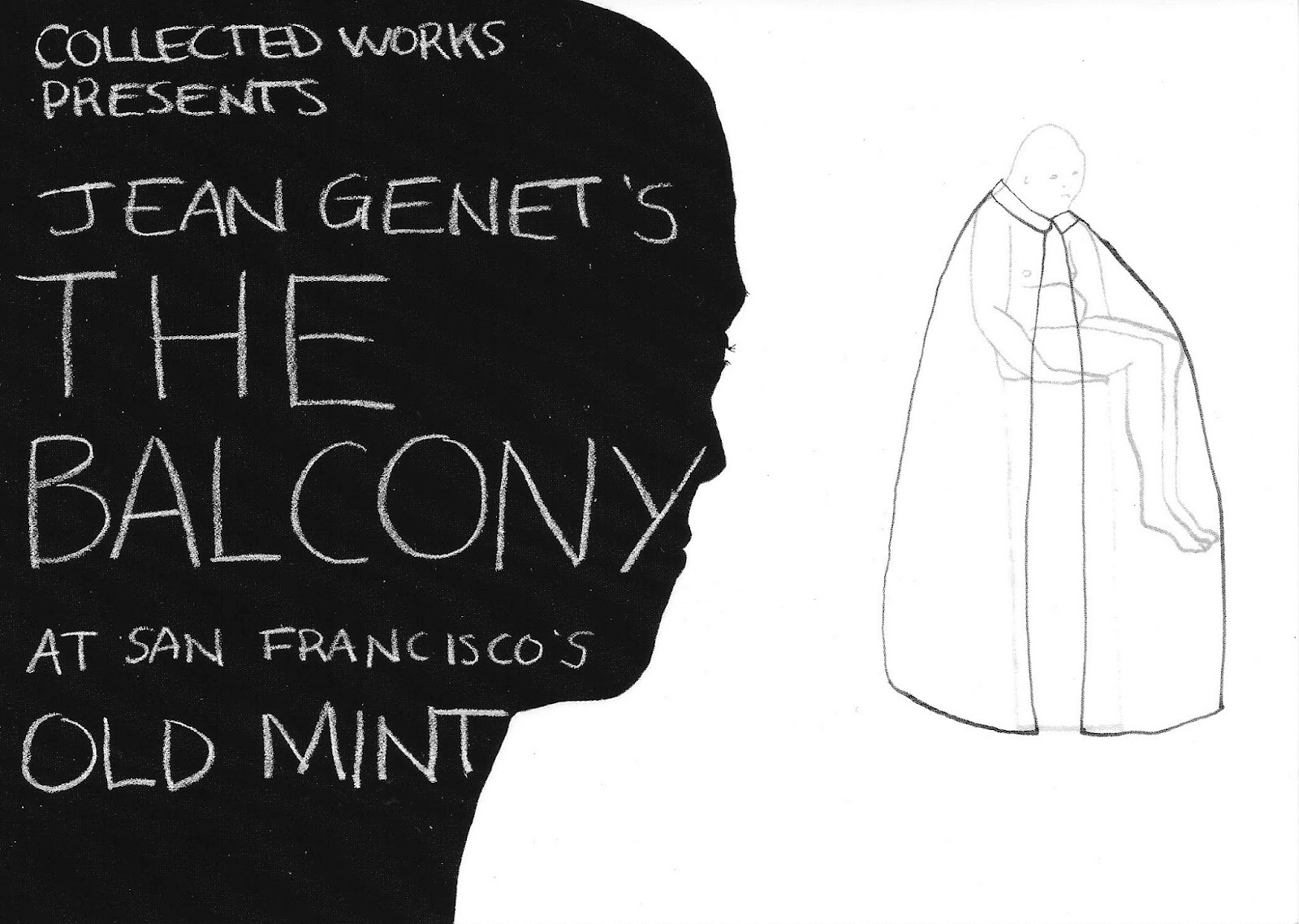
Collected Works Presents Jean Genet's "The Balcony"

I've mentioned the Collected Works theater company after going to see their production of Witold Gombrowicz’s Princess Ivona. Their current production is Jean Genet's play "The Balcony." They have some wonderful pictures available at their sneak peek page.

Making the production even more intriguing is its performance at The Old Mint in San Francisco. From the Collected Works' page about this location:
The Old Mint (affectionately referred to as “The Granite Lady”) was designed by Alfred B. Mullett and completed in 1874. The building sits on a concrete and granite foundation, designed to thwart tunneling into its vaults, which at the time of the 1906 earthquake and fire held $330 million, fully a third of the United States’ gold reserves. Heroic efforts by Treasury Department employees, using only a one-inch hose connected to wells in the interior courtyard (built just weeks earlier) saved the Mint from the fire that destroyed commercial San Francisco after the earthquake. With the downtown area and its banks destroyed, the San Francisco Mint was the only financial institution open for business in San Francisco, and became the depository and treasury for the city’s relief fund. The building continued operation as a U.S. Mint until 1937.

I plan on re-reading the play and posting on it soon, but for now I'll borrow their comments about it (again from their page on the play):

Genet’s play tells the story of a revolutionary uprising in the streets of an unnamed city. While armed rebels fight to take control of the city’s power structures, most of the action takes place in an elite brothel or “house of illusions,” where clients act out their fantasies of institutional power: they play judges, bishops, and generals as their counterparts in the “real” world struggle to maintain their authority. The Balcony is a landmark in modern theatre: the eminent American critic Edmund White noted that, with The Balcony’s foregrounding of the role of illusion and meta-theatricality in creating contemporary power and desire, Genet invented modern theatre.

I'm hoping I'll be able to attend a performance before the final performance on February 21. If you're in the area, I highly recommend you do the same!

Click here for more information on "The Balcony"


Many thanks to Cynthia Haven for alerting me about this production.

Monday, February 04, 2013

Princess Ivona at The Collected Works

Publicity card from The Collected Works' production of Princess Ivona

Saturday night my wife and I attended The Collected Works’ production of Witold Gombrowicz’s Princess Ivona at the Performance Art Institue in San Francisco. I provide a cursory overview of the play in this post.

As a director, I know a good play through working with it, and Gombrowicz’s script has continue to astonish me in its careful and imaginative plotting, it’s strange and rich characters, and it’s focused pursuit of some of the philosophical questions that would haunt Gombrowicz throughout his lifetime. Perhaps the strongest of these is the way the human being is constantly pulled between two poles: conventionality on one hand (or what Gombrowicz would call form); and pure freedom on the other. The former is necessary if one is to be recognizable to an other, to be a social being; but it can also calcify into something rigid and dead, limiting our human capacity for surprise, experiment, and imagination. But pure freedom, however enticing it may be as a horizon of possibility, is also chaos; and if it’s even possible to attain it for a moment, one can’t live in it.

(From director Michael Hunter’s notes on the play)

Michael’s summary captures the heart of many of Gombrowicz’s works, including Princess Ivona. The play takes turns being funny, menacing, absurd, and heartbreaking—oftentimes several of these sensations at the same time—and it’s to the company’s credit that they were able to capture with intensity of all of these feelings. In some of the posts on the company’s blog, Renu Capelli, the assistant director, looks at possible considerations within the text and ways to read the play. I want to focus on the following quote, though:

As we become more and more familiar with the text of Princess Ivona, I've been struck by the several (plural, contingent, dynamic) philosophical questions that it sets aloft, about personality, about freedom, about love, about fear, about how broader social contexts shape and then beguile the infrastructure of personality: family, status and class, proximity to powerful agents, proximity to radically different versions of power...these relationships are the "stuff" of the play, even as they are made restless and anxious by the appearance of the "sluggish" Princess Ivona (in part it's her non-participation in all of that, which seems to make everyone else's neuroses sparkle and pop). But, on first gloss, it would seem that the play's fascinating explorations into profound internal terrains remains the privilege and the agony of those characters who already have a certain access to complex personhood: as if identity crises are the privilege of the privileged.

She nails the “stuff” of the play and Ivona’s impact. Reread the last bit with “should have” instead of “already have” and you’re back to Gombrowicz’s use of forms. In the world of Princess Ivona members of the court are supposed to be ‘betters’ and complex people but their frivolity barely masks simple monstrous passions. Prince Philip endorses Renu’s last point when he notes that privilege has…well, its privileges (at least when it comes to handling misery, although more is implied). Ivona doesn’t have that luxury.

When watching a play I’m interested to see what I pick up differently from the page. A question occurred that I hadn’t thought of earlier—why does Ivona choose to speak when she does? Sometimes she defends herself. Other times she speaks in riddles, which the other characters either dismiss or invest with deep meaning. Occasionally she answers a direct question. But with my question, I’ve been transposed into the world of the court—I’m trying to impose my need for rationality on Ivona. Fortunately I didn’t feel the need to kill her (like several of the characters in the play). But there is an uncomfortable point to the play I didn’t pick up in the reading. We watch the play and laugh along at the jokes and taunts, just like the court does with Ivona. Once again we’ve entered the world of the courtiers, acting and reacting in a similar manner, although I have the excuse that I know I’m watching a play. It’s a troubling short step between the two worlds, though.

Meredith Axelrod provided the music at various points in the play, her specialty in pre-1930s pop music fitting perfectly. The first act takes place in the foyer as the actors mingle with the audience. (This wasn’t the only mingling during the evening.) The first few lines of the play were a little rough, probably because of that interaction, but the troupe quickly found its rhythm. The last three acts take place in the main section of the warehouse—‘cavernous’ might be too strong a word for its roominess, while ‘spacious’ doesn’t capture the feel. The company took full advantage of the space, although sometimes to the detriment of the audience. With action taking place at both ends of the ‘stage’, 60+ feet apart, you had to continually turn your head to catch what was happening in both places. Where the use of the entire space worked perfectly was with projections on the warehouse walls. During the final scene, imaginative projections of a raucous feast filled the walls while the ensemble recited the closing lines. I say recited because it was a flat reading of the lines—maybe meant as a simple narration to accompany the rollicking/sinister scenes on the walls? Whatever the reason, I loved the imagery and the final image sticks with me.

Speaking of imagery, if you use Facebook be sure to look up the Princess Ivona (by The Collected Works) page for some great pictures of the play.

Since I was familiar with the play I focused on the interactions between the actors and was impressed by the chemistry present in the new company. With only a few spoken lines in the play, Tonyanna Borkovi did a wonderful job in the difficult role of Ivona, portraying someone that has to be a blank slate for the characters’ projections in addition to being repulsive. Not to slight anyone else—they all did well in their roles, many of whom had to go from absurd to serious in a few seconds (see the cast and crew page for a full listing). Prince Philip's line "Do you know the sudden transition from frivolity to seriousness. There is a holiness to it. It's a revelation." captures what the actors had to accomplish. There were several moments where things were rough around the edges and a few missteps, but surprisingly few given the newness of the group. My only regret during the evening was that we had to leave immediately after the performance. I have to thank Michael Hunter for the kindness shown to us during the evening and answering my many questions. I look forward to seeing what The Collected Works does next!

Additional pictures of the production taken by Jamie Lyons can be found here.

Picture source

Thursday, January 31, 2013

Princess Ivona by Witold Gombrowicz

I am supposed to attend a performance of Princess Ivona (the English title) by Witold Gombrowicz this weekend and I wanted to write about the play in advance. For the record, there will be lots of spoilers in this post.

Gombrowicz wrote Ivona, Princess of Burgundia from 1933 to 1935 and it was first published in 1938 in the Polish literary journal Skamander. According to the chronology in Gombrowicz’s Diary it was noticed by one critic. Gombrowicz later provided a summary of the play:
The tragic-comic history of Ivona can be summed up in a few words. Prince Philip, the heir to the throne, meets this charmless and unattractive girl as he goes for a walk. Ivona is awkward, apathetic, anaemic, shy, nervous and boring. From the start the prince cannot stand her, she irritates him too much; but at the same time he cannot bear to see himself obliged to hate the wretched Ivona. He suddenly rebels against those laws of nature which order young men only to love seductive girls. ‘I won’t stand for it, I’ll love her!’ He defies the laws of nature and gets engaged to Ivona.

Introduced to the court as the prince’s fiancée, Ivona becomes a decomposing agent. The mute, frightened presence of her innumerable deficiencies reveals to each courtier his own blemishes, his own vices, his own dirtiness... . In a short time the court turns into an incubator of monsters. And each monster, including the fiancé, longs to murder the unbearable Ivona. Finally, the court mobilizes its pomp, its superiority and its splendor and, with full grandeur, kills her.

That’s the story of Ivona. Is it so hard to understand?

- A Kind of Testament, translated by Alastair Hamilton (Champaign/London: Dalkey Archive Press, 2007), pages 48-49. (Ellipsis in original)

As usual with Gombrowicz, it simultaneously is and isn’t easy to understand. On the page additional and contradictory meanings lurk just beneath the surface. I’ll add a few additional points on the story to flesh out the play. Prince Philip, tired of the frivolity and superficiality of the court, suffers from some sort of melancholy. He is unsure what he wants, and when he meets Ivona (with her insufferable aunts) he immediately sees her to be a “universal irritant.”

Ivona’s silence allows people to project their own behavior and feelings onto her. Philip sees Ivona by the light of his own turmoil, but his is a misery that he is rich and privileged enough to endure. The laws of nature Gombrowicz mentions in his summary are, of course, nothing of the sort but are social constructs, the sort Philip feels an urge to rebel against in order to prove his freedom. The court, in order to save face, calls the engagement an act of generosity. The lack of response from Ivona to questions and actions provokes everyone, who then blame her for her perceived provocations and slights.

The lack of response has other repercussions that can take several stages—in the case of Philip he initially believes her to be in love with him, causing him to feel a responsibility and tenderness for her. “She is the trap and I am captured. You love me, I must love you.” But then he sees himself as a laughingstock, interpreting every laugh and smile from members of the court as a barb aimed at him. Ivona signifies a mirror, always true in the reflection. People around her dismiss or rationalize the upsetting things they see, since she is, as the Prince puts it, “a living reproach.”

I’m interested to see how The Collected Works stages some of the ambiguous sections of the play, such as Ivona’s death. In that scene, the actors are saying one thing but their actions indicate something much more sinister. In addition, there will plenty of opportunities for slapstick and absurdity, with running gags showing up throughout the play. In other words, typical Gombrowicz, which is a good thing.

I’ll add a section with a few excerpts, and be sure to check out the links below for more examples as well as information on the play. All quotations are from the translation by Krystyna Griffith-Jones and Catherine Robins in Three Plays by Wiltold Gombrowicz (London: Marion Boyers Publishers Ltd., 1998). Ellipsis are in the original unless specified:

Prince Philip (responding to the charge that he frightened away some ladies of the court): I did not, their own secrets have driven them away. It appears that there is nothing more frightening. Famine and war are nothing compared to one little well hidden false tooth.


Prince Philip: Do you know the sudden transition from frivolity to seriousness. There is holiness to it. It’s a revelation.


King: I’ve just remembered something….
Chamlerlain: Remembered? What?
King: It’s a long time, I have forgotten all about it till now. I was only a prince and you were only an embryo of a chamberlain. That little one we…. You know…. I think on this sofa. I think she was a seamstress.
Chamberlain: The little seamstress. The sofa. Youth, oh blissful days of youth. [I'm skipping a brief interruption]
King: She died soon after that, I think…drowned herself.
Chamberlain: She did. I remember as if it were yesterday, she walked on to a bridge and then from the bridge…splash…oh, youth, youth. There is nothing equal to it.


Queen: I can’t go on like this. I must bring all my ugliness into the open before I am ready to go [kill Ivona]. Stop talking to yourself. Somebody will hear you. I can’t stop talking to myself. Do all murderers talk to themselves before the act?


For more on the play, including reviews of productions, see its page at Gombrowicz.net.
Thanks to Cynthia Haven for bringing the current production to my attention.
The Collected Works’ blog has some insight on their production.

As an aside, in Gombrowicz’s Diary there is a letter to the editor of a Polish journal that reports on the play Princess Ivona being panned by the critics upon its performance in Paris. Gombrowicz reports the summary of reviews that the troupe performing the play compiled, noting only four of thirty-nine reviews were unfavorable. The least favorable, of course, was the one reprinted in the journal. He may have had some thin skin, although his approach in the letter was more of trying to set the record straight. Finally getting performed in France and reviewed over 30 years after writing the play, Gombrowicz called his work “this Cinderella native literature,” a fitting description. (see pages 691-693 in the Yale University Press edition of Diary for the letter, translation by Lillian Vallee).

Update: see my post after attending it for more thoughts on the play and The Collected Works' wonderful performance.