Showing posts with label Online reading. Show all posts

Saturday, January 16, 2021

Dædalus now online

In January 2021, Dædalus became an Open Access journal. The editors of Dædalus thank you for your patience while they work to digitize the back catalog.

The current edition of the quarterly journal Dædalus is available online, and as you can see from the above quote from their "About" page they are working to make their back catalog available online, too. Many thanks to M. A. Orthofer at the Literary Saloon for noting this. As he mentions, the archive "will be something to return to again and again."

The entire Winter 2021 issue, "On the Novel" edited by Michael Wood, is available for free online. The articles feature

fourteen essays, written by scholars with a variety of approaches and interests, that offer remarkable insights into the behavior of this versatile literary form—how old the novel actually is, shifts in dominant patterns, the art of word-play, connections between the novel and TV and videogames, and the novel in the classroom—glimpses of where and what it has been and where it may go in the future.

The articles and their authors in the Winter 2021 issue
Introduction: In This World
(Michael Wood)

The essays in this volume of Dædalus do not survey or summarize the fate of the novel, but they do offer remarkable insights into the behavior of a versatile literary form, glimpses of where and what it has been and where it may go.

What Is It Like to Write a Novel?
(Lorrie Moore)

Two Theories
(Franco Moretti)

Finding the Time for Ancient Novels
(Simon D. Goldhill)

Some Endangered Feeling
(Nancy Armstrong)

Henry James in—and out of—the Classroom
(Ruth Bernard Yeazell)

The Hole in the Carpet: Henry James’s The Bostonians
(Sharon Cameron)

“A Woman Is a Sometime Thing”: (Re)Covering Black Womanhood in Porgy and Bess
(Daphne A. Brooks)

We “Other Victorians”? Novelistic Remains, Therapeutic Devices, Contemporary Televisual Dramas
(Rey Chow and Austin Sarfan)

The Survival of the Unfit
(Wai Chee Dimock)

Poets in Prose: Genre & History in the Arabic Novel
(Robyn Creswell)

Organic Reformations in Richard Powers’s The Overstory
(Garrett Stewart)

Video Games & the Novel
(Eric Hayot)

Losing Track of Time
(Jonathan Greenberg)

Thursday, November 07, 2019

Excerpt from The Glance of the Medusa by László F. Földényi

Földényi's The Glance of the Medusa: The Physiognomy of Mysticism is a book I have on my Christmas list, so I hope to read more of it soon. Hungarian Literature Online has an excerpt from the book's second chapter:
For this reason, the moment of love is not only about finding oneself but also about dispossession. While those in love are able to compress into someone else all the desire and longing that they have previously considered to be their own, and could not handle to a satisfactory extent, they also find that they ended up beyond themselves. They found their centre, yet this happens to be located outside the boundary of their selves. This does not mean that the existing centre has suddenly ‘shifted’ into another being, but, rather, that this centre has just come into being—sameness is the outcome of difference. In parallel with the ‘lightning glance’ and the ‘silver flash’, it becomes increasingly likely that the individual should lose itself at the very point when it supposedly found itself, because existence itself lacks a centre. Its alleged ‘basis’ is being, which permeates everything yet remains on the outside, so it becomes noticeable only in the lack inherent in things. Whenever one tries to ‘pull oneself together’, one cannot help finding oneself set into motion by a faith placed in some sort of a supposed centre. Beyond a certain point, however, it becomes obvious that this is impossible. The more existence ‘thickens’, the less one can find one’s way around, and ultimately all one is in a position to perceive is the fact of being at the mercy of the impossible.

In an earlier post, HLO included this from the bookflap:

In The Glance of the Medusa, Lászó F. Földényi offers a mesmerizing examination of the rich history of European culture through the lens of mythology and philosophy. Embracing the best traditions of essay writing, this volume invites readers on a spiritual and intellectual adventure. The seven essays bear testimony to Földényi’s encyclopedic knowledge and ask whether it is possible to overcome our fear of passing away. In doing so, they illuminate moments of mystical experience viewed in a historical perspective while inviting readers to engage with such moments in the present by immersing themselves into the process of reading and thinking.

Tuesday, November 05, 2019

Excerpt from The Russian Job by Douglas Smith

Found at Air Mail, an excerpt/adaptation from The Russian Job: The Forgotten Story of How America Saved the Soviet Union from Ruin, by Douglas Smith, published by Farrar, Straus and Giroux today. An engrossing read (no pun intended).
The stories began to appear in the Soviet press in the autumn of 1921, each one more gruesome than the last. There was the woman who refused to let go of her dead husband’s body. “We won’t give him up,” she screamed when the authorities came to take it away. “We’ll eat him ourselves, he’s ours!” There was the cemetery where a gang of 12 ravenous men and women dug up the corpse of a recently deceased man and devoured his cold flesh on the spot. There was the man captured by the police after murdering his friend, chopping off his head, and selling the body at a street market to a local restaurant owner to be made into meatballs, cutlets, and hash. And then there was the desperate mother of four starving children, saved only by the death of their sister, aged 13, whom the woman cut up and fed to the family.

The stories seemed too horrific to believe. Few could imagine a hunger capable of driving people to such acts. One man went in search of the truth. Henry Wolfe, a high-school history teacher from Ohio, spent several weeks in the spring of 1922 traveling throughout Samara Province, in southeastern Russia, intent on finding physical evidence of cannibalism. In the district of Melekess, officials told him about a father who had killed and eaten his two little children. He confessed that their flesh had “tasted sweeter than pork.” Wolfe kept on searching, and eventually found the proof he had been looking for.

And:
Cynthia Haven has an article on PBS "American Experience" documentary The Great Famine (trailer can be found here), based on Stanford researcher Bertrand Patenaude's The Big Show in Bololand: The American Relief Expedition to Soviet Russia in the Famine of 1921.

Tuesday, October 22, 2019

Article: How My Book Became a Prop in Marvel’s Avengers Endgame

As I've noted in several posts, I love seeing books used as props in movies or shows, especially when it's clear some thought went into what book was going to be in the frame. Here's an interesting story on how an unpublished book was used as a prop in Avengers: Endgame.
When the man who made Thor’s hammer asks if you want your book to be in the next Avengers movie, you say yes, even if your book is not yet a book.

Yes. Yes you do.

(Picture from the Brevity post)

Monday, October 21, 2019

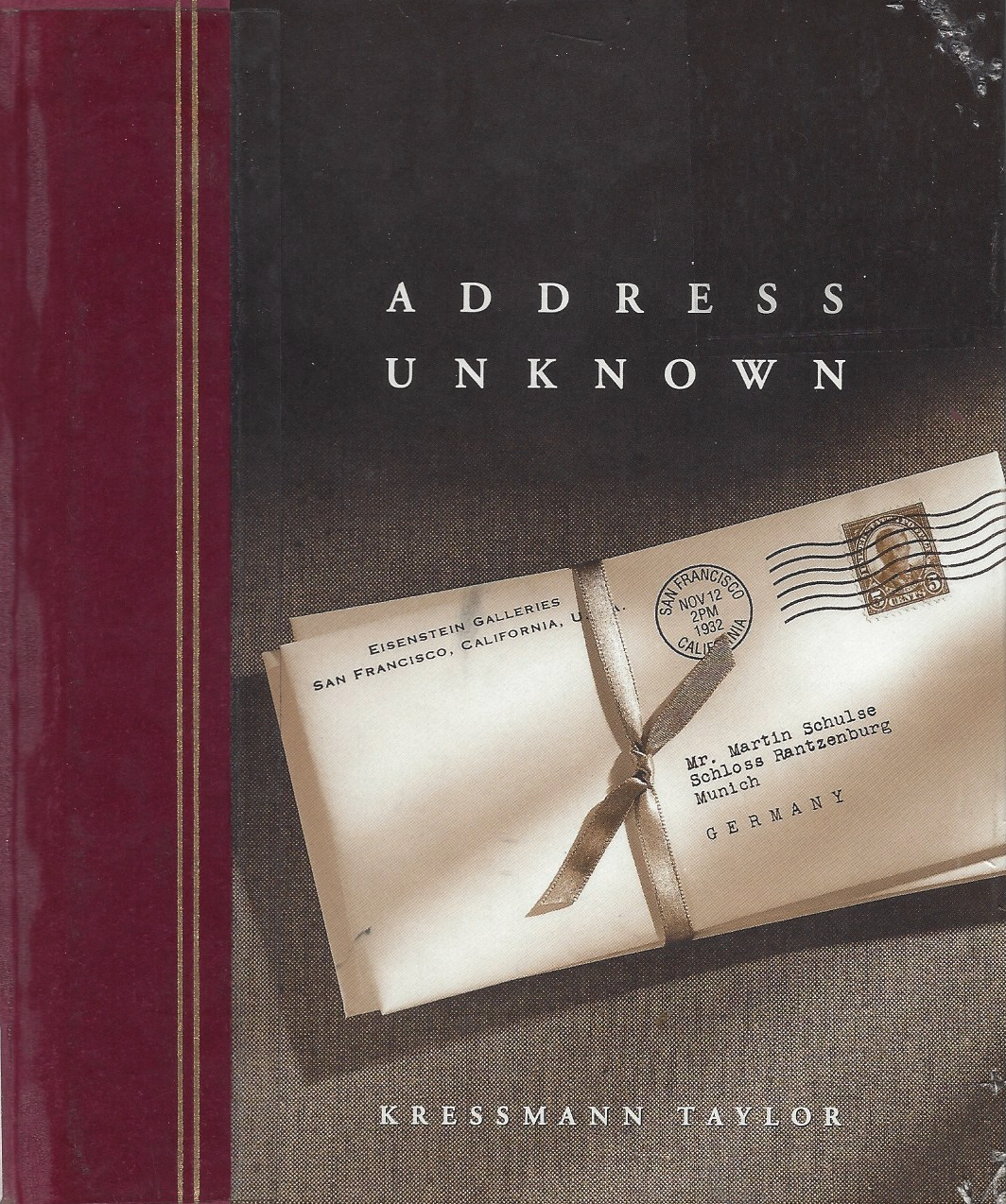
Address(ee) Unknown by Kathrine Kressmann Taylor

Another semi-recent article I should mention is Address Unknown: the great, forgotten anti-Nazi book everyone must read at The Guardian. There has been numerous blog reviews on the book over the years, and despite positive notes on the book I had never read it. The article title may be a bit overblown, but it did push me to finally read it. From the article:

Address Unknown was first published in Story magazine in September 1938, and then in book form a year later, becoming an instant bestseller. It has been translated across the world, adapted into a 1944 film and into multiple productions for the stage and radio – all under the name of Kressmann Taylor, after Story’s editor, along with Kathrine Kressmann Taylor’s husband, Elliott, decided it was “too strong to appear under the name of a woman”. The impact was immediate, the story credited with having “jolted America”, alerting it to the horror unfolding in Nazi Germany.

A short story-length tale, Address Unknown consists of the correspondence between business partners: Martin Schulse who has just returned to live with his family in Munich, Germany at the end of 1932, and (Jewish) Max Eisenstein who has stayed to run the U.S. business in San Francisco. As Max notes in his first letter, it's been fourteen years since the end of The Great War: " What a long way we have traveled, as peoples, from that bitterness!" As we know from history and soon find out in the story, maybe the distance isn't as great as hoped. Martin describes how their business success affords him a privileged lifestyle in impoverished Germany. We also find out that Max's sister Griselle, with whom Martin had an intense affair, has taken an acting role in a play in Vienna.

Martin brings up politics first, noting "there is much political unrest even now under the presidency of Hindenburg, a fine liberal whom I much admire." Max asks about "this Adolf Hitler who seems rising toward power in Germany? I do not like what I read of him." Martin responds,

I tell you truly, Max, I think in many ways Hitler is good for Germany, but I am not sure. He is now the active head of the government. I doubt much that even Hindenburg could now remove him from power, as he was truly forced to place him there. The man is like an electric shock, strong as only a great orator and a zealot can be. But I ask myself, is he quite sane? His brown shirt troops are of the rabble. They pillage and have started a bad Jewbaiting. But these may be minor things, the little surface scum when a big movement boils up. For I tell you, my friend, there is a surge — a surge. The people everywhere have had a quickening. You feel it in the streets and shops. The old despair has been thrown aside like a forgotten coat. No longer the people wrap themselves in shame; they hope again. Perhaps there may be found an end to this poverty. Something, I do not know what, will happen. A leader is found! Yet cautiously to myself I ask, a leader to where? Despair overthrown often turns us in mad directions.

The reader has to wonder how much of Martin's thoughts were shared by his fellow Germans. Publicly he's afraid to say anything, expressing no doubt, participating in local administration for his family's benefit. Martin's comments throughout highlight the clique-y nature and concerns of those lucky to be in the higher echelon of German society as the Nazis rise to power. Max's analysis that Martin has a "liberal mind and warm heart [that] will tolerate no viciousness" seems to be on point, but Martin continues to play the necessary games in order to not just survive but thrive in the new regime. He's caught up in the rebirth of Germany, both what is happening and what it symbolically means to Germans. His business acumen comes into play in regards to the politics, judging the positive benefits worth the negative cost.

The issue surrounding Max's Jewishness is raised early, jokingly, in his comments about taking advantage of customers who expect certain behavior from Jews. It acquires greater meaning when his sister has to choose between new acting roles, one in Vienna and the other in Berlin. Max relays some of the horror stories he has heard from Jewish friends and their relatives in Germany. Here we see the beginning of a schism between the businessmen. Over the years they have been close friends as well as successful partners. Griselle's Jewishness obviously wasn't enough to keep her and Martin from having some sort of affair, although we're not given a reason for things not going further between them. Martin's dismissiveness of Max's concerns is troubling. He diminishes what was happening in Germany as Jews simply being "the universal scapegoat," which is fine as long as you're not a Jew. Martin's exhilaration in being part of a movement that is greater "than the men who make them up" paints him in a monstrous light to the modern reader, which may be one of the goals for Taylor.

Max's concern for his friend/business partner and his sister are palpable in the subsequent letters. Toward Martin, he feels the pride in repatriation may not be as sincere as declared due to Martin's fear of censorship. For his sister, Max's concern of her being a high-profile Jew in Berlin appreciates when one of his letters to her is returned "Adressat Unbekannt," addressee unknown. Max's comment decocts what such a administrative, non-personal message means to those that receive it: "What a darkness those words carry! How can she be unknown? It is surely a message that she has come to harm. They know what has happened to her, those stamped letters say, but I am not to know. She has gone into some sort of void and it will be useless to seek her."

I'll end my notes on the letters at this point. The story is short and I highly recommend it if you have not read it. I will say that Taylor turns the irony meter off the dial in a manner she probably couldn't fully foresee, but apparently had an impressive percipience. Her insights are what make the story so moving. I will add that most reviews focus on the rise of Nazism in Germany and Martin's "conversion" in supporting it. What I found more interesting is Max's behavior after the disappearance of his sister. In a sense, he mirrors the lacerated and aggrieved Germans Martin meets when he relocates. Finding pride...meaning...is fine, until you realize where that focus leads. What Max is willing to do, or rather what he knows will happen because of what he does, is every bit as monstrous as those he wishes to punish.


Links and Notes

Friday, October 18, 2019

Recent(ish) articles

A grab bag of articles I've recently enjoyed:

"The Puzzles of Thermopylae" by Chris Carey
The story is well known and easily told. But the battle throws up a number of lasting puzzles. We have no contemporary account. Our earliest source, Herodotus, began his research perhaps 30 years or more after the event. He had no written records to draw on, so he had to rely on oral sources. For the last stand in particular credible witnesses were hard to find. The Persians were meticulous record keepers; but no Persian source has survived. On at least one key detail Herodotus’ informants were sound: excavations at Thermopylae in the 1930s unearthed arrowheads of an Anatolian design in large numbers on a hill in the pass, confirming both the location and the manner of the deaths. But by the time Herodotus began work the battle had long passed into legend.

"Wisdom in Your Pocket" by Tracy Lee Simmons
I recently posted on the Thucydides volume in Princeton University Press' Ancient Wisdom for Modern Readers Series. This article takes a look at the series.

Together, these volumes remind us of the classical distinction that should always be made between knowledge and wisdom. Knowledge begins with what is made of information and fructifies after long effort. Wisdom transcends knowledge and is never new. It is a firm grasp of the Good and True that does not consult our druthers—or, as I often tell my students, wisdom is that which is true whether we wish it to be or not.

"Mordecai Gist's Maryland Macaronis: The Maryland Battalion and the Battle of Long Island" at American Battlefield Trust
During the American Army's retreat after getting routed on Long Island, Mordecai Gist and his Marylanders found themselves responsible for delaying (Thermopylae-like) the advancing British.

In spite of the carnage and high percentage of casualties the Marylanders bought precious time for the rest of the American Army. To History they became known as the “Immortal 400.” Looking back on the affair, Gist and his men bought “an hour, more precious to American liberty than any other in history.”

Mordecai Gist's headstone reads “To the Memory of General Mordecai Gist. While in command of the First Maryland Battalion he so valiantly covered the retreat of American forces at the Battle of Long Island, August 1776. That his troops became known as the Bayonets of the Revolution”
A Tribute from the Sons of the American Revolution

Monday, January 20, 2014

Upcoming and recent releases, instant viewing, dinosaur rock

Renata Adler's "Letter from Selma", about the civil rights march from Selma to Montgomery, Alabama, is available at The New Yorker.

The real magicians of Latin America looks at Machado de Assis and "the publication by Dalkey Archive Press [scheduled for March] of a book simply titled Stories, which contains 13 of Machado’s stories, 10 of them never before published in English translation, plus an essay by Machado, translated by Rhett McNeil."

There have been several recent reviews of Mikhail Shishkin's The Light and the Dark. Here are some of my notes on it from last year. I just started Muireann Maguire's study Stalin's Ghost: Gothic Themes in Early Soviet Literature, which touches on Gothic-fantastic themes in Russian literature in general before focusing on writers and works between 1920-40. Parts of the two books by Shishkin that I've read (the other was Maidenhair) make use of these themes.

Unfortunately it's behind a paywall, but this review was very positive for Shakespeare and Classical Antiquity by Colin Burrow. The publisher's page gives some additional information. Online booksellers that allow a peek inside the book have some significant previews.
Colin Burrow's homepage
Here's an excerpt from the review (ellipsis in review):

In contrast to other scholars who have identified the classical writers Shakespeare would have read at school, Mr. Burrow emphasizes how students learned to engage imaginatively with the spirit of a writer. They were taught to extemporize in the style of classical writers and debate opposite sides of a question in what he alls "rhetorical training exercises." Hamlet's meditation upon suicide, for example, "is a textbook piece of such classically inspired debate, in which he sets out both sides of the question with perfect crispness…. The greatest soliloquy in English has its origins in classically inspired debating techniques."


Another recent book that looks interesting is A Curious Madness by Eric Jaffe. The book focuses on the only one of the 28 indicted Japanese World War II criminals to be released, Shumei Okawa and the U.S. Army psychiatrist who diagnosed him as mentally ill. The latter was Major Daniel Jaffe, the author's grandfather.

Instant viewing: Netflix has Big Star: Nothing Can Hurt Me (2012) available on instant streaming. It won't have much new for Big Star fans but it's still a good recounting of their story. It's also a great reminder why it's called the music business.
I'll mention that James Franco's version of Faulkner's As I Lay Dying is also available for instant viewing. I had low expectations so I wasn't disappointed.

Phil Everly died a few weeks ago and one of the best mentions I've seen was at the Bedazzled blog. The post contains two 45s released by the group in 1968, including two songs from their weird and wonderful Roots. If you think you're familiar with The Everly Brothers but haven't heard these tracks, do yourself a favor and click on over.

Speaking of music, the documentary Muscle Shoals will be available near the end of February. Sweet home Alabama indeed.

Monday, January 13, 2014

Recent online reading

I haven't had much time for browsing this week, so only a couple of articles…

The upcoming translation of Franz Kafka's The Metamorphosis by Susan Bernofsky has been well publicized. Here is an excerpt.
And Creative Review has an article on the book's covers.


I missed this when originally published, but I completely agree with the title of William Giraldi's essay: Why does almost everything written about Primo Levi revolve around his suicide?. He presumes Levi's death was undoubtedly a suicide, though, which I don't believe is a given. Even so, the title question stands, as does a look at why Levi's novels aren't as strong as his memoirs or his memoir-related books.


Miguel at the St. Orberose blog had a list of his to-be-read pile. Giambattista Vico's "The New Science" caught my eye since I have been wanting to read it. In my usual overblown fashion, I'll plan a month of posts about Vico and his work, probably August. I'll post more on this later as I get started on the project, but wanted to alert anyone interested in the book as to my plans.


When I remember them, I have the weirdest dreams. One of last night's dreams had a literary angle. I was asked to attend a brainstorming session on a possible play about a 20th poet/playwright's slide into depression and dementia. Weirdness set in during the session as ideas about using a band of drag queens devolved into stranger takes on the writer's life. My suggestion was roundly sniffed at: perform a take-off on The Firesign Theatre's Don't Crush that Dwarf, Hand Me the Pliers. Have the writer sitting on a couch, flipping the dial on the radio and listening to program after cheesy program based on his works. Hearing the debasement of his life's work causes him to slowly sink into madness and despair. Liven up the programs by having J R-like commercials: "It's green!"
I'm almost afraid to know where all of this came from.

Friday, January 03, 2014

Recent online reading

Public Seminar has Andrei Platonov's short story "Antisexus",
a provisional translation by Anna Kalashyan of an occasional piece by Platonov. In ‘Antisexus’ (1925-26), Platonov writes in a parodic vein about what Béatriz Préciado calls the sex-gender industrial complex. The production of gendered and sexualized bodies via technologies of the image and the orgasm appears here as something that might be implicated in both the western and Soviet modes of spectacle.

Please note the article also has a link to Platonov's Chevengur (pdf)!


Llewelyn Morgan posted about a tale from the Alexander Romance feeds into a scene in Shakespeare's Henry V. And more.


I'm so intrigued by Michael Orthofer's review of Leg Over Leg (Vol. 1) by Aḥmad Fāris al-Shidyāq that I've added it to my TBR pile.


Speaking of the to—be read—stack, I'm anxiously awaiting the upcoming translation of Marketa Lazarová by Vladislav Vančura. In the meantime, enjoy Alex Zucker's essay on the novel and its film adaptation. There's quite a bit on Vančura, too.


Stefany Anne Golberg has an essay on how a crisis in Miguel de Unamuno's life led to his philosophical outlook:

This “crisis of 1897” marked the crossroad of Miguel de Unamuno’s spiritual and intellectual journey. The philosopher would build no system that would eliminate his inner turmoil. He would not turn his back on the Angel of Nothingness. Rather, he would embrace this angel as his wife had embraced him in his grief. Miguel de Unamuno would develop from his nightmare a messy, passionate philosophy of conflict, a philosophy of tragedy. In short, a philosophy of himself.


Greg Grandin looks at fact and fiction behind Herman Melville's Benito Cereno. As is often the case, real life proves to be stranger than fiction.

Sunday, October 19, 2008

Online reading: week of October 20


Well, you can tell what we did this weekend, much to the chagrin of a few pumpkins. Not much in the way of links this week since the Chrees household has been busy with spookier things. That being said...

Brideshead undermined

It seems the recent movie version of Evelyn Waugh's novel decided to concentrate on sex and ignore religion--not surprising since this happens all the time (I still want to re-read The Scarlet Letter and find Hester Prynne's hot tub scene as portrayed by Demi Moore). This liberty stood out a little more for me since Brideshead Revisited is what I took to the hospital when my first son was born. I may have been sleep deprived and focusing on other things, but even with what little attention I paid to the book I could pick up on the religious current which was far from a feel-good message. I guess I'll have to re-read the book and see what I missed the first time around. And rent the TV mini-series instead of the recent movie.


Kafka and Bioy

I have been working on the gap I've had regarding Spanish, Latin American and Portuguese lit the past few years since the more I've read the more I have enjoyed. Since I'm reading Machado de Assis now and Kafka is up next, I found this article on the convergence of writing between two totally different writers informative:

If Kafka invented his distinctive kind of plot, then Bioy succeeded in twisting Kafka’s plot to serve his own ideas. Both Kafka and Bioy took a cue from G. K. Chesterton (whose writing they loved) in creating works of immense logical rigidity. They both wrote in a sort of adventure/detective genre, and though it is true that most adventure and/or detective novels are characterized by the kind of strict plotting exemplified by Chesterton and emulated by Bioy and Kafka, these two are notable for the way in which rigid logic governs their works. This rigidity goes above and beyond that typically found in novels of the genre, and in their hands the logic itself becomes a defining feature. It argues things that had never been argued before. It creates strange equivalences that beg perhaps unanswerable questions. In short, it gives their works their distinctive feel. Out of this logic come strange systems that shimmer through tears in reality, light and effervescent yet preternaturally able to sustain, and inspire, interpretations. It is precisely this clearly felt but impenetrable logic behind Kafka or Bioy’s work that leads readers to such robust, contradictory opinions on what each of their novels means.


Honoré de Balzac: A Man of Enormous Appetites

The article provides a nice summary of Balzac's life and voracious appetites:

Balzac was a man of enormous appetites and most of them were the subject of public comment, if not ridicule. Oddly enough, his love life remained largely out of the public eye. Balzac was nothing if not discrete, an important characteristic if you intend to sustain as many as four love affairs simultaneously. It’s never been determined with certainty the number of illegitimate children he bore, but there was certainly two and probably more. Many of his paramours were aristocratic women, most of them single. Only one, Duchess Claire de Castries, perhaps the woman of highest birth he ever pursued, is known to have rebuffed him. He had affairs with numerous Countesses, Marquises, and Baronesses. Madame De Berny, his first mistress, 20 years older than Balzac, was his lover well into his 40s, and the love of his life, Countess Eveline Hanska, who finally agreed to marry him near the end of his life, was his mistress for more than 15 years.


Sunday, October 12, 2008

Online reading: week of October 13

Jay Walker's library
Picture source


Geek meets library
A few weeks ago I linked to an article featuring beautiful libraries. This article features Jay Walker's library, "about 3,600 square feet on three mazelike levels". The Escher-like library is a beauty to behold, as well as the interesting works it contains:
What gets him excited are things that changed the way people think, like Robert Hooke's Micrographia. Published in 1665, it was the first book to contain illustrations made possible by the microscope. He's also drawn to objects that embody a revelatory (or just plain weird) train of thought. "I get offered things that collectors don't," he says. "Nobody else would want a book on dwarfs, with pages beautifully hand-painted in silver and gold, but for me that makes perfect sense."

What excites him even more is using his treasures to make mind-expanding connections. He loves juxtapositions, like placing a 16th-century map that combines experience and guesswork—"the first one showing North and South America," he says—next to a modern map carried by astronauts to the moon. "If this is what can happen in 500 years, nothing is impossible."


Do books make the man?

Speaking of libraries, Hitler's Private Library: The Books That Shaped His Life is a look at influences in Hitler's intellectual development. As the reviewer Robert Fulford mentions, this won't explain everything (or maybe even much), but it does promise to provide some insights. From the product description:

Hitler’s education and worldview were formed largely from the books in his private library. Recently, hundreds of those books were discovered in the Library of Congress by Timothy Ryback, complete with Hitler’s marginalia on their pages—underlines, question marks, exclamation points, scrawled comments. Ryback traces the path of the key phrases and ideas that Hitler incorporated into his writing, speeches, conversations, self-definition, and actions.

We watch him embrace Don Quixote, Robinson Crusoe, and the works of Shakespeare. We see how an obscure treatise inspired his political career and a particular interpretation of Ibsen’s epic poem Peer Gynt helped mold his ruthless ambition. He admires Henry Ford’s anti-Semitic tract, The International Jew, and declares it required reading for fellow party members. We learn how his extensive readings on religion and the occult provide the blueprint for his notion of divine providence, how the words of Nietzsche and Schopenhauer are reborn as infamous Nazi catchphrases, and, finally, how a biography of Frederick the Great fired the destructive fanaticism that compelled Hitler to continue fighting World War II when all hope of victory was lost.


Articles on books/authors

A few articles I'm still working through about some authors I enjoy or need to read:

The Irish Prophet by Henrik Bering

On Worshipping Walt: The Whitman Disciples by Michael Robertson

Revisiting Thomas Hobbes’s Leviathan

On Lucretius and some recent translations

Lastly, The Age of Wonder - How the Romantic Generation Discovered the Beauty and Terror of Science "It is this story of the opposition between the Romantic poets and the science of their time that Richard Holmes sets out to undo."

Building on a generation of revisionist scholarship that has been barely visible beyond the groves of academe, Holmes triumphantly shows that the Romantic age was one of symbiosis rather than opposition, in which scientists such as Sir Humphry Davy were also poets and poets such as Coleridge had a shaping influence on scientists - we discover indeed that it was Coleridge who was responsible for the early 19th-century invention of the term 'scientist' as an alternative to the older nomenclature 'natural philosopher'.


Jay Walker's library
Picture source

Monday, October 06, 2008

Online reading: week of October 6, 2008

Torturing Machiavelli again

Of the few biographies I've read in the past decade, Niccolo's Smile: A Biography of Machiavelliis one of my favorites. However, the above article at The New Yorker provides a lot on his life and a relatively balanced picture of Machiavelli before the predictable ending.


Mrs. Woolf and the Servants

Mrs. Woolf and the Servantsis the recent book by Alison Light. A brief interview with the author is at the link. I think the conclusion is that the best association with the Bloomsbury Group was to be one of the members so you could discuss semen.
Q. How did you become interested in Woolf's servants?
A. By reading Woolf's diaries, which I love, but which contain appalling references to the servants: Lottie Hope or Nellie Boxall being compared to animals and vermin. Woolf's disgust riveted me. I also wondered why she and Boxall had such rows. Then the fact that my grandmother was in service and my mother's sisters started out in service before the Second World War.

Sunday, September 21, 2008

Online reading: week of September 22, 2008

Library of the Benedictine Monastery of Admont, Austria

Librophiliac Love Letter: A Compendium of Beautiful Libraries

Posted over a year ago but I just discovered it this week. I’m still working my way through all the pictures of these gorgeous libraries (and will have to pace myself to work through the site). How to explain the frisson each image brings?


Analyzing The Best Game Ever

As someone who grew up studying pro football almanacs (I loved the three-deep charts they would show for each position) and updated my Gatorade cap standings board each week of the season, I enjoyed reading Mark Bowden’s viewing of the 1958 Championship game between the Colts and the Giants with Eagles coach Andy Reid. Bowden is the author of The Best Game Ever
“The thing you’d tell Johnny [Unitas] right here,” Reid said, “is to take your best mismatch. You put T.O. [former Eagle, now Cowboys receiver, Terrell Owens, a noted deep threat] here and just picture him running a post over the top of that guy [Crow].” Sure enough, several plays later, the Colts exploited the formation, zeroing in on the most obvious mismatch by sending the speedy Moore racing down the right side of the field one-on-one with Crow. Unitas heaved the ball for a 60-yard gain.
Reid was impressed with Moore’s speed and hands; less so with his blocking. On a later play, when Moore lined up in the backfield, Reid laughed and rolled the film back. “Watch this,” he said. The ball is snapped and Unitas is eventually brought down by the Giants’ defense, while Moore simply stays put in the same stance he was in before the snap of the ball. In slow motion, his statue-like pose is comical. On a later play where Unitas was sacked, Reid again laughed and pointed to Moore missing an assignment. “Lenny didn’t help, picking his nose right there, man. That’s pissing me off.” Then, on another play, “Lenny needs his ass whipped a little bit right here.”

(In the Hall of Famer’s defense, his back was injured early in the game when Huff picked him up and slammed him into the ground. Moore nearly came out after that, but Ewbank urged him to continue playing, if only as a decoy, because the Giants’ defense was keying on him.)

Excuse me while I see if Diner is airing somewhere…


A short interview with Umberto Eco

INTERVIEWER
Do you think you might have actually enjoyed living in the Middle Ages?

ECO
Well if I did, at my age, I’d already be dead. I suspect that if I lived in the Middle Ages my feelings about the period would be dramatically different. I’d rather just imagine it.


Opera (and more) on the web

Podcasts courtesy of the Royal Opera House in London. They will be airing Mozart’s Don Giovanni starting October 5th. Their site looks to be a good resource for opera and other performing arts.

Handelingenkamer Tweede Kamer Der Staten-Generaal Den Haag, the Hague, Netherlands

Sunday, September 14, 2008

Online reading: week of September 15, 2008

Shakespeare on the Hudson

On Sept. 18th at 8pm, WNET/Thirteen will air a documentary about the making of the Shakespeare On The Hudson production of Twelfth Night, followed by the play itself. The special is hosted by Kristin Chenoweth. More information at the link above.


An interview with Barbara Oakley: Evil Genes

Barbara Oakley is the author of Evil Genes: Why Rome Fell, Hitler Rose, Enron Failed and My Sister Stole My Mother's Boyfriend, if nothing else, one of the best titles of the year.
(A)though psychologists are fond of saying nowadays that personalities are formed by both environment and genetics, this is often simply lip service. Most research involves only the effects of environment on personalities—research on genetics is tacitly or actively discouraged. Academicians are as bad as fundamentalists in some ways—they believe that acknowledging the effects of genes somehow kills our free will. It doesn't, of course. Having a better understanding of what we are won't change what we are. But like religious believers who thought it might disrupt society to know that the earth revolves around the sun, some academics today don't want society disrupted by what they believe to be harmful knowledge about the effects of genes on personality. Obviously, I find this attitude repugnant. I thought that people should know what researchers have been discovering, because this knowledge can be extraordinarily empowering. That's why I wrote the book.

On a side note, some of the same genes that make for our worst, most "evil" behavior, can also make for our best behavior when mixed with a different set of genes. So there's really no way to eliminate purely "evil" genes, even if there really were such a thing.


Barry Gewen’s Proust and Us article at The New York Times book blog Paper Cuts

Like Mr. Gewen, I enjoyed Alain de Botton’s How Proust Can Change Your Life even though I don’t always agree with de Botton’s comments or conclusions. I doubt too many people read Proust simply to check that accomplishment off a list, although they may begin reading it with that in mind. That attitude won’t carry you through the entire work, however.

In his crucial final chapter, “How to Put Books Down,” de Botton warns us not to fetishize literature, or art in general, not to take it too seriously. It’s always something less than life itself. He quotes Proust: “Reading is on the threshold of the spiritual life; it can introduce us to it: it does not constitute it.” And the final sentence of de Botton’s book is in this Proustian key: “Even the finest books deserve to be thrown aside.”


The Art of Fiction No. 198 in The Paris Review

A nice interview with Marilynne Robinson, coinciding with the release of her latest novel Home: A Novel. There is also a long article this past week in The New Yorker on Robinson and her work.

INTERVIEWER

Mother Country appeared during the more than twenty-year gap between Housekeeping and Gilead. Why did it take you so long to return to writing fiction?

ROBINSON

It was largely as a consequence of the experience of writing Mother Country that I began what amounted to an effort to reeducate myself. After all those years of school, I felt there was little I knew that I could trust, and I did not want my books to be one more tributary to the sea of nonsense that really is what most conventional wisdom amounts to. I am not so naive as to imagine that I have escaped that fate except in isolated cases and small particulars. But the research and criticism I have done have helped me to be of my own mind in some degree, and that was a feeling I had to achieve before I could enjoy writing fiction.


Great and Imperfect

A review of Hans C. Ohanian's Einstein's Mistakes: The Human Failings of Genius. It's relatively common knowledge that Einstein wasn't the first to develop the equation E=mc2, nor did he offer a full proof of it.

"Almost all of Einstein's seminal works contain mistakes," he [Ohanian] writes. "Sometimes small mistakes -- mere lapses of attention -- sometimes fundamental failures to understand the subtleties of his own creations, and sometimes fatal mistakes that undermined the logic of his arguments."

The reviewer's conclusion, "To see Einstein's wanderings not as the strides of a god-like genius but as the steps and missteps of a man -- fallible and imperfect -- does not diminish our respect for him but rather enhances it", is an outlook that should be taken with more historical figures instead of demonizing or deifying them.

Monday, September 08, 2008

Online reading: week of September 8, 2008

I had never heard of Emanuel Haldeman-Julius but I had heard about the “Little Blue Books” he wrote. "Haldeman-Julius’s Kansas press debuted writers like Will Durant, Bertrand Russell, and Clarence Darrow to the American public, and titles by Henry James found more readers in their Little Blue Book editions than in those from any other contemporary publisher."


What's an old Sandinista to do? Apparently harass 83-year-old poet Ernesto Cardenal.


Interviews with travel writers Patrick Leigh Fermor and Paul Theroux

Monday, September 01, 2008

Online reading: week of September 1, 2008

A review of Brenda Wineapple's new book White Heat: The Friendship of Emily Dickinson and Thomas Wentworth Higginson. The author calls it an attempt "to throw a small, considered beam onto the lifework of these two unusual, seemingly incompatible friends." It definitely rounds out the Dickinson I'm used to seeing.

"If it seems a tad precious to peg 300-plus pages to an almost exclusively epistolary friendship -- Higginson and Dickinson met only twice, when he came to visit her at her home in Amherst, Mass., and his letters to her do not survive -- not to worry. Ms. Wineapple specializes in imparting flesh-and-blood substance and narrative thrust to literary biographies."


Daniel Mendelsohn on Herodotus and The Landmark Herodotus: The Histories. I’ve been eyeing this since its release and can’t wait to read it. The Landmark Thucydides is wonderful and I have been wanting to re-read Herodotus...I can't think of a better resource to do so.

“And so, in the end, the contemporary reader is likely to come away from this ostensibly archaic epic with the sense of something remarkably familiar, even contemporary. That cinematic style, with its breathtaking wide shots expertly alternating with heart-stopping closeups. The daring hybrid genre that integrates into a grand narrative both flights of empathetic fictionalizing and the anxious, footnote-prone self-commentary of the obsessive, perhaps even neurotic amateur scholar.”


Theodore Dalrymple muses on consciousness, a topic that has been in the forefront of several recent books posted here, in Of Death and Transfiguration
The precise boundaries of the sacred are always disputable, but we cannot do without an awareness of the sacred, even when we know that sacredness is not a natural quality, that it is not just ‘there’ in the way that natural qualities such as weight and density are, that it does not inhere as a natural quality of anything, that it is imposed upon the world by us in a way that other qualities are not. And that is part of the reason why a purely scientific attitude to life is both undesirable and impossible.

Unfortunately, people have often tried to adopt an impossible attitude to life. The mere fact that the attitude is impossible doesn’t mean that the attempt is without effect, quite the reverse. Attempts to desanctify human life in the name of rationality have, in my view predictably, resulted in the most terrible of crimes.


10 Questions for Tom Wolfe at Time.com
“If you add up the college education of Steinbeck, Hemingway and Faulkner, you get to spring break of freshman year.”


David Pryce-Jones reviews David Lebedoff's The Same Man: George Orwell and Evelyn Waugh in Love and War. "School exams often ask candidates to compare and contrast two unmatched subjects, and that is what David Lebedoff has done with Waugh and Orwell. In his eyes, the two are both geniuses with unchallenged places in the great canon of literature that justifies England to posterity—and more than that, they have the self-same persona."

Monday, August 25, 2008

Online reading: week of August 25, 2008

A few online things I found this week worth linking:

I had not visited The New Yorker site until today, but they have a nice fiction and poetry section. Two stories I read and liked are "Awake" by Tobias Wolff (visiting one of his favorite themes, the difficulty in growing up) and "The Dinner Party" by Joshua Ferris (timely because of finishing Mrs. Dalloway, but much more disturbing).

Theodore Dalrymple's short piece on Alexander Solzhenitsyn in City Journal: "Solzhenitsyn’s achievement was to render such illusion about the Soviet Union impossible, even for its most die-hard defenders: he made illusion not merely stupid but wicked."

The life and times of Samuel Pepys in the Dublin Review of Books.

Man of a Thousand Faces: Joseph Tartakovsky reviews Homer's the Iliad and the Odyssey: A Biography), by Alberto Manguel.
How astonishing that, in a language we no longer know precisely how to pronounce, a poet or various poets whose faces and characters we cannot conceive, who lived in a society of whose customs and beliefs we have but a very vague idea, described for us our own lives today, with every secret happiness and every hidden sin.